This post was originally published on here
The position of gender researchers has ignited global outrage. In a recently published essay, they downplay the severity of female genital mutilation, framing it within the context of “cultural diversity.”
Twenty-five authors, including sociologists, psychologists, cultural and social anthropologists, and philosophers, have criticised the ban on female genital mutilation (FGM) in an article published in the „Journal of Medical Ethics.” In the essay titled „The Harmful Effects of the Global Anti-FGM Campaign,” they call for a new approach to the so-called „diversity of practices and experiences” concerning this form of cultural violence against women. The authors argue that the safety and protection of women are secondary, accusing the West of bias while simultaneously downplaying the horror affecting over 200 million girls worldwide.
The article states:
„In this piece, we critically examine the harms caused by the anti-FGM discourse and policies, despite their foundations in human rights and health protection. We assert that a pervasive ‘standard narrative’ obscures the diversity of practices, meanings, and experiences among those affected. This discourse, driven by a strongly racist and ethnocentric framework, has unintentionally led to severe consequences: the erosion of trust in health institutions, the silencing of dissenting or nuanced community voices, racist profiling, and disproportionate legal surveillance of migrant families.”
🌍 „Harms of the current global anti-FGM campaign” by Fuambai Sia Nyoko Ahmadu and colleagues
This essay critiques the dominant global campaign against female genital mutilation (FGM), arguing that its universal, ethnocentric framing obscures cultural diversity and produces…
— J. of Medical Ethics (@JME_BMJ) September 17, 2025
The authors continue:
„Moreover, we highlight a troubling double standard that legitimises similar genital surgeries in Western contexts while condemning analogous procedures in other settings. We advocate for more balanced and evidence-based journalism, policy, and public discourse that take cultural complexity into account and avoid the reductive and stigmatising power of the term ‘mutilation.’ There is a need to reassess advocacy strategies to ensure they do not reproduce the injustices they aim to combat.”
The essay’s authors label the Western perspective as „racist” and „stigmatising.” They argue that it is primarily arrogant and disregards the cultural context of „mutilation.” The West, they contend, places its own culture above others, ignoring the cultural circumstances that give rise to this brutal form of female genital cutting. Generally, scholars in this context prefer the term „genital practice.”
„The female genital practices and their justifications associated with non-Western cultures are highly politicised, and Western governments are keen to demonstrate they are addressing the issue by establishing and maintaining bureaucracies to collect information on perceived affected populations,” the essay states, adding:
„Due to its intimate nature, health institutions have become the primary sites for such data collection. Consequently, nowhere are the problems of the anti-FGM discourse more direct than in the encounters between patients and healthcare professionals, where seeking healthcare for certain racialised groups becomes a site of state oversight and control. In various jurisdictions, healthcare professionals are encouraged, and even mandated, to collect information on ‘FGM,’ even when consultations are unrelated to this practice. This creates a situation that can be detrimental to both those seeking care and healthcare professionals, who struggle to reconcile this surveillance obligation with their personal and professional ethical principles.”
According to the researchers, if a patient’s complaints are unrelated to prior genital interventions, „such data collection jeopardises the provision of effective healthcare, as it diverts attention from the patient’s needs. Instead of being seen simply as someone in need of support for a specific health issue, the patient becomes a victim, perpetrator, or criminal, and the confidential space of the encounter is disrupted by biopolitical concerns that overlook these immediate needs.”
The essay states: „Attempts to seek healthcare may be limited to disrespectful or humiliating, genital-related questions that divert attention from effective medical history taking, diagnosis, and the management of active health problems, directly contributing to a sense of violation of integrity. Furthermore, such conversations can be (re)traumatising.”
We are shocked by a paper published in the JME suggesting that the violence of FGM can be culturally explained away and permitted.
FGM causes nothing but pain and harm to women and girls. There are no benefits at all.
It prevents sexual pleasure and makes childbirth more…
— Women’s Rights Network – WRN (@WomensRightsNet) December 16, 2025
The authors argue that „healthcare providers’ prejudiced notions, based on problematic political narratives associated with ‘typical’ experiences, encourage thoughtless and unfounded assumptions about the health of adult women, including sexual health, based on assumptions and ideas related to their past experiences.” The essay also questions the responsibility of healthcare professionals: „Healthcare professionals readily label the experiences of affected women as ‘child abuse,’ yet do not commit to protecting victims from re-experiencing these traumas with the same enthusiasm as they do for others.”
They further contend that the attitudes of doctors contribute to individuals from affected groups sometimes turning away from healthcare, leading to poorer health outcomes in other areas as well. The negative health impacts of prejudiced data collection are thus threefold: the anxiety and its consequences caused by the questions; the inaccuracies in diagnosis and care; and the loss of trust among vulnerable populations and the deterioration of their relationship with healthcare services.”
Mutilation – a symbol of oppression
In her opinion piece, Laura Sachslehner draws a parallel between female genital mutilation and the allowance or prohibition of wearing headscarves.
In host countries with a growing Muslim population, the dangerous reinterpretation of the headscarf has been observed for years. The symbol of women’s oppression and political Islam is increasingly being portrayed by some feminists as a symbol of self-determination and freedom of choice. The headscarf is being presented almost as a fashionable accessory. Even more insidious is the latest interpretation by some researchers regarding the brutal and life-threatening practice of female genital mutilation. Here, left-leaning scholars also speak of a cultural practice that should not be simply condemned from a European perspective.
She adds: „The criticism articulated by researchers is evidently compiled by a group of academics conducting absurd thought experiments within their protected domain, thereby playing with the suffering and bodily integrity of millions of girls worldwide. In these considerations, they completely overlook the fact that this ‘practice’ poses significant dangers to women.”
Many die or suffer from the consequences of mutilation for their entire lives. Doctors have long reported painful and complicated aftereffects that women endure even decades later. In Europe, there has been a social consensus for years that European society does not tolerate such practices, and such „traditions” are punished with the full severity of the rule of law.
While survivors and victims of genital mutilation, such as „Desert Flower” Waris Dirie, recount the severe consequences of trauma and life after such attacks, „postcolonial” scholars deny that unimaginable suffering accompanies this practice.
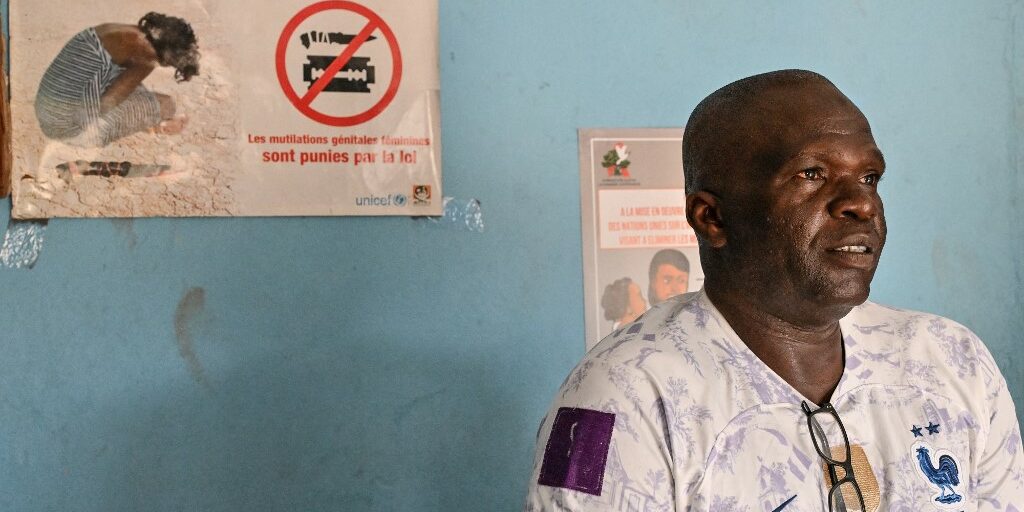
Cover image: A Maasai man walks past a mural advocating for the abolition of female genital mutilation (FGM) and child marriages in a corridor of a hospital in Narok County, Narok, on December 3, 2025. Photo: AFP