This post was originally published on here
A team of South Korean scientists have discovered evidence that dark energy may end the universe in what astronomers have called a ‘Big Crunch’.
Analysis suggests that instead of the universe continuing to expand, galaxies could be pulled back together via gravity.
Scientists who conducted the analysis believe they could be on the cusp of one of the most major discoveries in astronomy for decades.
Other astronomers have questioned the findings, however, but are unable to completely rule them out.
Previously, astronomers believed that the expansion of the universe, which kicked off with the Big Bang, should gradually slow down due to gravity.
But in 1998 evidence for dark energy was discovered as a force speeding up the expansion of the universe.
Theories suggested that the expanding universe would spread the stars so far apart that almost nothing would be visible to us in the sky at night.
Meanwhile, other theories suggested that it might even tear atoms apart, in what was described as a ‘Big Rip’.
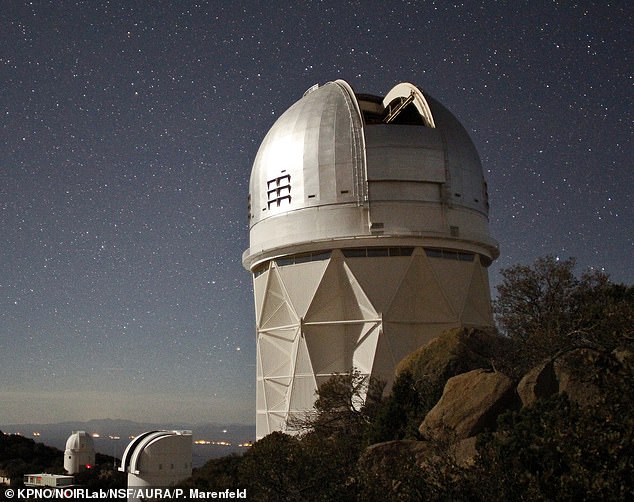
In March, surprising results from an instrument on a telescope in the Arizona desert, named the Dark Energy Spectroscopic Instrument (Desi), were collected.
Data suggested that acceleration of the galaxies had changed over time, according to Professor Ofer Lahav of University College London.
He told the BBC: ‘Now with this changing dark energy going up and then down, again, we need a new mechanism. And this could be a shake up for the whole of physics.’
Prof Young Wook Lee, of Yonsei University in Seoul, and his team returned to the kind of supernova data that first revealed dark energy nearly three decades ago.
Adjustments made by the team suggested that not only had dark energy changed over time, but that the acceleration was in fact slowing down.
Professor Lee said: ‘The fate of the Universe will change.’
If dark energy is really weakening, then one possibility is that it becomes so weak that gravity starts to pull the galaxies back together.
This would mean a Big Crunch is possible.
However, the mainstream view is still that the Universe is accelerating with virtually unchanging dark energy.
Senior astronomers such as Professor George Efstathiou of the Institute of Astronomy at Cambridge University have disputed Professor Lee’s theory.
Professor Efstathiou branded the idea ‘weak’, adding he thought the idea was ‘just reflecting the messy details of supernovas’.
The rebuttal comes amid the publication of hundreds of scientific papers and disagreement amongst experts as to the best explanation for the universe’s origin.
For most people on Earth, the first signs of the Big Crunch would be in the sky, with galaxy clusters and galaxies merging, or stars beginning to collide with each other.
Telescopes would show that the cosmic microwave background (a fossil echo of the Big Bang) was warming up — and would soon reach thousands of degrees Celsius.
For comparison, the current temperature of this background microwave radiation is just under 3 degrees above ‘absolute zero’ or ‘negative 273.15 degrees Celsius,’ according to the European Space Agency (ESA), NASA and other experts.
Roughly 300,000 years after the Big Bang, this cosmic microwave background is estimated to have been 3,000 degrees Celsius; and farther back in time, closer to the Big Bang itself, NASA estimates that its heat was as high as 273 million degrees.
‘At these high temperatures,’ according to NASA’s Wilkinson Microwave Anisotropy Probe team, ‘hydrogen was completely ionized into free protons and electrons.’
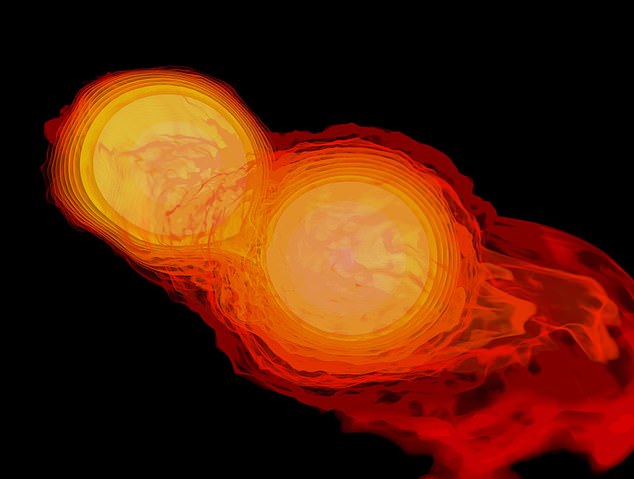
In short, the forces which currently make the universe expand would fizzle out and the universe would fall in on itself, in an obscene reversal of the Big Bang.
All intergalactic matter would condense together with stars and planets sucked into a burning core where the surface of stars would ignite other celestial bodies.
Eventually, the universe itself would become a single, vast fireball, at least according to some astronomers and astrophysicists, with all living things incinerated, and time and space itself wiped out of existence.