This post was originally published on here
Scientists have uncovered how some statins may cause muscle pain by disrupting calcium balance in muscle cells, offering paths to safer therapies.
Many people discontinue cholesterol-lowering statins after developing muscle pain, weakness, or ongoing fatigue.
New research from scientists at Columbia suggests that, for some patients, these symptoms may occur when statins attach to a protein inside muscle cells, triggering an abnormal release of calcium ions within the cell.
“It is unlikely that this explanation applies to everyone who experiences muscular side effects with statins, but even if it explains a small subset, that’s a lot of people we could help if we can resolve the issue,” says Andrew Marks, chair of the Department of Physiology and Cellular Biophysics at the Vagelos College of Physicians and Surgeons.
Statins are widely prescribed, with roughly 40 million adults in the United States using them to reduce cholesterol levels. About one in ten of these patients report muscle-related side effects.
“I’ve had patients who’ve been prescribed statins, and they refused to take them because of the side effects. It’s the most common reason patients quit statins, and it’s a very real problem that needs a solution,” says Marks.
Electron microscopy pinpoints statin-muscle interaction
Scientists have been trying to understand statin-related muscle problems since these drugs were introduced in the late 80s. While statins are meant to reduce cholesterol by binding to an enzyme involved in its production, they can also attach to other unintended targets. Earlier research has hinted that muscle symptoms may appear when statins interact with a particular protein found in muscle tissue.
Using cryo-electron microscopy, which allows researchers to visualize molecular structures at extremely high resolution, the team behind the new study was able to directly observe this interaction and map out its exact structural details.
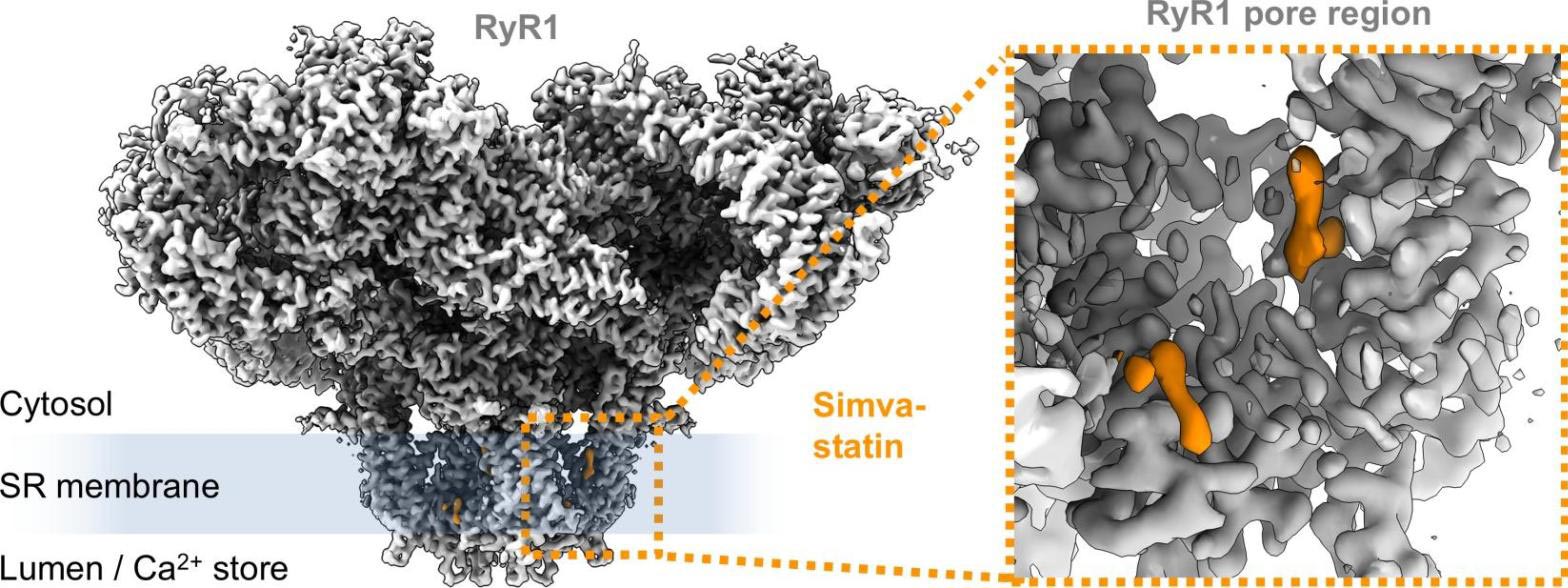
The images revealed two locations on the muscle protein, called the ryanodine receptor, where a statin called simvastatin binds, opening a channel in the receptor and allowing calcium to flow through.
The calcium leak could explain the muscular side effects of statins, Marks says, by weakening the muscle directly or by activating enzymes that degrade muscle tissue.
Building a better statin
The new images also suggest that statins could be redesigned so they do not bind the ryanodine receptor but retain their cholesterol-lowering ability.
Marks is now collaborating with chemists to create such a statin.
Plugging the calcium leak could be another option: Statin-induced calcium leaks in mice can be closed, the researchers showed, with an experimental drug developed in the Marks lab for other conditions involving calcium leaks.
These drugs are currently being tested in people with rare muscle diseases. If it shows efficacy in those patients, we can test it in statin-induced myopathies,” Marks says
Reference: “Structural basis for simvastatin-induced skeletal muscle weakness associated with type 1 ryanodine receptor T4709M mutation” by Gunnar Weninger, Haikel Dridi, Steven Reiken, Qi Yuan, Nan Zhao, Linda Groom, Jennifer Leigh, Yang Liu, Carl Tchagou, Jiayi Kang, Alexander Chang, Estefania Luna-Figueroa, Marco C. Miotto, Anetta Wronska, Robert T. Dirksen and Andrew R. Marks, 15 December 2025, The Journal of Clinical Investigation.
DOI: 10.1172/JCI194490
Funding: The research was supported by grants from the NIH (R01HL145473, R01DK118240, R01HL142903, R01HL140934, R01NS114570, R01AR070194, R01AR078000 , R25HL156002, R25NS076445, P01HL164319, and T32HL120826.
Disclosure: Andrew Marks owns stock in RyCarma Therapeutics Inc., a company developing compounds targeting the ryanodine receptor, and a coinventor on U.S. patent nos. US8022058 and US8710045. Gunnar Weninger, Haikel Dridi, Marco Miotto, and Andrew Marks are inventors on the patent application entitled “STATIN INNOVATION FOR MUSCLE-FRIENDLY CHOLESTEROL MANAGEMENT” [Invention Report (IR) #CU24350] to be filed by Columbia University.
Never miss a breakthrough: Join the SciTechDaily newsletter.
Follow us on Google and Google News.