This post was originally published on here
Scientists have uncovered long-hidden techniques used by Renaissance artists Rafael and Leonardo da Vinci through non-invasive imaging and chemical analysis. The study focused on six drawings and revealed complex layering techniques involving red chalk, metalpoint and iron gall ink.
The research gives rare insight into how Rafael, Leonardo da Vinci and their contemporaries worked out their compositions long before paint ever touched canvas.
Led by Silvia A. Centeno of The Metropolitan Museum of Art, the investigation was published in the journal npj Heritage Science. The team examined four drawings by Rafael, one by Leonardo da Vinci and one by Perugino. Until now, experts had assessed these works through visual observation alone.
By using advanced methods like X-ray fluorescence mapping and Raman spectroscopy, researchers identified how artists built up their drawings in stages. These layers often included preparatory grounds made from bone ash or colored pigments.
In Leonardo’s sketch of the Virgin adoring the Christ Child, for instance, the paper was prepared with a pink-tinted base containing red lead and bone ash, providing both tone and texture.
Layering techniques in works by Rafael and Leonardo da Vinci
In Rafael’s studies, including Madonna and Child and Studies of the Christ Child, red chalk was applied with both precision and softness. Elemental analysis confirmed the chalk as iron-based ochre, with natural variations in hue. Rafael adjusted pressure to vary the tone, using chalk not just for outlining but also to build depth and suggest form.
The study also uncovered fine use of metalpoint. In Nude Male, Rafael began the drawing with lead metalpoint, then followed with darker lines of iron gall ink. This approach allowed for quick sketching followed by more defined contours.
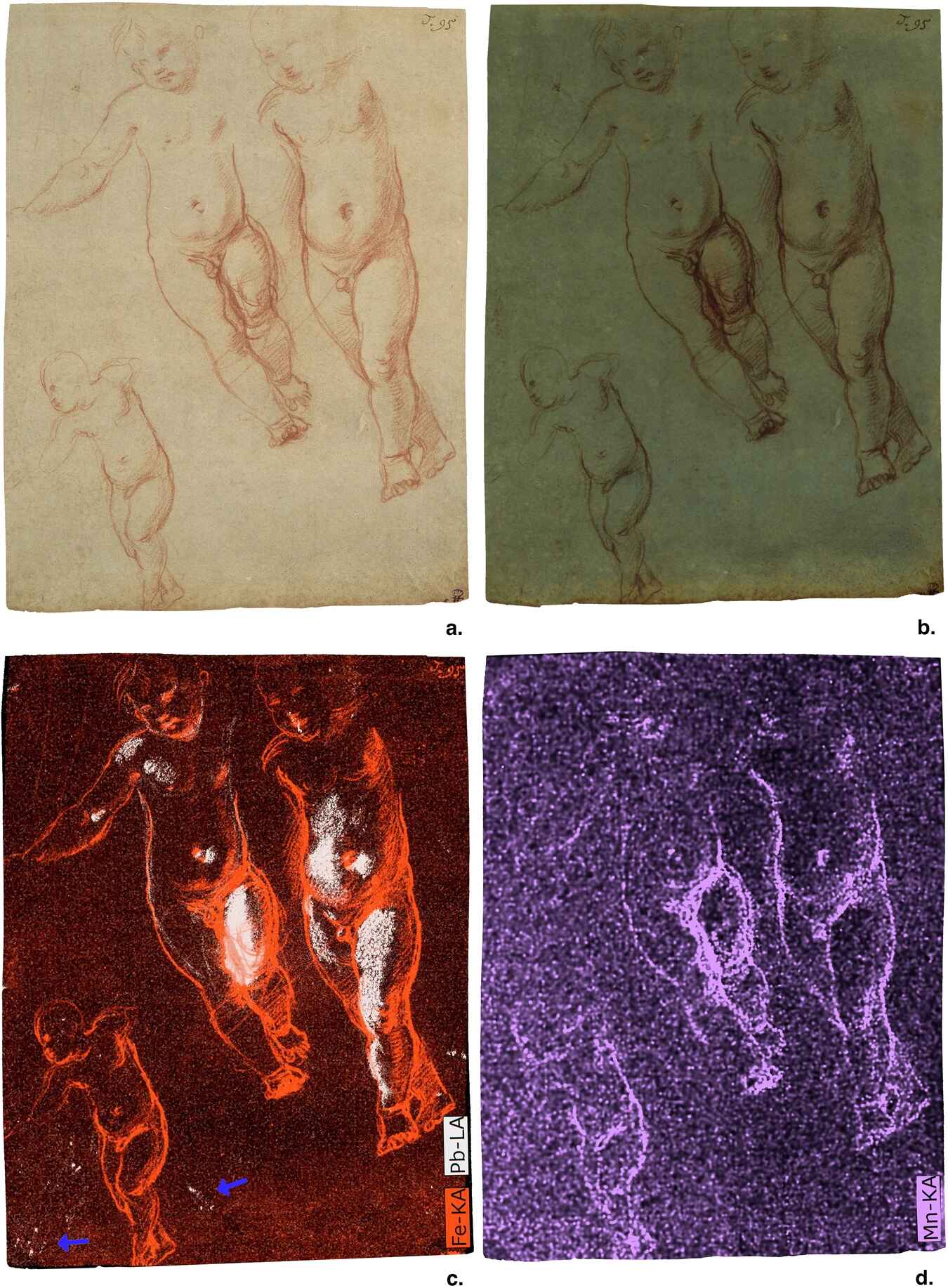
Leonardo used a silver-mercury alloy for his metalpoint and then added iron gall ink to refine the composition, according to the elemental mapping.
Perugino’s Study of a Kneeling Youth also revealed metalpoint drawn over a white bone ash preparation. Researchers detected silver mixed with mercury, a type of amalgam that was difficult to identify in past studies without chemical imaging.
Iron gall ink and Renaissance drawing practices
Iron gall ink was found in several drawings. While its original deep black tone has faded to brown over time, analysis showed it was made with iron salts and plant-based tannins, consistent with recipes of the period. The ink appeared layered over early sketches or used on its own, depending on the artist’s intent.
Centeno said these findings offer a deeper understanding of how Renaissance artists constructed their ideas on paper. The study confirms that these drawings were not simply drafts but essential parts of the creative process.