This post was originally published on here
Earth’s nearest celestial neighbor is set to take center stage in 2026, with major lunar missions and a rare solar eclipse highlighting the year in space and astronomy.
NASA is preparing for its first crewed mission around the moon in decades, while multiple robotic landers are scheduled to target the lunar surface. Later in the year, a total solar eclipse – with prime viewing from parts of Europe and the northern Atlantic – will give skywatchers another reason to look up.
Here’s a look at the space and astronomy stories expected to make headlines in 2026:
Artemis II astronaut launch to the moon
As early as February, NASA plans to launch a crewed mission around the moon as part of the Artemis II program. The mission will mark the first time astronauts travel beyond low-Earth orbit since the Apollo era and the first crewed lunar flyby in more than 50 years.
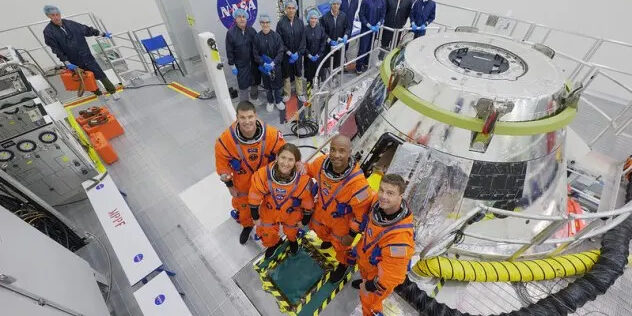
The Artemis II crew (from left to right) Canadian Space Agency astronaut Jeremy Hansen, NASA astronauts Christina Koch, Victor Glover and Reid Wiseman, don their Orion Crew Survival System Suits for a multi-day crew module training beginning Thursday, July 31, 2025 at the agency’s Kennedy Space Center in Florida. (Image: NASA)
After launching aboard NASA’s Space Launch System rocket from Florida, NASA astronauts Reid Wiseman, Victor Glover and Christina Koch, along with Canadian Space Agency astronaut Jeremy Hansen, will spend about 10 days aboard the Orion spacecraft on a loop around the moon before returning to Earth.
Advertisement
Advertisement
If successful, Artemis II will pave the way for Artemis III, which aims to return astronauts to the lunar surface as early as 2027. No humans have walked on the moon since Apollo 17 in 1972.
Total solar eclipse draws cruise ship crowds
A total solar eclipse will sweep across parts of the Northern Hemisphere on Aug. 12, 2026, though viewers in the continental U.S. will need to travel to see totality.
The eclipse will be visible along a narrow path across the Arctic Ocean, Greenland, Iceland, the Atlantic Ocean, northern Spain and parts of Portugal. Several cruise lines, including Princess Cruises, Cunard, Virgin Voyages, Holland America and Silversea, are offering eclipse-themed voyages promising views of totality from sea.

The Aug. 12, 2026 path of totality for the total solar eclipse. (Image credit: National Solar Observatory)
The U.S. won’t be completely left out. A partial solar eclipse will be visible across parts of New England, including Boston, where about 16% of the sun will be covered.
Advertisement
Advertisement
Safety reminder: Proper eclipse glasses are required to view the sun at all times during a solar eclipse, except during the brief period of totality. Not using a solar filter can cause serious eye damage.
More moon landing attempts
Multiple robotic missions to the moon are planned for 2026 under NASA’s Commercial Lunar Payload Services (CLPS) program, which partners with private companies to deliver science and technology payloads to the lunar surface.
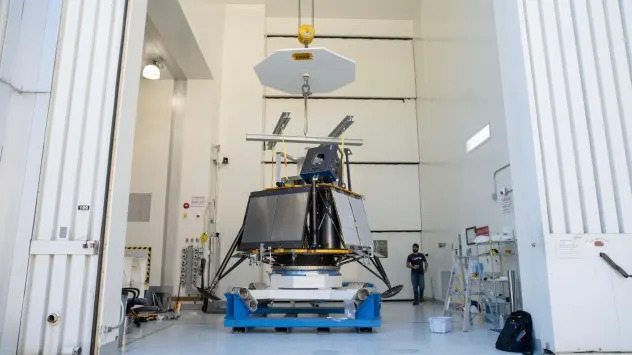
A full-scale model of Firefly Aerospace’s Blue Ghost Mission 2 lunar lander awaits transport into a clean room for environmental testing at NASA’s Jet Propulsion Laboratory in Southern California in September 2025. (Image credit: NASA/JPL-Caltech)
Astrobotic plans to launch its Griffin Mission One no earlier than summer 2026. Blue Origin, Firefly Aerospace and Intuitive Machines also have robotic lunar missions in development, with tentative launch dates throughout the year.
Each mission is expected to carry dozens of experiments for NASA and other research organizations, helping prepare for future human missions to the moon. While up to four lunar landing attempts are planned in 2026, success is never guaranteed. Historically, about half of all lunar landing attempts have failed.