This post was originally published on here
By JADE RUSSELL
Tribune Staff Reporter
[email protected]
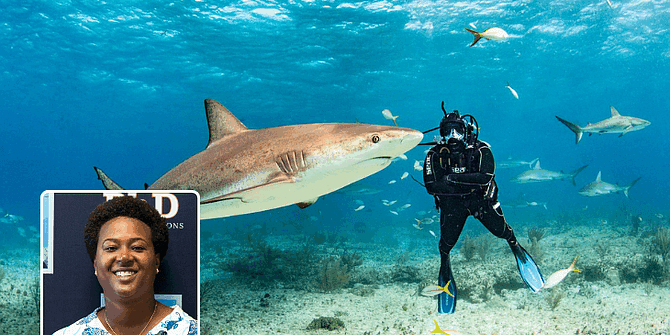
CANDACE Fields, a Bahamian marine scientist who has just earned her PhD, will return home from the United States next month to lead shark research and conservation at the Cape Eleuthera Institute, marking a major milestone for both her career and The Bahamas’ global role in shark protection.
Dr Fields, 30, completed her PhD in biology at Florida International University after beginning the programme in the fall of 2020. Her studies were initially disrupted by the COVID-19 pandemic, which forced her to attend classes virtually before she relocated to Florida in 2021 to continue what became a five-year academic journey. She graduated on December 16. During the commencement speech given by Jeanette Nunez, President of FIU, Candace was singled out as an outstanding scholar recognised globally in her field. Now, she will take up the role of heading the shark research and conservation programme at Cape Eleuthera, where she previously worked and where her interest in advanced research first took shape.
Driven by a long-standing passion for marine biology, Dr Fields said her time at the institute pushed her to deepen her scientific skills. Although she initially planned to pursue a master’s degree, she said conversations with advisers encouraged her to aim higher.
“I never would have thought this is something that I would have ended up doing,” she said, crediting her family and loved ones for helping her reach the milestone.
She is the first person in her immediate family to earn a PhD.
“For as long as I can remember, I always wanted to be a marine scientist of some sort. I always had a fascination for the ocean and its inhabitants.
“I’ve always enjoyed watching shark programming when I was a kid. It’s something that I when I look back, it’s definitely something that was a consistent desire of mine.”
Dr Fields defended her dissertation in October. Titled Understanding Shark Sanctuaries as a Conservation Tool: Impacts of the Bahamian Sanctuary on Key Coastal and Pelagic Species, the research examined how effective The Bahamas’ shark sanctuary has been in protecting shark populations.
Her dissertation was structured in three chapters. The first analysed long-term trends in shark populations following the establishment of the sanctuary. The second focused on the critically endangered oceanic whitetip shark, identifying The Bahamas as a key habitat for the species in the Atlantic. The final chapter traced shark fin trade routes from markets in Hong Kong back to their regions of origin.
Dr Fields said fear and misunderstanding of sharks remain widespread, but she hopes her research will strengthen protections for the species and reinforce their importance to marine ecosystems. She said her work aims to ensure conservation decisions are driven by data, while also contributing to public education and debate.
She also offered advice to aspiring marine biologists, stressing that academic paths do not have to be linear.
“My bachelor’s degree is in neuroscience, which has nothing to do with what I’m doing now. So I think you know, if you have a passion or dream to stick with it, and even if you feel that you’ve gotten off course, to remember that it’s always possible to return back to that passion.”
Beyond academia, Dr Fields has emerged as an advocate for shark protection and has appeared as an expert in international media, including National Geographic and other conservation platforms. She continues to contribute to research and policy efforts aimed at strengthening protections for sharks and safeguarding marine ecosystems, now bringing that expertise back home.