This post was originally published on here
What scientists long believed were knots in DNA may actually be persistent twists formed during nanopore analysis, revealing an overlooked mechanism with major implications.
For decades, researchers interpreted complex electrical patterns seen when DNA moved through nanopores as signs that the molecule was forming knots. Nanopore experiments, which are widely used to study genetic material, seemed to support this idea.
The comparison was often made to pulling a shoelace through a narrow opening. If the lace becomes tangled, its motion changes in noticeable ways. Scientists believed DNA behaved in the same manner, concluding that irregular signals meant the strand had become knotted as it passed through the pore.
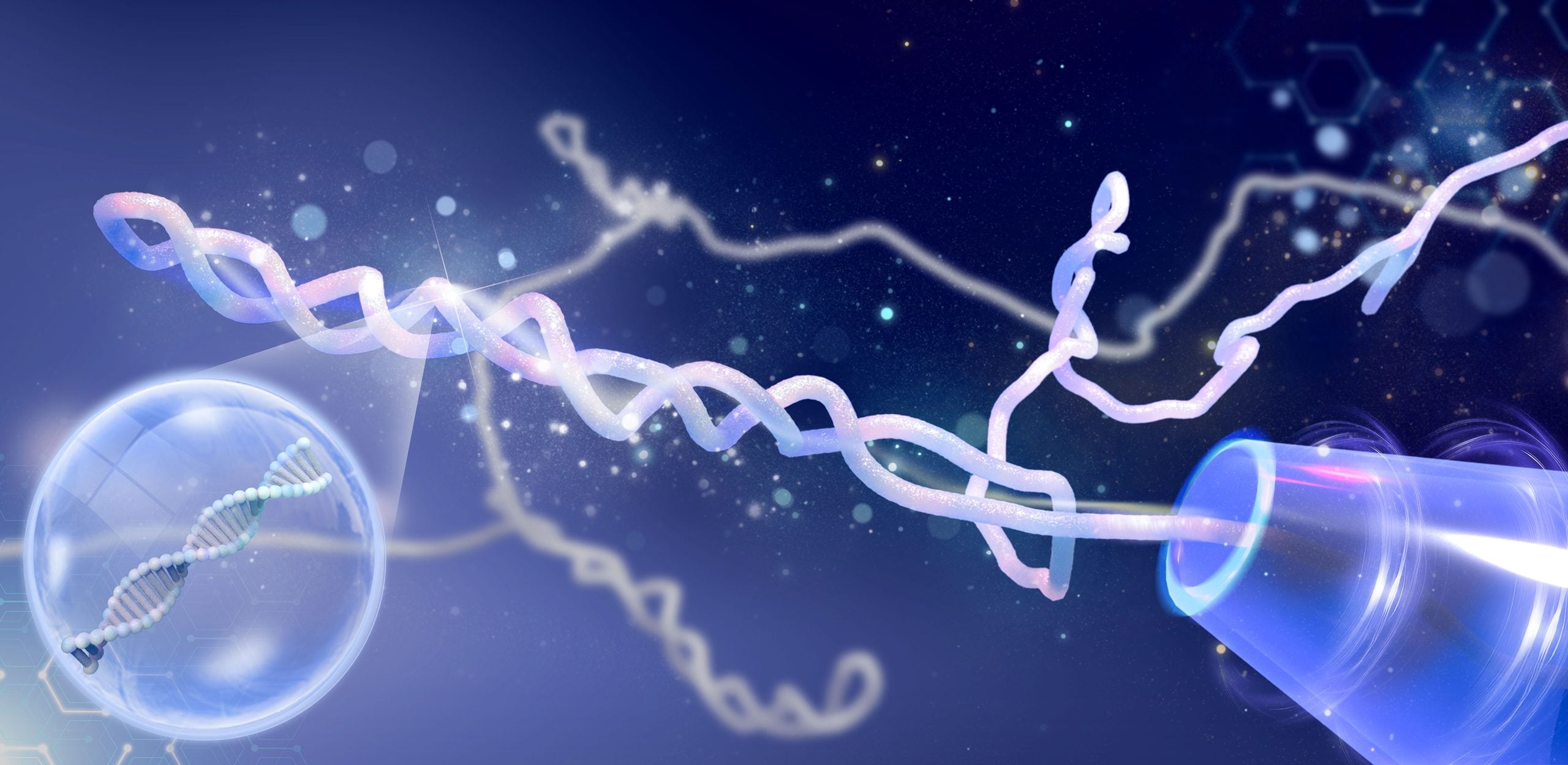
New research now challenges this long-standing view. The study, published in Physical Review X, shows that DNA does not simply become knotted (like the tangled shoelaces) as a result of signal disturbances during nanopore translocation. Instead, many of the structures previously interpreted as knots turn out to be plectonemes. In these configurations, DNA coils around itself in a twisted form, similar to a wound phone cord, rather than forming a true knot.
Rethinking DNA “Tangles” in Nanopores
“Our experiments showed that as DNA is pulled through the nanopore, the ionic flow inside twists the strand, accumulating torque and winding it into plectonemes, not just knots. This ‘hidden’ twisting structure has a distinctive, long-lasting fingerprint in the electrical signal, unlike the more transient signature of knots,” explained lead author Dr Fei Zheng from the Cavendish Laboratory.
To investigate this behavior, the researchers used nanopores made from glass and silicon nitride and tested DNA under many different voltages and experimental setups. They found that so-called tangled events, where more than one section of DNA appeared in the pore at the same time, occurred far more often than could be explained by knot formation alone. The frequency of these events rose with higher voltages and longer DNA molecules, pointing to an additional process that had not been fully recognized before.
Twisting Forces and Persistent Structures
They discovered that these twists are driven by electroosmotic flow—a movement of water inside the nanopore that generates torque on the helical DNA molecule. As the strand spins, this torque is transmitted to sections of DNA outside the pore, causing them to coil up. Unlike knots, which are tightened by pulling forces and tend to be short-lived, plectonemes can grow larger and persist throughout translocation. To investigate further, the researchers simulated DNA under realistic forces and torques. The simulations confirmed that plectonemes are generated by the twisting motion imposed by the nanopore’s electroosmotic flow and that their formation depends on the DNA’s ability to propagate twist along its length.
Further, in a clever twist, the researchers engineered “nicked” DNA, molecules interrupted at precise intervals, which blocked twist propagation and drastically reduced plectoneme formation in their experiments. This has not only confirmed the structure’s role but also points to potential new ways to sense or even diagnose DNA damage using nanopores.
“What’s really powerful here is that we can now tell apart knots and plectonemes in the nanopore signal based on how long they last,” says Prof Ulrich F. Keyser, who is also the co-author of the paper.
“Knots pass through quickly, just like a quick bump, whereas plectonemes linger and create extended signals. This offers a path to richer, more nuanced readouts of DNA organization, genomic integrity, and possibly damage.”
Broader Implications for Biology and Technology
The implications go even further. In biophysics, these findings could deepen our understanding of DNA entanglements within cells, where plectonemes and knots regularly emerge through the action of enzymes, playing crucial roles in genome organization and stability. For biosensors and diagnostics, the ability to control or detect these twist structures may open the door to a new generation of biosensors that are more sensitive to subtle DNA changes, potentially enabling the early detection of DNA damage in diseases.
“From the perspective of nanotechnology, the research highlights the power of nanopores, not only as sophisticated sensors but also as tools for manipulating biopolymers in novel ways,” concluded Keyser.
Reference: “Torsion-Driven Plectoneme Formation During Nanopore Translocation of DNA Polymers” by Fei Zheng, Antonio Suma, Christopher Maffeo, Kaikai Chen, Mohammed Alawami, Jingjie Sha, Aleksei Aksimentiev, Cristian Micheletti and Ulrich F. Keyser, 12 August 2025, Physical Review X.
DOI: 10.1103/spyg-kl86
Never miss a breakthrough: Join the SciTechDaily newsletter.
Follow us on Google and Google News.