This post was originally published on here
Last Updated:
Dark energy is the mysterious force thought to be accelerating the universe. . But a new study hints that scientists may have misread the cosmos’s speed entirely.
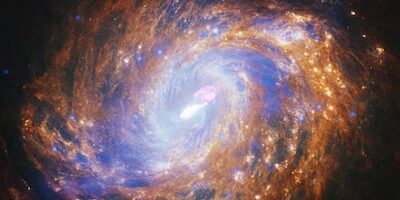
Dark energy pushes matter apart, driving the universe’s expansion across vast cosmic scales. (Representative Image: NASA)
When we hear the term “dark energy,” it often sounds mysterious or even sinister—something paranormal or harmful. But in science, dark energy has nothing to do with the supernatural.
In astrophysics, dark energy refers to an unknown force that is driving the accelerated expansion of the universe. According to NASA, around nine billion years after the universe formed, this force began overpowering gravity, causing space itself to expand faster rather than slow down.
Recommended Stories
What Is Dark Energy?
For most of human history, the universe was imagined as a quiet, unchanging backdrop to life on Earth. Then came the Big Bang, galaxies, black holes and finally, a discovery that stunned scientists: the universe isn’t just expanding, it’s accelerating.
Answering what exactly dark energy is, NASA says, ” We don’t know. But we do know that it exists, it’s making the universe expand at an accelerating rate, and approximately 68.3 to 70% of the universe is dark energy.”
How Scientists Discovered Dark Energy?
Dark energy is invisible. It does not emit light, reflect it, or interact with matter in any direct way we can measure. And yet, it makes up over 68 per cent of the universe, outweighing all stars, planets, galaxies, and even dark matter combined.
Scientists didn’t discover dark energy by spotting it. They discovered it by noticing something was wrong.
Dark energy may sound like a recent idea, but its scientific roots go back more than a century. While it wasn’t identified until the late 1990s, the story begins in the early 1900s, when scientists were first trying to understand how the universe behaves.
In 1922, Russian physicist and mathematician Alexander Friedmann used Albert Einstein’s newly published theory of general relativity to explore different possibilities for the universe’s future. His calculations suggested something radical for the time: the universe might not be static at all—it could be expanding.
A few years later, in 1927, Belgian astronomer Georges Lemaître reached a similar conclusion. Working independently and also using Einstein’s equations, Lemaître showed that the mathematics actually supported an expanding universe, even though Einstein himself had assumed the universe was unchanging.
The idea moved from theory to observation in 1929. Astronomer Edwin Hubble, using data collected by his colleague Milton Humason, studied distant spiral galaxies. Humason measured how the light from these galaxies was stretched, or “redshifted,” as they moved away from Earth. Hubble then compared this redshift with the galaxies’ distances, calculated using Cepheid stars.
The result was clear: the farther a galaxy is, the faster it is moving away from us. This relationship, now known as Hubble’s Law (or the Hubble–Lemaître law), confirmed that the universe is expanding.
Decades later, when scientists discovered that this expansion was not slowing down—but speeding up—they realised something unseen must be at work. That unknown force became known as dark energy.
The ‘Big Crunch’: Why Scientists Are Concerned
To understand dark energy, it helps to imagine the universe not as objects moving through space, but as space itself expanding. Galaxies aren’t racing away from each other; the space between them is growing.
Gravity tries to pull matter together, forming stars, planets, and galaxies. Dark energy does the opposite. It pushes outward, ensuring that on the largest scales, the universe keeps expanding.
For years, scientists believed dark energy was constant—unchanging, steady, and permanent. If that were true, the universe would continue expanding forever, growing colder and emptier in a scenario known as the Big Freeze.
But recent studies, including research by scientists at Yonsei University in South Korea, suggest something unsettling: dark energy may be losing strength over time.
If dark energy weakens, gravity could slowly regain control. Expansion would begin to slow. Eventually, it could stop altogether. And if gravity fully takes over, the universe could begin contracting—pulling everything back toward itself. This scenario is known as the Big Crunch.
In a Big Crunch, galaxies would drift closer, temperatures would rise, and space itself would collapse, potentially ending the universe in a hot, dense state—possibly similar to how it began.
This idea isn’t new, but what worries scientists is the growing possibility that dark energy may not behave the way they once assumed.
It’s important to be clear: this does not mean the universe is about to collapse. These processes unfold over billions or trillions of years, far beyond human timescales.
Why Dark Energy Matters?
Because dark energy shapes the fundamental laws of the universe. If its strength changes, it challenges some of the most basic assumptions in cosmology—including how space, time, and gravity work.
Scientists are worried not because the end is near, but because the universe may be far less predictable than we thought.
A weakening dark energy could also support alternative models of the universe—such as cyclic universes that expand, collapse, and begin again. Each possibility forces physicists to rethink long-standing theories.
Despite decades of research, dark energy remains one of science’s greatest mysteries. Scientists don’t know: What dark energy actually is, why it has the strength it does, whether it changes over time, or how it fits into existing theories of physics
New telescopes, space missions, and precision measurements are always being designed to track cosmic expansion more accurately than ever before. The goal is simple but profound: to understand whether dark energy is stable—or slowly fading.
The European Space Agency’s Euclid mission, launched in 2023, aims to create a detailed 3D map of the universe to track how dark energy has shaped and stretched matter over time. It will observe billions of galaxies up to 10 billion light-years from Earth.
Meanwhile, NASA’s Nancy Grace Roman Space Telescope, scheduled for launch by May 2027, will further probe dark energy while mapping dark matter in three dimensions, helping scientists better understand the universe’s large-scale structure.
Dark energy won’t affect Earth, the Sun, or even the Milky Way in our lifetimes. But it defines the ultimate fate of everything—every star, galaxy, and atom in existence.
By studying dark energy, scientists aren’t just predicting how the universe ends. They’re trying to understand why it exists at all.
December 30, 2025, 16:40 IST
Loading comments…

Stay Ahead, Read Faster
Scan the QR code to download the News18 app and enjoy a seamless news experience anytime, anywhere.