
This post was originally published on here
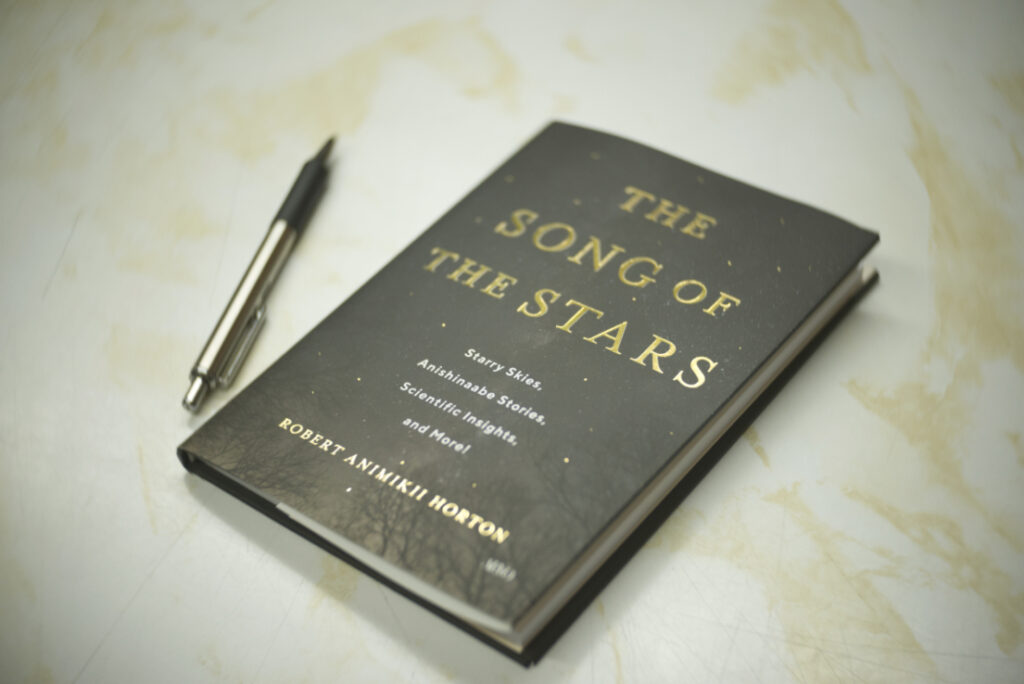
Robert Animikii Horton’s The Song of the Stars: Starry Skies, Anishinaabe Stories, Scientific Insights, and More! is a fresh and profoundly endearing perspective on the conflict and connection of science and spirituality.
A Times columnist and award-winning Anishinaabe educator, sociologist and activist from Rainy River First Nations in Treaty #3 Territory, Horton told the Times that the book took shape during the lockdown period of the COVID-19 pandemic along the shores of Longbow Lake.
Using traditional Anishinaabeg stories to illustrate the intersection of science and spirituality, as well as other historical examples from cultures and peoples around the globe, the book became an outlet for Horton’s perspective on the subject through internal and external journeys, celestial events, and more.
“I’ve always been a fan of science, ever since I was a kid,” Horton said. “Likewise, I’ve been a fan of where my family comes from. Over the years, what I discovered is that there’s been a sort of wrestling match between belief and knowledge, science and spirituality. Whether it’s from the more spiritual end of the matter, or the more objective fact that science can reveal, we’re answering different questions. One describes where we walk, and the other describes how we walk.”
Horton, who holds the title of Gaa-aazhide-gikinoo’amaaged (an Anishinaabemowin word for one who teaches across philosophies) at Seven Generations Education Institute, said there are deep roots to his ruminations over the relationship between the two lines of thought. A descendant of Chief Mawedopenais (the spokesperson for Treaty #3 negotiations at Harrison Creek in 1873, and a modern sociologist, activist and contrarian commentator, he became keenly aware that the duality need not lead to conflict.
“For time immemorial, in all parts of the human family, we’ve had a sort of wrestling match between different kinds of knowledge. For a few centuries now, we’ve had one of the biggest that we’ve seen occurring, that between science and spiritual belief,” Horton said. “I think that match, that conflict only continues, and it only continues if we misunderstand the nature of each one.”
This misunderstanding is something Horton sought to soften with The Song of the Stars.
“If technology outpaces principles and ethics, it creates a dangerous world,” Horton said. “But if we go the other way, if we rise in spirituality, but we don’t find a way to innovate, we don’t progress. Both can complement one another. Both are sources of awe, but the methods and the rules of each differ.”
In the book, Horton postulates that humanity’s attitude on Earth should be one of awe, no matter the moral or intellectual perspective.
“It’s sort of a double meaning. One is our vantage point, standing here in Fort Frances, on earth, looking up at the sky. But I think there’s a second vantage point that happens internally,” Horton said. “A worldview, a way of relating to the stars, a way of relating to everything that we’re interrelated to, interconnected to and interdependent on.”
For Horton, this process began when he was 15 years old, gazing up at the stars and the northern lights as they danced across the night sky while sprawled across the picnic table in the backyard of his family’s home. But since then, its meaning has deepened.
“I started to acknowledge that there are different ways to look at these. One way may be from an objective, material, scientific view. Another could be from a cultural, spiritual view. Not just ours, but the ones that the Greeks and the Romans talked about, too,” said Horton.
“That awe for the transcendent, the awe for the spellbinding, the absolute awe to be in this time and place, to experience all those things that we see around us in our universe. I would say it’s a source of awe that transfers to things like music and art and things like that: the dynamic, the arcane, the epic, the mysteries and the awe.”
There are many stories, Horton said, but engaging, discussing and engaging in debate and dialogue about those stories is when true engagement begins. “Not only does more knowledge come from that constructive method of discourse, but new things can be born from that.”
In The Song of the Stars, celestial events help Horton illustrate the connection between spiritual and scientific concepts.
“This human family, by means of our stories and ‘The All’ we feel when getting into relationships with celestial events, shows we have much more in common than we do apart,” Horton said. “We all come from the celestial blast furnaces. Maybe it could take that celestial vantage point to show that we, as much as we’re individuals, as much as we’re groups, we’re a human family first.”
In general, Horton hopes The Song of the Stars serves as a way to orient oneself in their endeavours.
“I hope that it points some in the direction to find awe or to increase it; I hope it inspires people to continue looking up, dreaming big and burning bright, scattering sparks, and hopefully, lighting all lanterns; I hope people enjoy it.”
The Song of Our Stars is on sale at Betty’s and online at www.strongnations.com and Amazon.ca.