This post was originally published on here
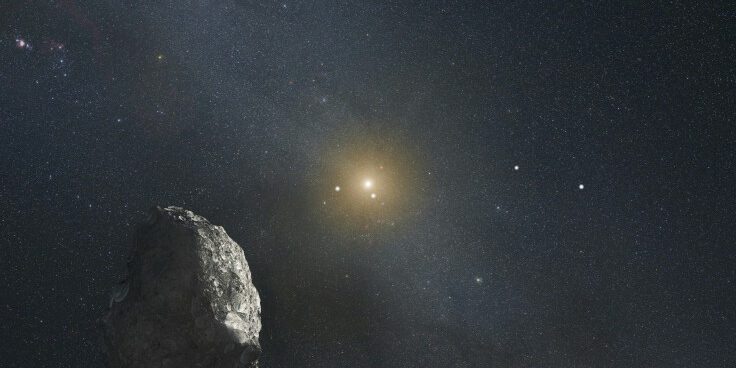
The extraordinary interstellar object 3I/ATLAS has remained a fascinating object of study for astronomers since it flew past our Solar System on a short orbit.
Detected on 1 July 2025 by the Asteroid Terrestrial-impact Last Alert system (ATLAS) survey telescope at the Observatory of Las Armas, Chile, 3I/ATLAS is poised to challenge conventional cometary theories.
In contrast to regular comets, domestic to our Solar System, 3I/ATLAS is hyperbolic in its orbit — not bound to our Sun by gravity but has had to cross the space around our star. This direction and the speed of approximately 58 km/s (approximately 130,000 mph) with respect to the Sun prove its origin in the interstellar.
Older Than The Sun?
The one thing that stands out the most in 3I/ATLAS is its seeming age. Research indicates it may have formed in the Milky Way’s thick disk, a population of stars that formed in the galaxy’s primordial days, long before our own Sun was born.
A study by astronomers at the University of Oxford, based on a statistical model of the stellar age distribution, placed the age of 3I/ATLAS between 8 and 14 billion years (approximately 68% confidence). This would otherwise make it older than the Solar System, which is estimated to be 4.6 billion years old.
Independent age analysis by researchers at the University of Michigan indicates that there is a high likelihood of an age range of 3 billion to 11 billion years that has been determined using the high galactic velocity of the object, which is a method that compares the motion of the object in space with the age-velocity lines observed in the stars.
This evidence converges in a remarkable way to reach the following conclusion: 3I/ATLAS is billions of years older than the Sun and planets, and thus likely the oldest comet-like object ever discovered.
The original parent star of 3I/ATLAS is not detectable since it has been wandering across the Milky Way for several billion years. The gravitational interactions with the other stars and the galaxy structures over these immense timescales would have wiped out any specific path to the birth system. Its stellar birth certificate, which it presumably had, is, in fact, smeared out.
A Comet By Nature, Not A Probe
3I/ATLAS shares the characteristics of a comet, such as a glowing coma of gas and dust formed when its icy materials heat in the light of the Sun, and a tail pushed away by solar radiation.
It has been confirmed that comet-like compositions are present across large areas of 3I/ATLAS, where unusually high amounts of carbon dioxide are observed, along with water vapour and various other volatiles.
However, this does not undermine the scientific consensus that the interstellar object is of natural origin. Scrutiny has not given evidence of any plausible proof of artificial propulsion, organised engineering or indications of a non-natural source. Speculating about exotic possibilities, as one professional organisation noted, may capture the headlines; however, existing scientific evidence remains consistent with known cometary physics.
According to scientists, the notion that this interstellar visitor is an alien probe is not supported by the available data. Even though other hypotheses have been proposed in the public media by some scientists, including, most famously, astrophysicist Avi Loeb, they remain speculative. The astrophysics community does not generally regard them as legitimate.
A Rare Cosmic Messenger
The flyby of 3I/ATLAS into the inner Solar System, its closest approach to the Sun on or about 30 October 2025, also provided a unique opportunity to view such a body at a relatively closer distance. It came nearest to the Earth on 19 December 2025 at a distance of approximately 1.8 astronomical units — far less than that of Mars.
Since the 3I/ATLAS is currently moving out into the Galaxy, the device will become less visible, yet the data gathered during its fly-through will be invaluable. Scientists hope that the chemical and physical mysteries embedded in this ancient traveller will help inform theories of how planetary systems develop and transform throughout the universe.
In a universe that extends over billions of years and trillions of kilometres, 3I/ATLAS has not merely come to visit; it’s now a time capsule from a bygone age, with the traces of star nurseries and star systems long gone. Its path is a reminder that the smallest global bodies can hold grand narratives of existence in the universe.