This post was originally published on here
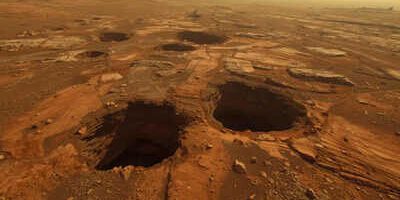
Mars often feels finished. Mapped, scanned, labelled in broad strokes. Yet every so often, something unsettles that sense of familiarity. A shadow where none was expected. A shape that does not fit earlier categories. Researchers studying satellite images noticed a small cluster of openings in a remote Martian region that did not behave like known features. They were not craters. They were not volcanic pits. They sat quietly in the landscape, round and deep, without the usual signs of impact or eruption. At first glance, they seemed minor. On closer inspection, they began to suggest something else entirely. Not activity, but absence. Empty space beneath the surface. Cavities shaped long ago, possibly by water, and possibly capable of keeping secrets.
What exactly was found on the Mars surface
Published in The Astrophysical Journal Letters, the study centres around eight deep openings in an area known as Hebrus Valles. Each appears as a near circular pit, dropping sharply into darkness. Unlike impact craters, these pits lack raised rims or scattered debris. Their edges look clean, almost softened, as if the collapse came from below rather than from force from above.Researchers describe them as skylights. These form when the ceiling of an underground cavity gives way, revealing what lies beneath. On Mars, most known skylights are linked to volcanic lava tubes. These new ones behave differently.
Why are these caves considered unusual
The surrounding terrain tells part of the story. Data from orbital instruments detected minerals such as carbonates and sulphates near the pits. These minerals often form in the presence of water. On Earth, landscapes rich in these materials are prone to slow chemical erosion.This process creates karst terrain. Water seeps into rock, dissolves it over time, and leaves behind caves, sinkholes, and underground channels. Until now, this kind of landscape had not been clearly identified on Mars.The suggestion is cautious but significant. If correct, these caves were not shaped by fire but by water.
How old might these caves be
The region itself is ancient. Hebrus Valles shows signs of erosion that likely date back billions of years. That places the caves in a period when Mars is thought to have been wetter than it is today.If water flowed beneath the surface, even intermittently, it could have carved these spaces slowly. The collapse that revealed them may have happened much later. What remains hidden below is unknown.The caves may still extend far beyond what orbiters can see.
Why do caves matter in the search for life
The surface of Mars is harsh. Radiation, temperature swings, and dust storms make long term survival difficult. Underground spaces change that picture slightly.Caves offer shelter. They block radiation. They soften temperature extremes. On Earth, similar environments support microbial life in places once thought uninhabitable.If life ever existed on Mars, it may have retreated below ground as conditions worsened. These caves could have provided refuge. They may also preserve chemical or biological traces that the surface has long since lost.
Could these caves still hold signs of life
No direct evidence of life has been found. The idea remains speculative. Still, these caves meet several criteria scientists look for when narrowing search targets.They are linked to water related minerals. They are protected environments. They are stable over long periods. All of this makes them interesting rather than definitive.Future missions may be able to study them more closely. For now, they remain dark openings with unanswered questions beneath them.
What happens next
At present, these caves are identified only from orbit. Reaching them would require careful planning and new technology. Rovers are not designed to descend into steep pits. Landers would need precise targeting.Even so, the discovery reshapes priorities. Instead of scanning endless plains, scientists can focus on places where conditions once aligned.The caves themselves do not promise life. They promise possibility. And on a planet as quiet as Mars, possibility still carries weight.