This post was originally published on here
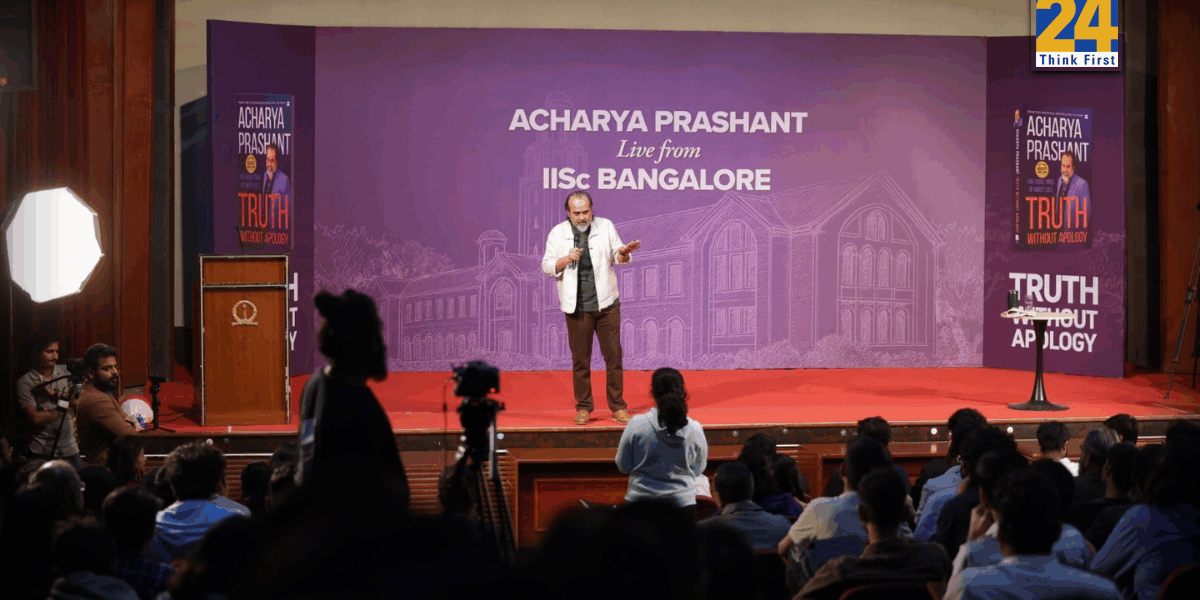
It is not often that a philosopher gets invited to address scientists. Rarer still is a second invitation within the same year. Yet, on December 13, Acharya Prashant found himself back at the Indian Institute of Science, Bangalore, standing before a packed Satish Dhawan Auditorium. Researchers, faculty and students had gathered not out of obligation, but genuine curiosity. When he took the stage, the auditorium broke into sustained applause before he had spoken a single word.
This was his second session at IISc in 2025. The first, held in March, had left a mark. That session had confronted the foundations of identity, knowledge and suffering, contrasting Vedantic inquiry with neuroscience and exposing how modern frameworks of cognition often reinforce the ego rather than dissolve it. Students had walked out not with neat answers but with deeper questions. The December invitation suggested that the discomfort of that first encounter had been valued, not resented.
The return visit came after an extraordinary run through India’s premier technical institutions. Between October and December, Acharya Prashant had addressed four IIT campuses in quick succession: IIT Hyderabad, IIT Kharagpur, IIT Madras and IIT Bombay. The December IISc session brought the total to five engagements at India’s most rigorous scientific and technical institutions within a span of roughly ten weeks. No other philosopher in recent memory has commanded such repeated access to these campuses.
The pattern is telling. India’s landscape of spiritual discourse is crowded. Motivational speakers, lifestyle gurus and self-help personalities routinely draw large audiences. But when institutions like IISc and the IITs seek serious engagement with philosophy, the invitations hardly go to lifestyle gurus or feel-good orators. They go to someone willing to challenge, unsettle and hold his ground before audiences trained to interrogate. The repeat invitations suggest that these institutions have found in Acharya Prashant an interlocutor who meets their standard of rigour, someone whose discourse can withstand the scrutiny of minds that do not settle for easy answers.
IISc occupies a unique position in Indian academia. Unlike the IITs, which train engineers, IISc is fundamentally a research institution. Its students are doctoral scholars and scientists whose work involves questioning assumptions, demanding evidence and subjecting ideas to relentless scrutiny. The culture here is one of unsparing enquiry. Assertions are not accepted at face value. Arguments must hold up under pressure. A speaker who trades in vague inspirational rhetoric would not survive ten minutes here.
That a philosopher would be welcomed into such an environment once is noteworthy. That he would be invited back within the same year, after a session that had challenged rather than comforted, suggests something more than passing curiosity.
The December session reflected the character of the institution. The panel discussion opened by probing the very impulse behind scientific enquiry. What drives us to look outward? Career, prestige, social validation? Or is there another centre altogether, one rooted in genuine curiosity? Acharya Prashant distinguished these two motivations, suggesting that the quality of enquiry depends entirely on which centre it emerges from. The room grew noticeably still.
The conversation then moved into territory that would unsettle any audience trained in empirical method: the limits of science itself. “Science cannot completely cure superstition,” Acharya Prashant observed. “Only superficial superstition can be eradicated. The deeper tendency to believe without knowing remains untouched.” For an auditorium full of researchers, this was not a dismissal of science but an invitation to examine its boundaries. It was met not with defensiveness but with applause.
When the floor opened for questions, the audience did not hold back. One student, voicing a disillusionment familiar to many high achievers, asked bluntly: “I ground myself to get into IISc, but now what’s the point? Everything feels absurd. What is the meaning of life?” The question drew knowing nods from across the hall.
Acharya Prashant’s response was characteristic. He did not offer reassurance. “You see yourself as small only episodically,” he said. “When desires are fulfilled, you feel happy. When they are not, you feel small. The real question is: why do I exist? And the answer is: to see that I do not.” He went on to distinguish between external knowledge and inner wisdom. “Knowledge is additive. Wisdom is demolition.” The line drew a burst of applause, the kind that follows recognition rather than mere agreement.
The discussion turned to suffering, a theme that recurred throughout the session. Can it ever truly end? Acharya Prashant challenged the assumption embedded in the question. “Suffering and joy are not two exclusive things. Peace does not lie at the end of suffering. If it did, it would always remain imaginary. Peace and suffering co-exist.” He pushed further: “Freedom from suffering is itself a desire. Vedanta says that which you feel as ‘I’ is unreal.” For an audience trained to solve problems, the suggestion that some problems dissolve rather than get solved was visibly provocative.
When a student asked about artificial intelligence, he cautioned against a common error. “You are anthropomorphising that which doesn’t have intention,” he said, redirecting the conversation toward the human tendency to project consciousness onto machines rather than examining consciousness itself.
Another question touched on the historicity of the Bhagavad Gita. Was it real? His response was precise: “Mythology and history are different. A work of philosophy is complete in itself. Philosophy means love for the Truth.” The clarity cut through what could have become a meandering debate.
One moment captured the flavour of the session. When a question about societal laws demanded further elaboration, he stepped away from verbal explanation altogether. In a spontaneous move, he invited over thirty students from the audience near the stage, using their participation to enact the point he was making. The auditorium came alive. It was the kind of unscripted moment that transforms a lecture hall into something closer to a live experiment, and it demonstrated why his sessions resist easy categorisation.
The session extended past three hours. Even then, the questions showed no sign of drying up. As it concluded, a long queue formed near the stage. Students waited with books to be signed, questions still on their minds, phones ready for photographs. The curiosity that had filled the Satish Dhawan Auditorium at the start remained palpable at the end. Many lingered, unwilling to let the conversation close.
Taken together with the four IIT sessions that preceded it and the March session that preceded them all, the December engagement points to a pattern that is now difficult to ignore. India’s most analytically demanding institutions, places where intellectual rigour is non-negotiable, are making room for philosophical enquiry. And they are returning for more.
The students driving this interest are not abandoning scientific thinking. They are recognising its boundaries. The tools of science illuminate much, but certain questions, those concerning meaning, purpose and self-understanding, require a different kind of investigation. When that investigation is conducted with the honesty, clarity and directness that scientific minds respect, it finds not just a receptive audience but a hungry one.
In a country where spiritual discourse often trades in easy comfort, these institutions have made a different choice. When they want philosophy that can hold its own against scientific scrutiny, they know where to turn. The two IISc invitations in 2025, following the trail of IIT sessions, make that clear. As word spreads and more premier institutions prepare to host him, Acharya Prashant’s engagement with India’s scientific community appears to be not a passing moment but the continuation of something larger.
Videos and content from this intriguing session can be accessed on Acharya Prashant’s official social media channels.