This post was originally published on here
ALBANY – DNA from an animal shot in 2021 has proven that wolves do occasionally traipse into New York.
It’s been more than 125 years since wolves truly lived in New York state – or anywhere in the Northeast. They were exterminated in the 1800s and scientists are not aware of any breeding groups here.
They have long suspected that lone wolves travel here from Canada. But photos and hunter reports have often been dismissed as coyotes mistaken for wolves.
Advertisement
Advertisement
Then, in 2021, a hunter in Cherry Valley shot a coyote that looked an awful lot like a wolf. It was much bigger than the typical coyote. The hunter said he thought, when he shot, that it was a coyote – which are legal to hunt. Wolves are protected and must not be hunted.
But it was so difficult to know for sure that a New York State Museum scientist turned to DNA.
In a report published in December in Northeastern Naturalist, Jeremy Kirchman laid out the lengths to which he went to prove that the animal was a wolf.
First, the skull: Huge. Much bigger than a coyote’s head.
Next, the body. Samples showed the animal lived on a diet of wild food “at all stages of its life.” Scientists even pulled out a tooth and studied the root as part of their investigation into whether the animal ever ate anything connected to corn. The answer was no, suggesting it never lived off human trash.
Advertisement
Advertisement
And finally, the DNA. The animal matched the Great Lakes Gray Wolf genetic cluster, not the local dogs and coyotes.
“Our analyses add to the growing body of evidence of wild Wolves occasionally dispersing long distances from core breeding areas to localities east of the Great Lakes and south of the St. Lawrence River,” Kirchman wrote.
But it took four years to get to that identification.
It began on Dec. 19, 2021, when a licensed hunter on a search for deer heard an animal behind him. He turned and saw a large animal about 15 meters away, he said. He fired, killing the animal, which he reported to the state Department of Environmental Conservation as a possible record-holder for the largest coyote killed. A DEC officer measured the animal (85 pounds – twice as heavy as a typical coyote) and collected blood for genetic testing. The hunter was allowed to take the animal to a taxidermist, which mounted it for display.
Advertisement
Advertisement
East Stroudsburg University analyzed the blood sample and decided it was a coyote, with about 65% wolf ancestry. But other scientists cried foul. So the State Museum scientists got permission from the hunter to take tongue and lung samples for a deeper analysis.
They found the animal had a specific genetic mutation found in Eastern wolves and that its genes matched wolves in the Great Lakes region.
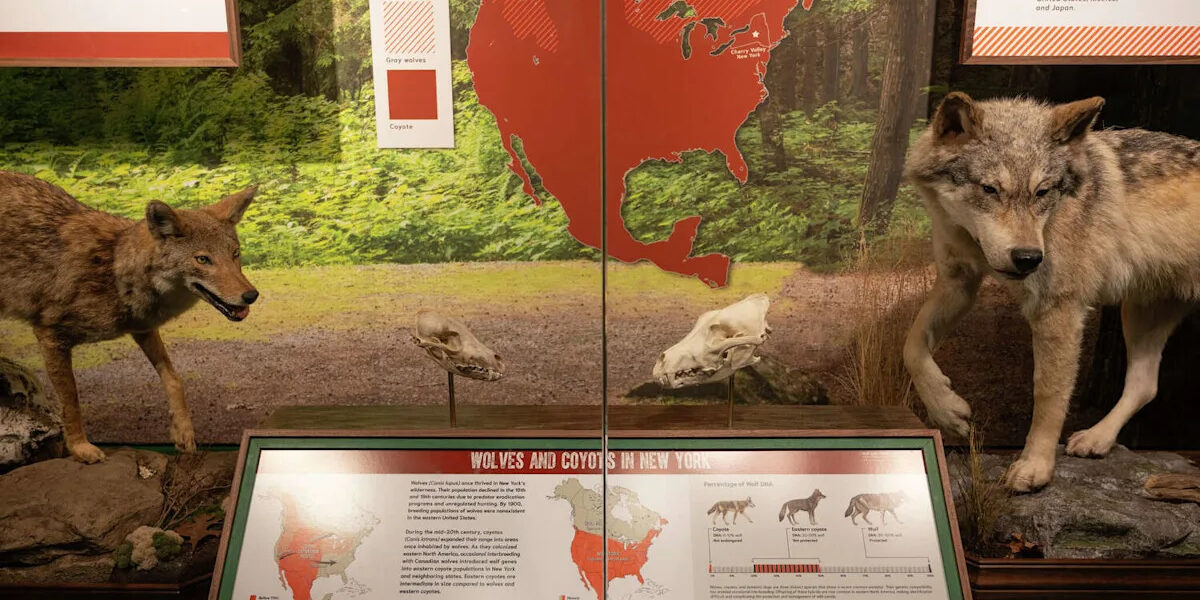
Want to see the wolf? It is on display at a new exhibit at the State Museum. The exhibit, which opened in 2024, discusses the ways in which coyotes and wolves have interbred over the last century. The wolf is shown across from a coyote, to show how similar they have become – though the wolf is still much bigger.
In response to the incident, DEC has changed how it educates hunters about wolves. Hunters are now warned that wolves might be in the state, and are told how to attempt to distinguish them from coyotes. Any coyote-like animal shot that weighs more than 50 pounds must be reported to DEC for evaluation as to whether it was a wolf.
Advertisement
Advertisement
It is still illegal to hunt wolves, but their possible presence has “raised some difficult questions,” the scientists wrote.
“How should licensed Coyote hunters/trappers react to a sighting of an especially large canid? How should the nature-loving public react to the occasional presence of an apex predator that was deliberately extirpated for the perceived good of society?” they wrote.
Still, only two wolves have been definitively identified in New York in the last 25 years. Could they be making a comeback?
In the report, scientists wrote, “That possibility still seems remote.”
This article originally published at It was a wolf: Animal shot in 2021 was not a coyote, scientists say.