This post was originally published on here
A British man living with motor neurone disease (MND) has been able to operate a computer using only his thoughts after being fitted by Elon Musk’s Neuralink. The man, known only as Paul, is among a small group of up to seven participants enrolled in a trial assessing whether the technology can improve quality of life for people with severe neurological conditions.
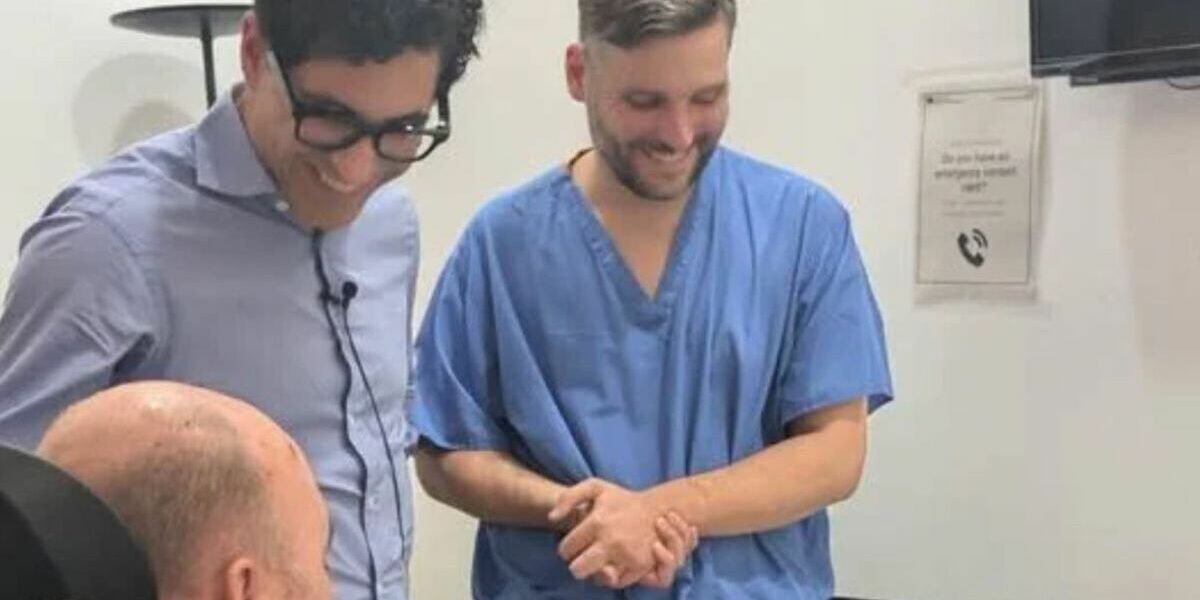
Trial participants include patients with conditions such as spinal cord injuries and MND, many of whom have limited mobility and difficulty communicating or using digital devices. In a UK first, Paul underwent the procedure at University College London’s National Hospital for Neurology and Neurosurgery and was able to move a computer cursor with his mind just one day after the operation.
Paul said: “To say I was nervous about having brain surgery is a huge understatement.
“But when I heard about this study, I was drawn to see if I could make use of this technology to improve my freedom, but also to contribute to research for other people with conditions like mine.”
Neuralink’s N1 device is roughly the size of a 10p coin and links to the brain via 128 ultra-fine threads, each thinner than a human hair.
The threads carry around 1,000 electrodes that sit on specific brain cells, detecting electrical signals from neural activity and translating them into actions such as typing or moving a cursor.
Paul is now working with engineers to finetune the technology and to help them understand how the technology can be better used to add lost autonomy to those impacted by MND and other degenerative or mobility-limiting conditions.
William Muirhead, the principal investigator on the GB-Prime trial and consultant neurosurgeon at NHNN, said: “It was remarkable to see Paul using his brain–computer interface on the very first day after surgery.
“He is now using it in his own home and working hard every day to improve his calibration and control.
“Using digital devices can be very challenging for people living with paralysis, so to see Paul’s growing independence in directly controlling his computer is incredibly rewarding.”
The UK study builds on earlier Neuralink trials in the United States and Canada, where participants are already using the N1 implant to operate everyday technology, including computers, smartphones and robotic arms.
In 2024, Arizona resident Noland Arbaugh became the first person to receive the device, enabling him to move a cursor, spell words on a screen and play video games using only his thoughts.
Another participant, identified as Alex, has since demonstrated the ability to design three-dimensional objects mentally.
While the technology is currently focused on helping people with severe neurological conditions, Elon Musk has said he ultimately envisions it being used to integrate the human brain with computers, potentially enhancing human capabilities.