This post was originally published on here
The first meteor shower of the New Year always has the potential to be one of the year’s best – but rarely rises to the occasion.
Astronomers lament that the Quadrantid meteors tend to fall short of expectations due to the comparatively short length of their maximum activity and the obscuring wintry conditions of early January.
That doesn’t mean the cosmic display – one of the few meteor showers to be caused by debris from an asteroid instead of a comet – isn’t worth seeking out. Though a full moon will spoil the show in 2026, stargazers could be treated to a host of bright fireballs and the sight of multiple meteors per hour whizzing across the night sky at more than 25 miles per second when the Quadrantids peak.
Here’s everything to know about the Quadrantid meteor shower, including when it peaks and what causes it.
When is the Quadrantid meteor shower?
Meteor showers occur on a predictable schedule each year, with some lasting for mere days and others stretching on for weeks.
Advertisement
Advertisement
The Quadrantids began zipping through the skies on Dec. 28 and will continue through Jan. 12, according to the American Meteor Society.
Quadrantid meteor shower 2026: When, what time, activity peaks
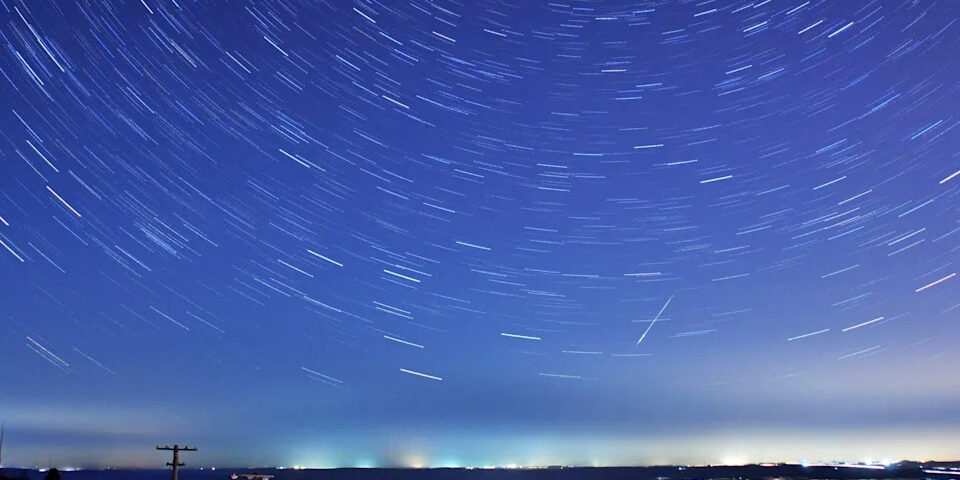
A meteor streaks past stars in January 2014 during the annual Quadrantid meteor shower in China.
A meteor shower is at its best when the Earth passes through the densest part of the associated cosmic debris. That window, otherwise known as the shower’s peak activity, is when stargazers will want to be on the lookout for meteors.
In 2026, the Quadrantid meteor shower is set to peak between Friday, Jan. 2, and Saturday, Jan. 3, according to the Planetary Society.
In general, the best time to see meteors are typically between midnight and pre-dawn hours.
Advertisement
Advertisement
But while most meteor showers have a two-day peak, the Quadrantids’ maximum activity only lasts a few hours – making the meteors much more difficult to spot, according to NASA. For stargazers, that means the best time to catch the Quadrantid meteors will be in the predawn hours, astronomers say.
Visit the website TimeAndDate.com to find the best times and viewing directions for your location.
How many meteors will be visible? What to know about shower rate
Under ideal conditions, about 25 Quadrantid meteors would be visible per hour, according to NASA. While the meteors are known to lack persistent tails, they often produce bright fireballs, which are larger explosions of light persisting longer than an average meteor streak.
Could the moon interfere with Quadrantids?
In 2026, a full moon will make it very difficult to witness any but the brightest streaking Quadrantid meteors during the shower’s peak. That means, expect to see fewer than 10 meteors per hour this year.
How to watch Quadrantids: Tips for seeing streaking meteors
The Quadrantids are best viewed from the Northern Hemisphere and are not well seen from the Southern Hemisphere.
Advertisement
Advertisement
The meteors seem to emerge – or radiate – from an obsolete constellation called “Quadrans Muralis” that today is located between the constellations of Bootes and Draco near the end of the handle of the Big Dipper, NASA says. Both the constellation and the meteor shower are named after the quadrant, an early astronomical instrument used to observe and plot star positions.
Astronomers caution that the radiant is not a good guide for where stargazers should look to view the streaking meteors, which should be visible across the night sky.
Here are some general viewing tips from NASA:
-
Find an area well away from street lights and the light pollution of cities.
-
Come prepared for winter temperatures with a sleeping bag, blanket or lawn chair.
-
Lie flat on your back with your feet facing northeast and look up, taking in as much of the sky as possible.
Advertisement
Advertisement
It should take less than 30 minutes for your eyes to adapt so that you can see streaking meteors.
Want to find a dark area near you? DarkSky International is a U.S nonprofit that maintains a list of designated dark sky communities around the world, including 169 in the United States.
What causes the Quadrantids? Are meteor showers ‘shooting stars?’
Meteor showers occur when Earth passes through dusty debris trails left by comets and other space objects as they orbit the sun.
The debris – space rocks known as meteoroids – collides with Earth’s atmosphere at high speed and disintegrates, creating fiery and colorful streaks in the sky, according to NASA.
Advertisement
Advertisement
Those resulting fireballs, better known as “shooting stars,” are meteors. If meteoroids survive their trip to Earth without burning up in the atmosphere, they are called meteorites, NASA says.
Unlike most meteor showers, the Quadrantid meteor shower doesn’t originate from a comet, but from an asteroid.
For many years, the origin of the Quadrantids remained unknown. Though the Quadrantids were first seen in 1825, it wasn’t until 2003 that an astronomer at Lowell Observatory in Arizona discovered a small asteroid, 2003 EH1, was the source of the shower.
Astronomers theorize that 2003 EH1, which takes about 5 ½ years to orbit the sun, is a dead comet that is now essentially a rock.
Advertisement
Advertisement
Eric Lagatta is the Space Connect reporter for the USA TODAY Network. Reach him at [email protected]
This article originally appeared on USA TODAY: Quadrantid meteor shower kicks off 2026. Time, date, how to watch