This post was originally published on here
Scientists puzzled by Comet 3I/ATLAS: Here’s why

3I/ATLAS delivers valuable insights into the composition of objects from beyond Solar System
By The News Digital
January 03, 2026
The interstellar comet 3I/ATLAS, the third confirmed object from outside the Solar System, passed closest to the Sun on October 30, 2025, revealing unusual water production. Observations by the SWAN instrument on the SOHO satellite captured intense hydrogen emissions, providing crucial data on the comet’s composition and activity.
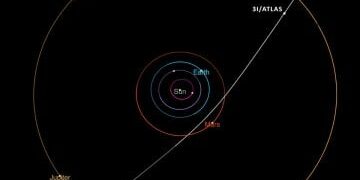
3I/ATLAS was first identified on July 1, 2025, by the Asteroid Terrestrial-impact Last Alert System (ATLAS). Its hyperbolic orbit confirmed an origin beyond the solar system, with an entry speed exceeding 30 km/s.
Teams immediately began working around the clock at NASA and the European Space Agency (ESA) to follow the interstellar visitor, placing its nucleus at anything from several hundred metres up to several kilometres across. As it drew close to the Sun, surface ices warmed, giving rise to a visible coma and two distinct tails, one dust, one ion.
Nine days past its closest approach to the Sun, on November 6, 2025, SWAN measured water release at about 3.17 × 10²⁹ molecules per second, enough to flood Olympic-sized pools in mere seconds.
The production tapered off as the comet receded, dropping down to roughly 10-20 trillion molecules per second by early December. The team coupled hydrogen images with solar ultraviolet data to ensure accurate, reliable measurements.
The coma and colour changes were documented by the Hubble Space Telescope and Gemini North, which showed that the comet developed a greenish tint caused by molecules such as cyanogen and dicarbon. Its nucleus remained intact, with about 20% of its ice actively sublimating, well above the 3–5% seen in typical Solar System comets.
Scientists frame it as evidence of primordial volatile preservation and offer a rarely opened window into how distant planetary systems might have formed.
3I/ATLAS now joins the ranks of 1I/’Oumuamua and 2I/Borisov, but it immediately stands out due to its rich water content and its rather active surface. Researchers also expect that the post-perihelion data will sharpen models on how interstellar objects form, how ices are preserved, and how comets make their way across the galaxy.
More From Technology News