This post was originally published on here
The rocket scientist behind Nasa’s Moon programme, Wernher von Braun, once stormed out of a press conference in disgust. He had just been asked by an enterprising British journalist whether he could guarantee that the Saturn V to be launched the next day would not land on London. The story is almost certainly apocryphal – a piece of gossip popular among journalists at the time – but still, it encompasses a poetic truth: everyone knew that von Braun had designed the Nazis’ V-1 and V-2 rockets, which terrorised London between 1944 and 1945, before he had been spirited away to the United States and reinvented as a space-travel pioneer.
What was less known in the 1960s – indeed, the Americans themselves had helped to cover it up – was that Braun had not been a mere apolitical physicist but an ardent Nazi. Through his rocket programme and its slave labour, he had presided over the deaths of tens of thousands. In 1944, he personally arranged the transfer of prisoners from Buchenwald concentration camp to enlarge his labour force. The journalist, if they were real, would have hit a nerve.
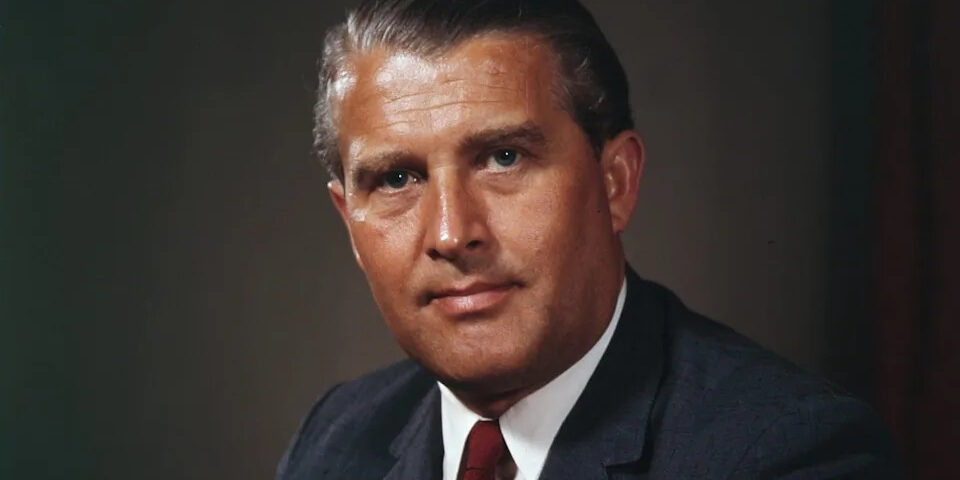
Von Braun had been an ardent Nazi and designed the V-1 and V-2 rockets that targeted London in the Second World War – Bachrach/Getty Images
There were hundreds more like von Braun, as Jacobsen’s rangy and newly reissued book, Operation Paperclip (2014), tells us. At the end of the war, the occupying Americans realised that the Germans were far ahead of them in areas of military technology, and wanted to pick their brains for the showdown with the USSR that everyone was sure was inevitable. They also wanted to prevent the Russians from getting their hands on the same men. So files on the top Nazi scientists were covertly passed through military and intelligence channels: if a person of interest might be implicated in war crimes, a paperclip was discreetly attached to the front page. That only meant they needed to be exfiltrated more quickly.
Advertisement
Advertisement
So it was that the US Army Chemical Corps employed former researchers from IG Farben, the chemical company that produced synthetic rubber with slave labour at Auschwitz, to help them manufacture huge stockpiles of sarin and tabun nerve gas. And so the Naval Medical Research Institute hired Dr Theodor Benzinger, who had personally helped screen, for Heinrich Himmler, a documentary film showing experiments in which prisoners were murdered by freezing or by being forced to drink seawater.
Among Nasa’s boffins was former Nazi Hubertus Strughold, a specialist in aviation medicine who had overseen murderous experiments on inmates at Dachau. (They were frozen to death in ice baths to see if they could subsequently be revived, or subjected to explosive decompression in specially built pressure chambers.) He became revered in the US as “the father of space medicine” and for many years an award was given in his name. There was also Walter Schrieber, who was taken to the US to work for the Air Force on classified research into biological warfare. Unfortunately for him, a few years later he was recognised by a young Holocaust survivor for having been present at Auschwitz when the legs of young women were deliberately broken and then infected with gangrene. The adverse publicity this attracted encouraged the Americans to help Schreiber safely emigrate to Argentina, where he lived out his days peacefully until 1970.
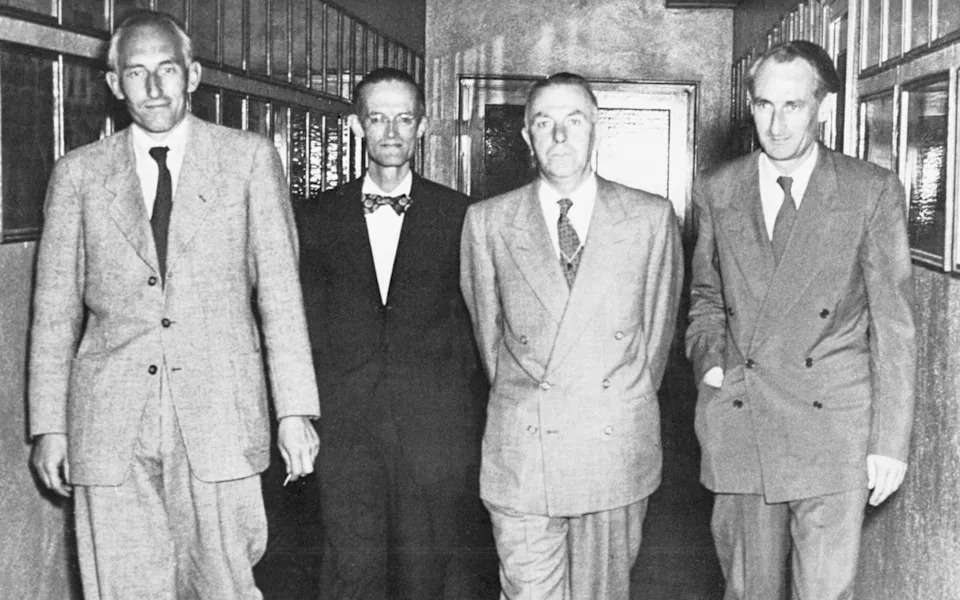
Original members of the first department of space medicine (L-R): Fritz Haber, Konrad JK Buettner, Hubertus Strughold and Heinz Haber – Bettmann
To be fair, one scientist – Benzinger – did later invent the ear thermometer during a long and celebrated medical career in the US. And some Operation Paperclip officials hoped to turn Nazi science to more humane ends. An American doctor named L Wilson Greene, conducting tests on Nazi nerve gases in 1947, observed that in small concentrations they simply disabled his volunteer soldiers for a week or two, after which they made a full recovery. Wouldn’t it be nicer, he reasoned, if wars could be conducted by such means, rather than by actually killing people? Alas, his visionary concept of “psycho-chemical warfare” didn’t stop people blowing other people up, but simply mutated into the CIA’s later obsession with brainwashing and mind control with hallucinogens.
It was only at the command of Richard Nixon in 1969 that the US ceased its Nazi-inspired proactive research into biological and chemical warfare. By the 1990s, more information about Operation Paperclip had come to light through the efforts of investigative journalists, but Annie Jacobsen updates the story skilfully with files declassified thereafter, archived journals and letters, and interviews with the families of some of the men involved, on both sides. There are some loose threads, which hadn’t been tied up when the book was first published: presumably it is being reissued, with a brief afterword, to profit from Jacobsen’s recently successful book, last year’s Nuclear War.
Advertisement
Advertisement
Like that book, Operation Paperclip combines indefatigable reporting, breathless thrillerisms and peculiar syntax. But in a way it has become newly topical, too. After all, the planet’s most famous rocket scientist today is Space X’s Elon Musk, who has been accused of giving a Nazi salute.
★★★★☆
Operation Paperclip is published by Penguin at £12.99. To order your copy for £10.99, call 0330 173 0523 or visit Telegraph Books