This post was originally published on here
“My cat always watches my phone as I text or read a book,” someone wrote on Reddit. “Even right now she is on my shoulder, intently watching what I am typing on this post. Can she read or is she just interested in what I am doing?”
Some non-human animals have shown a surprising ability to understand symbols, although—as we shall see—scientists resist calling this reading.
Symbol-savvy species
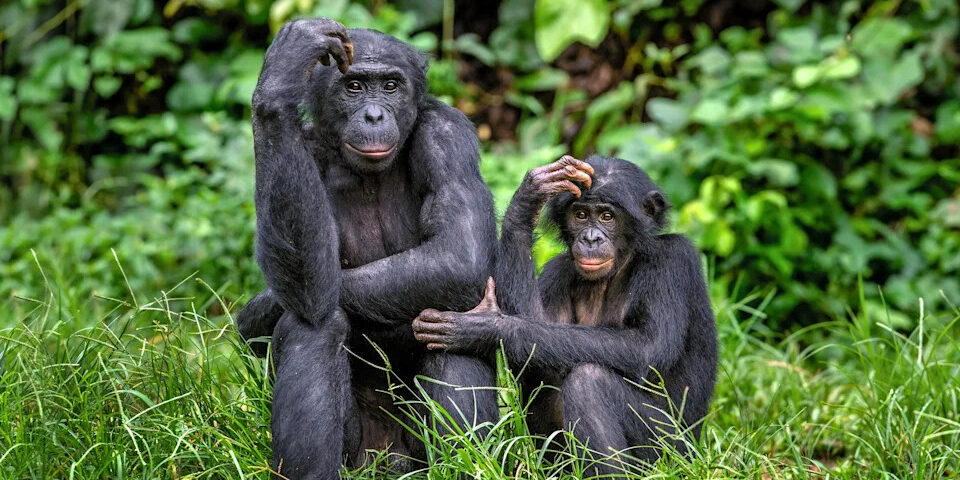
Take bonobos, for example. At the Ape Cognition and Conservation Initiative in Iowa, researchers have spent decades introducing these apes to pictorial symbols called lexigrams, representing everything from bananas to abstract ideas like “good.” Bonobos use the lexigrams, accessible via computerized touchscreens, to communicate with their human caregivers and visitors.
Advertisement
Advertisement
For example, they are able to request their favorite foods, indicate which social partners they want to be with, and ask their caregivers to play “water chase” with them (a game that involves running through misted water). Kanzi, who passed away this year at 44, was a superstar. He mastered hundreds of lexigrams and could combine them creatively—once calling a beaver a “water gorilla.”
Bonobos aren’t the only animals that can decode human-made symbols. A Goffin’s cockatoo named Ellie can tap a tablet-based speech board to communicate with her owner, Northeastern University researcher Jen Cunha. Ellie taps specific icons on the tablet to ask for sunflower seeds, requests “music” (specifically “piano” or “Beethoven”), and even expresses her delight after receiving treats by tapping the on-screen buttons to make the tablet say “yum” and “happy.”
Dolphins at the Roatan Institute for Marine Sciences in Honduras have been trained to read two-dimensional symbols as commands. For example, when shown a board with a wave symbol meaning “swim fast,” a dolphin called Cedana instantly does a quick lap in front of her trainers.
Pigeons can even learn to visually distinguish written words from nonsense words. In a study from New Zealand, researchers trained four pigeons to recognize dozens of words. The cleverest pigeon learned around 60 words, which it could distinguish from about 1,000 nonsense words. On a screen, each word appeared next to a star, and using food as a reward, the pigeons were taught to peck real words (e.g. GREY and SOON) and peck the star if the word was fake (e.g. GRRU and USKH).
Advertisement
Advertisement
Amazingly, the pigeons also noticed common letter patterns, allowing them to make educated guesses with words they had never seen before. Lead researcher Damian Scarf told NPR that many more animals with good vision could probably learn to recognize words, too.
Is it reading?
Does recognizing symbols—or even printed words—count as reading? Dr. Arik Kershenbaum, a zoologist and associate professor at the University of Cambridge, doesn’t think so. “Do you consider understanding road signs to be reading? Not really,” he says. “Reading seems to be a wholly linguistic phenomenon.”
Dr. Sue Savage-Rumbaugh, the pioneering researcher who first taught bonobos to use lexigrams, agrees that reading relies heavily on language skills.
Scientists see reading as a two-step process. First, your brain must decode words, turning letters into sounds. This involves picking up the sounds of language, spotting letter patterns, and understanding the building blocks of words.
Advertisement
Advertisement
Then, in the second step, your brain must make sense of those sounds, connecting them to meaning. This requires grasping sentence structure, word meanings, context, and how ideas link together across a text.
Because animals have a limited capability of understanding human language, they cannot “read” the way humans do.
Related ‘Ask Us Anything’ Stories
Why some animals eat their babies
How do snakes move? It’s not all slithering.
Why do horses have eyes on the side of their head?
How squirrels actually find all their buried nuts
Which animals can and can’t fart?
Even for humans, reading is not an inborn biological trait, but a relatively recent cultural invention. “Reading and writing themselves did not appear until about 5,000 to 6,000 years ago in Mesopotamia,” Savage-Rumbaugh says. “Homo sapiens appeared about 300,000 years ago,” she says. “So we were on Earth a very long time before we decided to ‘invent’ reading and writing.”
Advertisement
Advertisement
Savage-Rumbaugh says that ability to use language—and then read—stems from an individual’s lived experience and social context. In Kanzi’s case, his ability to use graphic symbols to communicate with humans emerged because he was raised in an environment where those symbols and humans were continuously present. “The [bonobo] infants reared without exposure to the forest or to human beings with whom they shared their daily lives, fail to acquire an understanding of spoken words and/or graphic symbols,” she says.
The bottom line? Scientists don’t equate symbol use in animals to “reading” in the human sense. Reading requires a deep understanding of human language, which animals lack.
So what about that Redditor’s cat? She was probably watching the screen because it moves, glows, or because she was curious about her human—not because she was decoding text.
In Ask Us Anything, Popular Science answers your most outlandish, mind-burning questions, from the everyday things you’ve always wondered to the bizarre things you never thought to ask. Have something you’ve always wanted to know? Ask us.