This post was originally published on here
China has been investing billions in nuclear fusion research. A potential game-changer for global energy, fusion has been slow to live up to promises, but now, Chinese scientists have reported yet another breakthrough in the process: a state of matter that was previously only theorized.
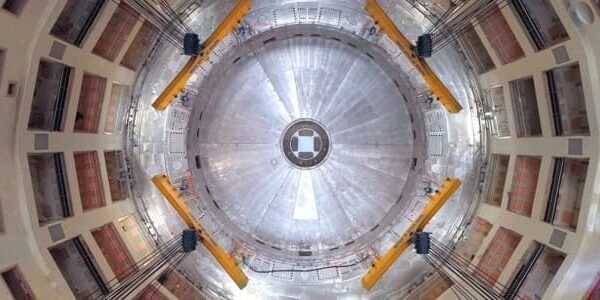
Reported in Science Advances, the breakthrough consisted in overcoming a limit in electron density that, if breached, disrupts the operation of the tokamak—the installation where fusion occurs. In a sense, the achievement appears to be one more obstacle cleared on the way to sustained fusion, which likely still remains years away.
“High plasma density operation is crucial for a tokamak to achieve energy breakeven and burning plasma,” the researchers wrote. “However, there is often an empirical upper limit of electron density in tokamak operation, namely, the Greenwald density limit, above which tokamaks generally disrupt. Achieving high-density operation above the density limit has been a long-standing challenge in magnetic confinement fusion research.”
Related: Oil Eyes Supply Disruptions as Venezuela Rebuild Talk Falls Flat
The reason for it being challenging is that at that upper limit, plasma becomes unstable and therefore unreliable, prone to spontaneous releases of energy, Xinhua wrote in a news release on the topic. That upper limit manifests at the boundary between the plasma and the wall of the tokamak. What the research team did was build a theoretical model of interaction between the plasma and the walls of the tokamak, and then used this model to experimentally manipulate the plasma so it goes beyond the Greenwald density limit without becoming unstable and releasing energy.
Advertisement
Advertisement
Effectively, the scientists proved experimentally the existence of what they call “a density-free zone,” previously only theorized. Of course, this does not mean that in a couple of years we will have fusion reactors all over the place, but it does mark another small step in the direction of a functional fusion reactor.
Fusion is the natural process that heats the Sun and all other stars, in which a huge amount of energy is produced by the fusion of light atoms, such as those in hydrogen, into heavier elements like helium.
Nuclear fusion has long been considered the answer to zero-emission, no by-product energy generation. However, no one has cracked the nuclear fusion code yet because of the challenges associated with the environment in which the process could take place. This is why research has been advancing slowly, prompting a lot of skepticism about whether it is at all possible on the scale that we need it.
China, however, seems to be upbeat, planning to have a functional fusion reactor by 2030. The country has spent as much as $13 billion on fusion research over the last three years alone. What’s more, it is not betting on only one fusion approach. There are three of these: magnetic confinement, inertial confinement, and magneto-inertial confinement. The first one, as the name suggests, uses magnets; the second one works with lasers. China’s existing tokamak works with magnetic confinement, but it is building another one, and there is speculation that that second one may utilize laser technology to achieve fusion—either that, or electric currents.
Advertisement
Advertisement
Nuclear fusion research and development have gained momentum in recent years after several momentous breakthroughs and achievements. However, major engineering challenges remain in bringing fusion from the realm of research to commercialization. There is also growing concern in the United States that China’s progress in the fusion field could secure a major advantage for the country in the future, putting the U.S. itself at a disadvantage.
“Fusion energy technologies must be developed and deployed by nations that uphold democratic values, transparency, and international cooperation—not by authoritarian regimes that might exploit energy dominance as a weapon,” the chair of the House Science, Space, and Technology Committee’s Energy Subcommittee, Republican congressman Randy Weber said last year in a speech seeking to prompt faster fusion research at home.
By Charles Kennedy for Oilprice.com
More Top Reads From Oilprice.com
Advertisement
Advertisement
Oilprice Intelligence brings you the signals before they become front-page news. This is the same expert analysis read by veteran traders and political advisors. Get it free, twice a week, and you’ll always know why the market is moving before everyone else.
You get the geopolitical intelligence, the hidden inventory data, and the market whispers that move billions – and we’ll send you $389 in premium energy intelligence, on us, just for subscribing. Join 400,000+ readers today. Get access immediately by clicking here.