This post was originally published on here
From a young age, William “Bill” McClure was fascinated with how things worked. He tinkered first with bicycles, then with cars, rebuilding a Ford from the axles up with his father.
When McClure was a high school senior, a recruiter from the California Institute of Technology visited him, and received a tour of McClure’s large traditional radio and ham radio collection. He didn’t use them to talk to anyone, McClure explained, he just liked understanding their mechanics.
His love of digging into the inner workings of things was the start of a long scientific career. McClure’s main research focus was the causation of schizophrenia, with the aim of developing better drugs to treat the disease. He also played a key role in the development of neuroscience programs and research at USC.
McClure, Professor Emeritus of Biological Sciences at the USC Dornsife College of Letters, Arts and Sciences, died July 24. He was 87.
Early to the field
McClure was born in Yakima, Wash., to Rexford McClure, a physician, and Ruth McClure, a nurse. In high school, he was a standout track and field athlete who set records that lasted nearly 30 years. McClure received a bachelor’s degree in chemistry and biology from Caltech in 1959 and a PhD in biochemistry from the University of Washington in 1964.
He was a post-doctoral fellow and assistant professor at The Rockefeller University in New York City from 1964 until 1968, when he moved to the University of Illinois Urbana-Champaign as an assistant professor in the biochemistry department.
In 1968, McClure participated in the first months-long research program hosted by the Neuroscience Research Program at the American Academy of Arts and Sciences offices in Boston, Mass. Founded by Francis Schmitt of the Massachusetts Institute of Technology in 1962, the program played a key role in establishing neuroscience as an academic discipline through its retreats and workshops.
The program also sparked McClure’s interest in the emerging field, although his department at the time wasn’t so keen on him pursuing the subject. When he was invited to launch a neuroscience institute at USC Dornsife in 1975, he jumped at the chance. McClure joined the faculty as a full professor in 1975 and stayed with the College until his retirement in 2013.
With then Dean of Natural Sciences Bill Wagner, McClure developed the Neural, Informational, and Behavioral Sciences program, which recruited leading scientists to USC to conduct research and teach. McClure also oversaw construction of the Hedco Neurosciences Building, which opened in 1989. His vision and administrative acumen were also instrumental to the subsequent creation of the Neuroscience Graduate program.
McClue held several patents and consulted and served as the vice president of scientific affairs for the Nelson Research and Development Company from 1972 to 1992. He was a member of several prestigious associations, including the American Association for the Advancement of Science. In 2003, he received USC’s Peer Achievement Award and the Presidential Medallion, the university’s highest honor.
“Bill’s intellectual leadership, collegial spirit and unwavering commitment to students and faculty alike have left a lasting legacy. His contributions to the advancement of USC’s neuroscience education will be remembered with deep respect,” says Chien-Ping Ko, Professor Emeritus of Biological Sciences, who co-taught a general education class with McClure.
A mentor and friend to many
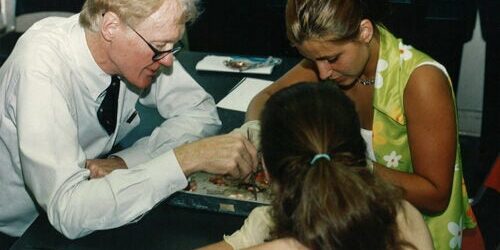
Throughout his career McClure was a popular teacher and dedicated mentor to students. Many stayed in touch for years after graduation. “There are several students I now call ‘brother’ and ‘sister’ because they were mentored by my dad and remained close with him for decades,” says his daughter Heather McClure.
As an undergraduate, Michael Khandelwal took a general education class with McClure. The two hit it off so well that Khandelwal worked as a teacher’s assistant for McClure for seven years. When he moved back to Virginia, he missed teaching so much he started The Muse Writers Center in Norfolk.
“Thinking back on it, if I had not met Bill, most of what I consider to be me or my life would not be the same,” says Khandelwal, who completed an interdisciplinary studies degree in 1991 and a master’s in professional writing in 2007.
Beth Zelonis Shou, who completed her bachelor’s in biomedical engineering at the USC Viterbi School of Engineering, first encountered McClure as her instructor in an introduction to biology class.
“I was so taken by the passion he had for teaching and science that I was determined to work in his lab. I spent four years working alongside Bill to discover a causation for schizophrenia — all while eating handfuls of M&Ms,” says Zelonis Shou. McClure’s mentorship inspired her to eventually become an emergency medicine physician. She is one of dozens of USC students who went on to become physicians and scientists thanks to McClure’s guidance.
“At the end of his career, he would often say to me that his mentorship and teaching of students were his greatest accomplishments,” says Heather.
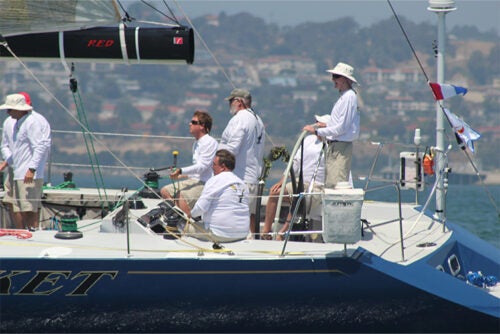
After retirement, McClure was program director and instructor with Thrive Scholars, which provides educational resources to high-achieving students from low-income schools. He also took up sailing and sailboat racing. He joined the Los Angeles Yacht Club, crewing three races from L.A. to Hawaii. He also co-founded the Offshore Racing Foundation to support sailors underrepresented in offshore sailing.
McClure is survived by his daughter, granddaughter, sisters, nieces and nephews, and his former wife Pamela McClure-Johnston. He was predeceased by his son Rexford McClure, and his second wife Sara Joan Rorke, who died in 2006.