This post was originally published on here
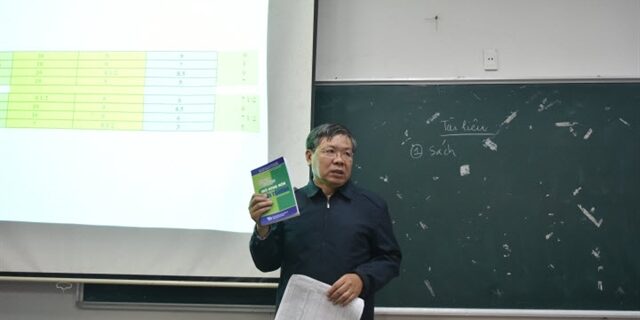
| Professor Bùi Tá Long. — Photo envim.net |
Professor Bùi Tá Long of the Key Laboratory of Digital Control and Systems Engineering at Việt Nam National University HCM City gives Nhân Dân (The People) newspaper an in-depth analysis of the current air pollution situation in Hà Nội, outlining underlying causes and urgent and long-term solutions.
Led by Long, the university’s Envim research group recently published the results of a study on fine particulate matter (PM2.5) pollution in the capital city in the Asian Journal of Atmospheric Environment.
As the leader of the research team and an expert in environmental studies, how do you assess the current level of air pollution in major cities and key economic regions?
Assessing pollution levels in major urban areas falls under the remit of the Ministry of Agriculture and Environment and its subordinate departments. From a research perspective, however, I believe air pollution in Hà Nội is severe. In the southern key economic region, particularly HCM City, the situation is also deeply concerning.
Air pollution, especially from ultrafine particles like PM2.5, is a serious global issue, particularly for densely populated cities like Hà Nội.
According to our calculations for 2023, a year in which Hà Nội’s economy rebounded after COVID-19, the daily average PM2.5 concentration exceeded the permissible limit (50 µg per cubic metre under QCVN 05:2023/BTNMT) on 100 days or 27.4 per cent of the year.
January 2023 recorded 27 out of 31 days above this standard, while April 2023 saw 17 out of 30 days exceeding the limit. The ‘cleanest’ month was July 2023, with only one day above the threshold. The calculations were based on modelling methods using modern tools widely applied internationally.
Based on your studies and monitoring data, what are the main emission sources, and how have rapid urbanisation and economic development contributed to the pollution?
In our studies on Hà Nội, the Envim research group (www.envim.net) adopted a modelling-based approach. We combined ground-based monitoring data from Hà Nội with a top-down method to construct an emissions inventory. Meteorological data were derived from global models and downscaled for the study area.
The top-down approach starts from atmospheric observations such as satellite data or sensor networks and uses atmospheric transport models to infer the emissions required to produce the observed concentrations. Its key advantage is comprehensive spatial coverage, including the detection of sources not captured in official inventories.
I would note that many Vietnamese colleagues use a down-up approach. In our view, each approach has strengths and weaknesses. We chose our method because down-up approaches depend heavily on the accuracy of socio-economic activity data and emission factors, and may miss sources that have not been fully inventoried.
Regardless of the approach, ground-based monitoring data are crucial. I recommend that relevant authorities reorganise and integrate data sources to provide scientists with valuable, high-quality measured datasets. Recent studies show that central Hà Nội is significantly affected by PM2.5 pollution. However, there is no conclusive evidence that the pollution is directly caused by emissions within the central area itself, particularly carbon monoxide (CO) from traffic.
Analysis indicates an inverse relationship between PM2.5 concentrations and CO emissions, as well as other precursors such as organic carbon (OC), black carbon (BC), nitric oxide (NOx), sulfur dioxide (SO2) and non-methane volatile organic compounds (NMVOCs) at site HN1 (central Hà Nội).
This suggests increases in these precursor emissions do not lead to higher PM2.5 concentrations at HN1, but instead show a positive correlation with PM2.5 levels in surrounding areas HN2 and HN3. This highlights the critical role of inter-regional traffic and transport within Hà Nội, which should be emphasised in pollution mitigation strategies.
Based on our research, we estimated total emissions in Hà Nội at 403,533 tonnes per year in 2023 from nine key precursors. The four largest contributors were CO at 159,944 tonnes per year (approximately 39.6 per cent), OC at 125,494 tonnes (31 per cent), BC at 64,679 tonnes (16 per cent), and NOx at 30,757 tonnes (7.6 per cent). Together, these four precursors accounted for 94.38 per cent of total emissions.
We also identified sectoral contributions. For CO, emissions came from industry (37 per cent), transport (34 per cent) and residential sources (21 per cent). For OC, industry contributed 45 per cent, residential sources 36 per cent and agriculture (rice straw burning) 15 per cent. For BC, industry accounted for 76 per cent, residential sources 11.4 per cent and transport 7.6 per cent. For NOx, industry contributed 78.7 per cent, transport 17 per cent and residential sources 2 per cent.
Our results reveal clear seasonal differences in pollution levels in the capital. During the dry season (November to April), PM2.5 concentrations ranged from 51.3 to 63.7 µg per cubic metre, while in the rainy season (May to October) they ranged from 30.45 to 39.67 µg per cubic metre.
We paid particular attention to central Hà Nội, concluding that while PM2.5 pollution levels are high, they cannot be conclusively attributed to local emissions. This underscores the importance of the movement of particulate matter from surrounding areas into the city centre. Hà Nội, therefore, needs to pay close attention to urbanisation and socio-economic development in suburban areas, as these can significantly affect air quality in the city centre.
Following the publication of your study, many people have suggested that Hà Nội’s air pollution is not caused by motorcycle use in the inner city. What is your view on this?
Our study should be interpreted in a comprehensive manner and supported by empirical data. The paper clearly shows the dominant role of industry and transport in the structure of PM2.5 precursor emissions in Hà Nội.
Transport contributes 34 per cent of CO emissions, less than industry at 37, while contributing only marginally for BC (7.6 per cent) and for NOx 17 per cent.
By contrast, industry is the largest emitter of three out of four key precursors, OC, BC and NOx, and also leads in CO emissions. Specifically, industry accounts for 37 per cent of CO, 45 per cent of OC, 76 per cent of BC and 78.7 per cent of NOx.
This demonstrates that industrial parks, industrial clusters and manufacturing activities are the decisive factors in Hà Nội’s emissions profile. Reducing industrial emissions would therefore yield the greatest benefits in lowering PM2.5 levels across the city.
Could you explain more clearly why your team was unable to demonstrate that local emissions are the main cause of fine particulate pollution in central Hà Nội?
Our paper presents five key conclusions. The fifth, which has attracted particular attention, states that although PM2.5 pollution levels in HN1 are high, they do not primarily originate from local emission sources, especially CO from traffic.
Statistical analysis shows that PM2.5 concentrations there have an inverse relationship with precursors such as CO, OC, BC, NOx, SO2 and NMVOCs. In contrast, in neighbouring areas such as HN2 and HN3, these precursors are positively correlated with PM2.5, indicating that these areas are the true sources influencing fine particulate pollution.
This contrast demonstrates that most PM2.5 in the city centre is transported from surrounding areas rather than generated locally. Inter-regional transport mechanisms must therefore be treated as a central factor in air pollution mitigation strategies.
I believe these findings should be further examined in subsequent years, as our study focused on Hà Nội in 2023, the post-COVID period. The paper has clearly identified the emissions contributions of five areas of Hà Nội to the city’s overall pollution profile.
From a professional perspective, which short-term and long-term measures are most urgently needed to sustainably control and improve air quality?
Short term measures include strengthening monitoring and early warning systems; expanding the monitoring network; publishing real-time AQI data to enable public self-protection; restricting private vehicles during peak hours; promoting public transport; and conducting regular vehicle emissions inspections.
Other short-term measures would be to require the covering of construction sites; limit open burning of rice straw and agricultural waste; encourage the use of clean fuels in households; and require factories to reduce output or temporarily suspend operations when emission thresholds are exceeded.
To mitigate the harmful effects of air pollution in the short term, authorities should also advise residents to wear masks and limit outdoor activities when air quality reaches hazardous levels.
Meanwhile, long-term measures include transforming production technologies; promoting renewable energy, such as solar and wind power; assessing and upgrading industrial combustion technologies; gradually phasing out petrol-powered motorcycles in central districts; developing metro systems, electric buses and green transport infrastructure; building modern wastewater treatment and solid waste collection systems; enhancing automatic pollution control equipment in industrial zones; and increasing green spaces and water bodies to absorb fine particles and reduce the urban heat island effect.
In short, solving Hà Nội’s air pollution challenge requires coordinated action. The State provides legal frameworks and infrastructure, businesses innovate and ensure transparent emissions, and communities change behaviour and participate in monitoring.
Only when all three act together, can Hà Nội move towards a green, clean and sustainable urban model. — VNS