This post was originally published on here
Most college students turn in assignments. The Texas A&M Food Science Club bottles theirs.
In the Texas A&M College of Agriculture and Life Sciences, the next generation of food scientists isn’t just learning how products are made in order to pass a class, they’re running a small-scale production line where they formulate, process and bottle their own sauces using industry-grade equipment.
With support from faculty, students in the Department of Food Science and Technology and the Texas A&M Food Science Club, the university’s chapter of the Institute of Food Technologists Student Association, IFTSA, have created a lineup of Aggie-made products.
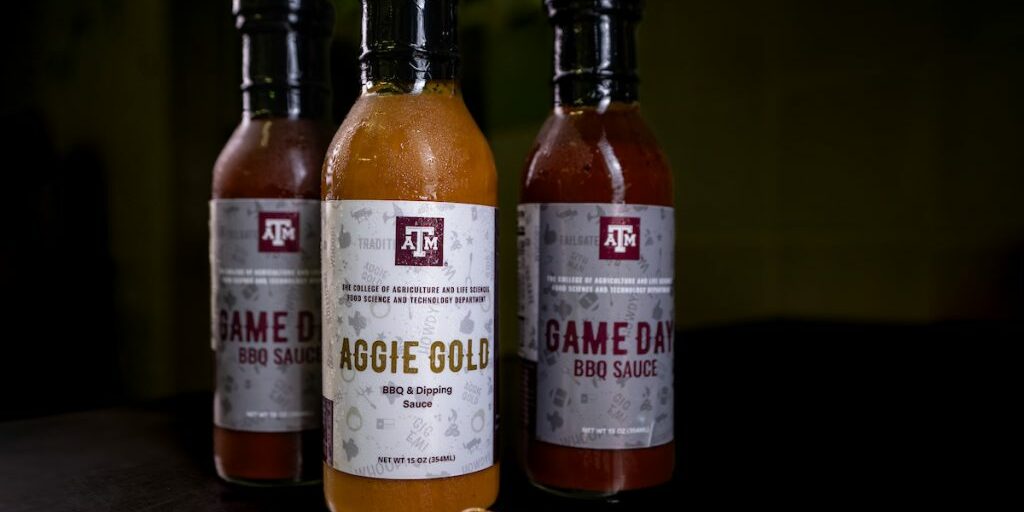
The collection includes Aggie Gold, a mustard-based BBQ sauce, along with a classic tomato-based variety called Game Day. A third flavor, Old Army, and a student-developed maroon lemonade are nearing release as well.
These products are made, bottled and sold by students who are learning the nuts and bolts of the food industry in real time.
“We are not just learning food science; we are applying it,” said junior Marcus Waskom ’27. “We develop the recipes, run the processing line and sell the final product.”
A classroom that runs like a plant
The operation centers around the department’s high acid hot-fill processing line. Installed in 2019, the system gives students direct experience with equipment similar to what they will encounter in commercial plants. The line was fully certified and ready for use in early 2020, though COVID delayed the launch.
“Some lessons cannot be replicated on a stovetop,” said Susanne Talcott, Ph.D., molecular researcher and professor in the department. “We know how Aggieland looks and feels and now we are exploring how Aggieland tastes.”
She and Stephen Talcott, Ph.D., professor of food chemistry, advise the students.
To get the students started, the Talcotts made sure their food processing equipment was technically sound and put regulatory food safety procedures in place to have a fully approved commercial operation.
They also brought in additional faculty from the Department of Food Science and Technology to advise students on food production operations, including Rebecca Creasy Buckley, Ph.D., an instructional associate professor, who assisted with food product development.
Matt Taylor, Ph.D., assistant professor of food microbiology and Alejandro Castillo, Ph.D., associate professor in food science, helped students with food safety testing and product monitoring. Both Taylor and Castillo have faculty appointments in the Department of Animal Science and Department of Food Science and Technology.
“We want students to run a pilot plant where they operate real equipment and create a product they can sell,” Stephen Talcott said.
Students produce the sauces and lemonade through various food science courses and the Food Science Club. They manage every stage of production: formulation, ingredient procurement, processing, bottling, labeling and compliance with food safety standards.
The hands-on learning comes with lessons theycannot get from lectures alone. In one instance, during an early batch, students forgot to pre-suspend their spices before adding them to a batch already loaded with ketchup and tomato paste.
Opening the powder mill released what Susanne Talcott described as a “mushroom cloud of paprika, onion powder and chili.” Everyone left sneezing, but no one forgot the lesson.
“That mistake only happens once,” she said. “Scale brings challenges you never see in class.”
From trial batches to finished products
Development starts in the Heep Building, where students meet twice a week to test flavors and troubleshoot. They scale successful recipes to full production in the pilot plant.
Currently, they are learning how heat, pH and storage conditions affect color and stability as they work to perfect a naturally colored maroon lemonade without artificial additives. The challenge is to create a color that lasts.
Junior Dane Handke ’27 said the process builds real industry skills.
“You learn how to respond when something goes wrong, how to adjust a formula and how to maintain quality,” he said. “It is the closest thing to working in a plant without being in one.”
Built by students, for students
“There is a long tradition of student-made food at Texas A&M,” Stephen Talcott said. “This brings that spirit back.”
The products are sold online and at campus pop-ups, with proceeds supporting the Food Science Club. As sales grow, the department hopes other student groups use the plant to produce custom-labeled batches for fundraising.
“My goal is to make this something that continues after we graduate,” Waskom said. “We want it to outlive us.”
Building future food innovators
Discover the high-impact opportunities that prepare Food Science and Technology students through immersive learning, real-time production and collaborative projects to lead the food science industry.