This post was originally published on here
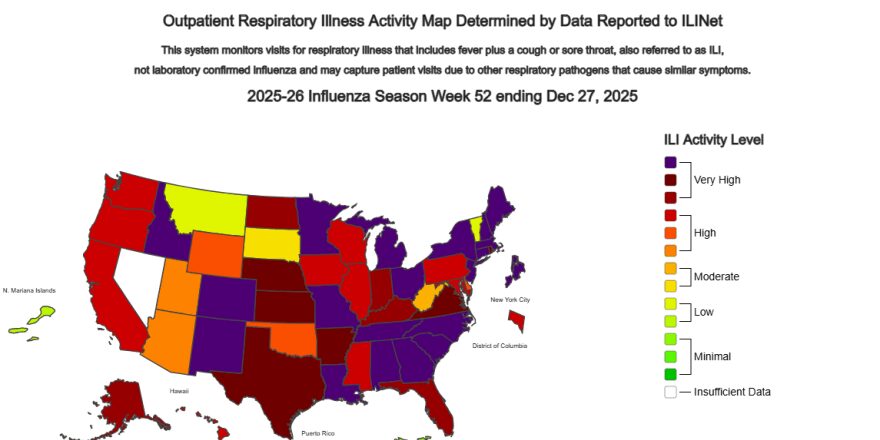
Influenza is circulating rampantly throughout Michigan and across the United States.
According to the most recent state Flu-Focus Report, 11.3% of Michigan’s out patient care visits were related to influenza. It increased by 7.5% from the week before.
Nationally, the CDC estimates 11,000,000 illnesses, 120,000 hospitalizations and 5,000 deaths have already been reported for the 2025-26 flu season.
Michigan Department of Health and Human Services Flu-Focus Report
/
Center for Disease Control and Prevention
Natasha Bagdasarian, chief medical executive for the State of Michigan, said the severity of flu season fluctuates each year, but health officials are attributing this season’s numbers to two main causes: a new variant of influenza and declining vaccination rates.
The variant, known as Subclade-K, has driven the number of cases up, Bagdasarian said. Initially, the medical community was concerned current vaccines would not protect against it.
“The early data from the UK showed that the vaccine is actually still quite protective in terms of keeping people out of the hospital,” Bagdasarian said, “which is one of the things that we really want to focus on, is keeping people out of the hospital, keeping them out of emergency departments and out of the ICU.”
Despite the vaccine’s effectiveness, Bagdasarian said growing amounts of people are going through the season unvaccinated. Data presented in the Flu-Focus report confirms that only 23.9% of Michiganders have received an influenza vaccine for the 2025-26 respiratory season. The state and national figures have been trending downward since 2020.
She said confusion between what the federal government says about vaccines and what medical providers say leads people to look at vaccines with distrust.
“There was a change in language around [the] influenza vaccine,” Bagdasarian said. “We were no longer seeing it being recommended to everyone. So that’s why in Michigan, we are following the science.”
With less and less people getting vaccinated, flu-like illnesses circulate more rapidly. The rise of flu-like illnesses is expected to continue to grow throughout the next few weeks.
“We know that the vaccine is effective, but if no one is using that vaccine or a significant portion of the population isn’t using that vaccine, then of course that protection isn’t there at all,” Bagdasarian said.
Michigan health care centers are seeing the effects of the surge first hand.
Tom Wood, the vice president and chief administrative officer at Midland’s MyMichigan Medical Center, said the health system has seen a noticeable rise in flu-like illnesses across different state facilities.
“This is nothing unusual for us to handle this time of year,” Wood said. “Although our hospitals are currently operating under normal conditions, there is a significant increase in demand for outpatient services that has lengthened overall wait times.”
Wood went on to say the best practices to avoid getting sick are getting vaccinated, practicing good hygiene and distancing from those experiencing flu-like symptoms.