This post was originally published on here
Fifteen-year-old Aoibheann Daly’s project “GlioScope: Multi-task Deep Learning and Causal AI for Glioma & Glioblastoma Profiling” was described by judges as an “extraordinary achievement” and a “stunning piece of work”.
GlioScope was designed to helps doctors identify specific genetic mutations present where there is a brain tumour, but there are currently no good methods for identifying these mutations. Doctors rely on taking samples of brain tissue, which is expensive, slow and carries a high risk of bleeding in the brain.
GlioScope allows a doctor to predict what genetic mutation is likely to be present from a simple MRI brain scan, so they can make quicker treatment decisions and reduce risk for the patient.
Professor Catherine Darker, head judge for the health and well-being category, said brain cancer is a devastating condition and GlioScope, “developed by a 15-year-old student, is an extraordinary achievement”.
She added: “Aoibheann has brought together scientific areas of medicine with computer science to improve the chances of early intervention for people with brain cancer.
“She is a worthy winner of the Stripe Young Scientist and Technologist 2026.”
Eileen O’Mara, chief revenue officer at Stripe, said it was “inspiring to see the incredible depth of talent displayed by all the winners of the various sections”.
“Aoibheann has taken a tragic health condition affecting hundreds of Irish families and applied cutting-edge science to move the field forward. It’s a stunning piece of work,” she said.
Aoibheann said her project stemmed from a short course she did in DCU when she was just a first year in primary school.
“We started learning about brain tumours, and specifically glioblastoma. And it kind of shook me. It was 2023, and I thought why is the survival rate only 5.1pc, the five-year survival rate? And so I knew how to code, so I was wondering could I combine these two and help somehow. So that’s kind of what led to development of my project,” she said.
“My project focused on adult diffused gliomas. They’re a really aggressive type of brain cancer, really poor outcomes. So one of the biggest problems with treating them is you have to determine the genetics before you can determine optimal treatment, but this requires an invasive biopsy that takes weeks to come back.
“So my solution was GlioScope. It enables Day Zero decision making by predicting WHO grade, patient survival and genetics directly from pre-operative MRI scans, and then it determines the tumour subtype using an established rubric criteria.”
Principal of Mercy Mounthawk Secondary School Pat Fleming said: “It’s been coming for a while. Aoibheann has been coming for a while, right since first year when she was in first year asking her teacher could she have some university level physics questions to practice on at home.
“The talent was always there, getting the right project behind it and she’s really passionate about it and knowledgeable about it.
“The way she was able to develop it on this year to a whole other level was amazing. “
The project is a continuation of Ms Daly’s entry into the competition last year, which she took home a category award for.
The Stripe YSTE trophy was presented to Aoibheann this evening by Education Minister Hildegarde Naughton and Stripe co-founder, and former Young Scientist winner, Patrick Collison.
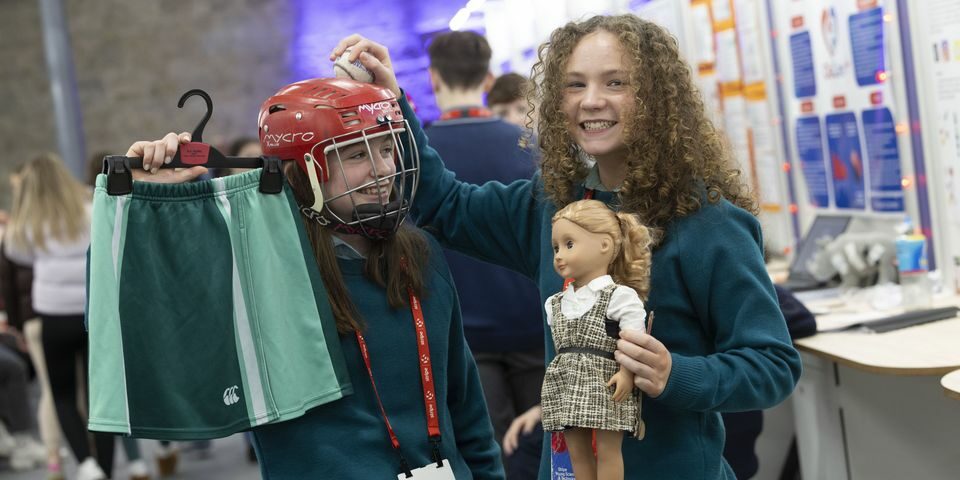
Students Alice Brosnan and Isla Conlon from Mount Anville Secondary School in Dublin with their project on the topic of skorts. Photo: Sam Boal/Collins Photos
In addition to receiving the grand prize of €7,500, she will go on to represent Ireland at the European Union Contest for Young Scientists in Kiel, Germany, in September 2026.
Students from 221 schools with 550 projects competed for over 200 prizes.
Aoife Fadian and Jessica O’Connor, fifth-year students from Ursuline College in Sligo, were named Best Group for their project “Sheep Strength II: Using Sheep Wool to Reinforce Concrete”.
Expanding on their work from last year, the pair investigated the most effective, market-friendly form of sheep wool as a strengthening agent for concrete.
Barry Kennedy, head judge for the technology category, said: “This novel use of wool has the potential to enable the manufacture of more sustainable concrete, enable new forms of thermal batteries, and open new business opportunities for sheep farmers in Ireland.”
Joshua Corbett, a sixth-year student from St Mary’s CBS in Laois, won Individual Runner-Up, with his project “There’s Plenty of Room To Break Through at the Bottom”.
It identifies tiny nanocarriers for drug delivery administered through the nose to treat brain cancer.
Judge Dr Rachel Quinlan said his project “can guide the next practical steps in the development of treatments leading to better outcomes.”