This post was originally published on here
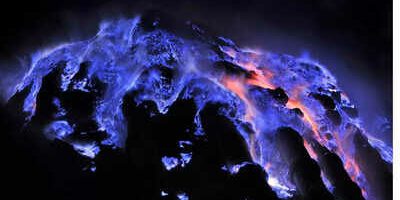
Few natural wonders are as breathtakingly surreal as the electric blue flames dancing across Indonesia’s Kawah Ijen volcano. Unlike the familiar red-orange glow of molten lava, this volcano gives off an electric blue illumination at night that attracts photographers, travellers, and scientists worldwide. This phenomenon is not a result of lava itself but a product of burning sulfuric gases at very high temperatures, resulting in a neon-blue blaze visible against the dark landscape of the crater. More than just the visual, this rare display underlines a complex geological process and the hazardous conditions that the local miners have to put up with to extract sulfur, making Kawah Ijen a human story besides being a natural wonder.
Why Kawah Ijen’s lava appears bright blue
Typically, when people think of volcanic lava, they picture liquid lava with a reddish hue because of its higher temperatures. However, in Kawah Ijen crater, nothing could be farther from the truth because the blue illumination has nothing to do with volcanic lava. Sulfur vapours emit from fissures in the crater with a temperature of more than 600 °C (1,112 °F). Upon encountering oxygen, the Sulfur vapors immediately ignite and burn with a blue flame. The higher temperature of Sulfur vapors is responsible for the “blue lava” phenomenon because it appears as if there is blue lava when, in fact, lava is of its regular colour.As per ZME Science, the blue flames are accompanied by a phenomenon known as the Cerulean eruption, a process in which molten sulfur flows down the slopes of the volcanoes. Upon burning, the sulfur turns to liquid and flows down the volcanoes like a river, giving it a neon-like effect. In turn, the process has been referred to by its name due to its rare nature, as it occurs in a handful of locations around the globe, one of which is Ethiopia’s Danakil Depression. Taking a photo of the phenomenon, as explained by photographers, feels more like a piece from a sci-fi movie than nature.
Hidden dangers behind Kawah Ijen’s blue flames
Although the blue flames are a sight to admire, they also illustrate the level of danger that the Kawah Ijen miners encounter regularly.
- These miners dig for sulfur in a poisonous environment, with minimal protection against the choking smoke emanating from the ground.
- They usually protect themselves with damp cloth masks, which provide little protection for their faces against the burning gas.
- Afterwards, once the sulfur has solidified, the miners haul heavy wicker baskets full of sulfur, scaling steep mountain sides, a very arduous and risky endeavour.
- This sulfur, which has come to be nicknamed ‘Devil’s Gold’ for its valuable qualities, is essential for industrial applications, with the chemical serving as a basis for fertilisers and other chemicals.
Why scientists study the blue flames
There is much more to Kawah Ijen than meets the eye of a photographer or tourist. The blue flames of Kawah Ijen also serve as important scientific study material. It is rare to see such a set of conditions coming together. The presence of magma, water, and escaping sulfuric gases gives scientists important material to study. Such a study helps scientists understand gas emanations, chemical reactions, and the danger to humans and the environment. Kawah Ijen is one such instance where natural beauty, science, and human survival meet on the edge of risk.