
This post was originally published on here
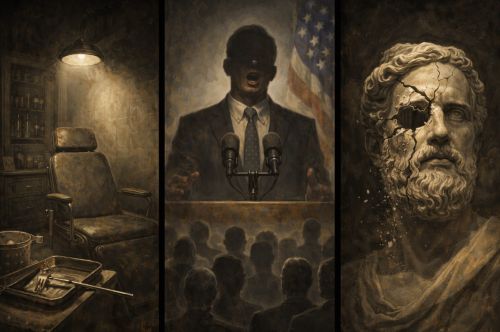
History does not repeat itself mechanically, but it does echo with unsettling clarity. History is warning us again, not to silence dissent, but to demand responsibility.

By Matthew A. McIntosh
Public Historian
Brewminate
Introduction
For much of the twentieth century, Walter Freeman was celebrated as a medical innovator. A neurologist without surgical training, he became the most visible advocate of the prefrontal lobotomy, promoting it as a miracle cure for mental illness at a time when psychiatry had few effective treatments. Freeman’s confidence was unshakable, his certainty theatrical. He toured the country in what became known as the “lobotomobile,” performing thousands of procedures using an ice pick–like instrument inserted through the eye socket, a method now widely recognized as catastrophic and unethical. Today, Freeman’s legacy is remembered not as progress, but as a cautionary tale of medicine unmoored from evidence and accountability.
The damage Freeman left behind was immense. Many patients were rendered permanently disabled, emotionally flattened, or cognitively impaired. Some were left in vegetative states. An estimated hundreds died as a direct result of the procedure, while countless others lost the ability to live independently. None of this stopped Freeman at the time. His authority was rarely questioned, his critics marginalized, and his methods tolerated by institutions desperate for solutions. The problem was not simply a bad idea, but a system that mistook confidence for competence and speed for success.
That history matters now because we are watching a disturbingly familiar pattern unfold in public health. Robert F. Kennedy Jr. has spent years promoting claims that link vaccines to autism despite overwhelming scientific evidence to the contrary, a myth long debunked by large-scale studies and public health agencies (CDC on vaccines and autism). He has promoted unproven alternatives during measles outbreaks, attacked the credibility of federal health institutions, opposed water fluoridation despite decades of supporting evidence, and advanced speculative claims blaming technologies like Wi-Fi for depression while encouraging skepticism toward established mental health treatments.
The comparison is not rhetorical excess. Freeman and Kennedy operate in different eras, but the mechanism is the same. Both present themselves as truth-tellers battling a corrupt establishment. Both dismiss expert consensus while asserting moral clarity. Both gain influence not despite their rejection of evidence, but through it, by appealing to fear, distrust, and the seductive promise of simple explanations. We have seen this movie before. History shows that when anti-science certainty is granted authority, the ending is never liberation. It is damage, denial, and regret.
Walter Freeman and the Seduction of Certainty
Walter Freeman’s appeal rested less on evidence than on assurance. At a time when psychiatric hospitals were overcrowded and treatments for severe mental illness were limited, Freeman offered decisiveness. The lobotomy was fast, dramatic, and framed as compassionate intervention rather than experimentation. Freeman spoke with absolute confidence about outcomes, dismissing criticism as obstructionism and doubt as cruelty toward suffering patients. In an era desperate for solutions, certainty itself became persuasive.
That certainty traveled with spectacle. Freeman famously performed lobotomies in front of audiences, sometimes dozens in a single day, wielding an ice pick–like instrument through the eye socket in minutes. The procedure required no operating room and little anesthesia, which Freeman touted as proof of its elegance and accessibility. His nationwide tours in the so-called “lobotomobile” turned medicine into performance, reinforcing the illusion that speed and simplicity were virtues rather than warnings.
Evidence that contradicted Freeman’s claims accumulated quickly. Many patients lost basic cognitive and emotional functions, becoming apathetic, childlike, or unable to live independently. Families reported profound personality changes and irreversible damage. Yet Freeman continued, reframing failures as acceptable trade-offs and portraying critics as naïve idealists unwilling to confront reality. The absence of meaningful oversight allowed this narrative to persist long after harm was evident (history of lobotomy outcomes).
What made Freeman dangerous was not malice, but conviction. He believed deeply in his own correctness and treated dissent as moral failure rather than scientific disagreement. Institutions enabled him because his confidence aligned with their needs: quick fixes, visible action, and the appearance of progress. The lesson of Freeman’s rise is not simply that bad ideas can spread, but that certainty, when mistaken for truth and paired with authority, can overwhelm evidence itself.
How Bad Science Becomes Policy
Bad science rarely announces itself as such. It enters public life clothed in urgency, necessity, and moral purpose. In Walter Freeman’s era, lobotomy was defended not because it worked well, but because institutions needed something to work at all. Overcrowded hospitals, limited budgets, and political pressure created a climate in which action mattered more than validation. Freeman’s procedures were fast, visible, and decisive, qualities that appealed to administrators far more than slow, uncertain clinical research.
Policy followed performance. Hospitals adopted lobotomy not after rigorous trials, but after watching Freeman demonstrate it. Courts accepted it as a legitimate medical intervention. Families were told it was the best available option. The absence of standardized oversight meant that once an idea gained institutional momentum, it could propagate without meaningful challenge. By the time outcomes were impossible to ignore, lobotomy had already been normalized across the country.
A similar pattern appears whenever authority substitutes narrative for evidence. Bad science becomes policy when charismatic figures frame dissent as obstruction and complexity as elitism. Freeman did this relentlessly, portraying critics as sentimental and irresponsible. He positioned himself as the only adult in the room willing to make hard choices. This rhetorical strategy insulated him from accountability and reframed harm as unfortunate but necessary collateral (history of medical paternalism).
Institutions often cooperate in this process because uncertainty is politically inconvenient. Admitting that knowledge is incomplete undermines confidence and exposes liability. It is far easier to elevate a confident voice than to defend nuance. Once embedded in policy, bad science acquires a defensive perimeter: careers depend on it, reputations are invested in it, and reversing course becomes an admission of failure. Evidence is no longer evaluated neutrally; it is filtered through institutional self-preservation.
The most dangerous moment is not when bad ideas are proposed, but when they are enforced. Freeman’s methods crossed that threshold when they became routine practice rather than experimental gamble. At that point, skepticism was no longer academic; it was ethical. History shows that when policy is built on certainty rather than evidence, correction comes only after damage accumulates. The cost is measured not just in statistics, but in lives permanently altered by authority that refused to slow down.
Enter RFK Jr.: The Modern Parallel
Robert F. Kennedy Jr. has built his public profile not through medical training or scientific research, but through sustained attacks on scientific consensus. For years, he has promoted the claim that vaccines are linked to autism, despite decades of large-scale studies finding no such connection. That claim has been repeatedly rejected by public health authorities and researchers, including the U.S. Centers for Disease Control and Prevention, which states plainly that vaccines do not cause autism (vaccines and autism). Like Freeman before him, Kennedy frames himself as a lone truth-teller standing against a corrupt establishment.
Kennedy’s influence extends beyond rhetoric. During measles outbreaks, he has promoted unproven or ineffective alternatives while questioning established vaccination guidance, messaging that public health experts warn can undermine outbreak control. Measles, once nearly eliminated in the United States, has resurged in communities with declining vaccination rates, a trend closely tracked by global and national health agencies. The consequences of such messaging are not theoretical; they are visible in preventable illness and death.
His attacks have also targeted public health institutions themselves. Kennedy has repeatedly accused federal health agencies of corruption and malfeasance, portraying regulatory science as captured and untrustworthy. This strategy mirrors Freeman’s dismissal of critics as obstacles rather than interlocutors. By eroding trust in institutions without offering credible alternatives grounded in evidence, Kennedy substitutes suspicion for scrutiny and grievance for peer review.
The pattern widens further. Kennedy has opposed community water fluoridation despite its long-established role in reducing tooth decay, a position rejected by major medical and dental organizations. He has also promoted speculative claims linking everyday technologies such as Wi-Fi to depression and other health problems, assertions unsupported by credible scientific evidence. These claims follow a familiar trajectory: identify a modern anxiety, assign a technological villain, and position skepticism as courage.
Perhaps most troubling is the way Kennedy’s messaging intersects with mental health. By encouraging distrust of established medical guidance and casting doubt on evidence-based treatment, he risks pushing vulnerable people away from care that is known to help. As with Freeman, the danger lies not only in individual claims, but in the authority conferred by confidence. When anti-science narratives are delivered with moral certainty and amplified through media and political platforms, they begin to function as policy by proxy. The parallel is not perfect, but it is unmistakable: confidence without evidence, once again, is being mistaken for leadership.
Fluoride, Wi-Fi, and the Expansion of Mistrust
One of the defining features of Kennedy’s public health rhetoric is its tendency to widen distrust rather than focus it. Opposition to vaccines has not remained an isolated concern but has expanded into a broader skepticism toward multiple pillars of modern public health. Water fluoridation is a clear example. Despite decades of evidence showing that fluoridation significantly reduces tooth decay without causing systemic harm, Kennedy has argued against it, framing the practice as a form of mass exposure imposed without consent. This position places him at odds with major medical, dental, and public health organizations worldwide.
The same pattern appears in Kennedy’s claims about everyday technology. He has suggested, without credible evidence, that Wi-Fi and wireless radiation contribute to depression and other mental health problems. Extensive scientific reviews have found no reliable link between Wi-Fi exposure and mental illness, yet such claims resonate in an environment already primed for suspicion toward invisible forces and technological change. By elevating speculation to the level of warning, Kennedy reinforces the idea that modern life itself is inherently toxic and poorly understood.
This expansion of mistrust has cumulative effects. When multiple evidence-based practices are presented as suspect, the result is not informed skepticism but generalized doubt. Public health guidance becomes just another opinion, and scientific consensus is reframed as groupthink. In this climate, individuals are encouraged to see themselves as besieged truth-seekers navigating a hostile system rather than participants in a shared effort to reduce harm. The erosion of trust is broad, not targeted, and it spreads across domains that have little connection beyond rhetorical framing.
The danger lies in what follows from that erosion. Once institutions are dismissed wholesale, evidence loses its anchoring function. People are encouraged to rely on intuition, fear, or ideological alignment rather than expertise. This mirrors earlier moments in medical history when skepticism slid into rejection and rejection into harm. Freeman’s patients paid the price of misplaced certainty in the past. Today, the cost of expanding mistrust is borne by communities navigating preventable disease, untreated mental illness, and policy shaped by suspicion rather than evidence.
Why the Freeman Comparison Matters
Comparisons between historical and contemporary figures often risk oversimplification, but the parallel between Freeman and Kennedy is not rhetorical excess. It rests on a shared pattern of authority exercised without adequate respect for evidence. Freeman was convinced he was alleviating suffering, just as Kennedy insists he is protecting public health. In both cases, certainty functions as a substitute for proof, and moral conviction replaces methodological restraint.
Freeman’s defenders once argued that he should be judged by the standards of his time, that psychiatry lacked better tools and that his intentions were humane. That defense collapses under scrutiny. Even within his own era, critics warned of harm, questioned outcomes, and urged caution. What Freeman rejected was not future knowledge, but contemporary criticism. The danger was not that science later moved on, but that Freeman refused to slow down when evidence demanded it.
The same mechanism is at work when modern figures dismiss overwhelming scientific consensus as corruption or conspiracy. Kennedy does not merely question specific studies; he undermines the legitimacy of the institutions that produce them. This is precisely how bad ideas gain durability. Once expert disagreement is framed as moral failure or institutional rot, evidence loses its corrective power. Authority becomes self-sealing, insulated from challenge by the claim that challenge itself is proof of persecution.
The Freeman comparison matters because it reminds us that harm often arrives wearing the language of reform. Freeman was not stopped by outrage but by accumulation of damage so undeniable it could no longer be ignored. History does not judge him kindly, nor does it excuse the institutions that enabled him. The lesson is not that dissent is dangerous, but that dissent wielded as certainty, combined with power, is. When skepticism hardens into crusade and authority replaces accountability, history shows us exactly how the story ends.
The Cost of Anti-Science Leadership
The most immediate cost of anti-science leadership is confusion. When prominent figures repeatedly contradict established evidence, the public is left unsure whom to trust. Vaccines, water safety, and mental health treatments become matters of opinion rather than evidence. This erosion of clarity does not produce healthy debate; it produces paralysis. In public health, hesitation is not neutral. It delays action, weakens prevention, and allows preventable harm to spread.
That confusion translates quickly into measurable outcomes. Communities with declining vaccination rates have seen the return of diseases once considered under control. Measles outbreaks, documented by global health agencies, track closely with misinformation and distrust rather than with new scientific discoveries. Each outbreak is a reminder that public health relies on collective participation. When leadership undermines confidence in evidence, individual doubt becomes communal risk.
The damage extends beyond infectious disease. When figures in authority cast doubt on water fluoridation, they invite communities to abandon one of the most effective and inexpensive public health measures ever implemented. The scientific case for fluoridation’s safety and benefit is longstanding, yet suspicion alone can be enough to derail policy. The result is higher rates of tooth decay, disproportionately affecting children and low-income families. Anti-science leadership often harms those with the fewest resources first.
Mental health is particularly vulnerable to this dynamic. Encouraging skepticism toward established treatments or framing medications as inherently dangerous can push people away from care that is known to reduce suffering and save lives. While questioning overprescription is a legitimate conversation, broad distrust of mental health medicine carries serious consequences. When authority figures blur the line between caution and rejection, individuals already struggling may forgo help entirely, with devastating results.
There is also a long-term institutional cost. Public health depends on trust built slowly through transparency, accountability, and demonstrated results. Once that trust is fractured, rebuilding it is extraordinarily difficult. Agencies forced to defend basic facts spend less time improving systems and more time countering misinformation. Expertise becomes politicized, and evidence is evaluated through ideological filters rather than methodological rigor.
History shows that societies pay dearly when evidence is subordinated to certainty. Walter Freeman’s legacy is measured in ruined lives and institutional shame. Anti-science leadership today risks repeating that pattern on a broader scale, not through surgical instruments but through policy, rhetoric, and erosion of trust. The cost is not theoretical. It is counted in preventable illness, untreated suffering, and the slow dismantling of the shared factual ground on which public health depends.
Conclusion: History Is Warning Us Again
History does not repeat itself mechanically, but it does echo with unsettling clarity. Walter Freeman was not stopped because his ideas were immediately recognized as dangerous. He was stopped only after the damage became impossible to deny. Institutions that once celebrated his confidence quietly distanced themselves, and the people harmed by his certainty were left to live with consequences no apology could undo. The pattern is familiar: authority elevated, evidence sidelined, correction delayed until the cost is irreversible.
What makes the present moment so troubling is not disagreement, but inversion. Skepticism is healthy when it sharpens evidence; it is corrosive when it replaces evidence. When leaders encourage distrust of vaccines, public health agencies, fluoridation, or mental health care without offering rigorously supported alternatives, they do not empower the public. They abandon it. The language of courage and reform becomes a shield against accountability, and uncertainty is weaponized rather than resolved.
History is warning us again, not to silence dissent, but to demand responsibility from those who wield influence. Science advances through challenge, replication, and correction, not crusades fueled by suspicion. Freeman believed he was right. So do many who come after him. The lesson is not that confidence is dangerous, but that confidence without evidence, amplified by power, always is. When authority outruns accountability, the ending is never discovery. It is regret.
Originally published by Brewminate, 01.11.2026, under the terms of a Creative Commons Attribution-NonCommercial-NoDerivatives 4.0 International license.