This post was originally published on here
The presidential elections take place in autumn this year.
Finding a candidate amenable to all Riigikogu members is proving practically impossible. On the one side lies the Reform–Eesti 200 governing coalition together with their former partners in office, the Social Democrats (SDE). All of them hope to get the next president elected by the Riigikogu. On the other is the rest of the opposition: Isamaa, the Center Party and the Conservative People’s Party of Estonia (EKRE).
Their favored candidate is more likely to be made president via the electoral college. In any case, a unified candidate is not going to happen, experts say.
“It is also totally unrealistic that the governing coalition would want to go and reach an agreement with them. I think there is no such will on either side. This does nothing to support the run-up to parliamentary elections [in 2027],” said political expert Annika Arras.
University of Tartu political scientist Martin Mölder said the governing parties will have to make a strong effort for their candidate to make it through in the Riigikogu. Current approval ratings indicate that Isamaa chair Urmas Reinsalu is likely to become the next prime minister.
“The moment of the presidential election may be, for the current coalition parties, perhaps the last opportunity to fill one very important office with a person suitable to them,” Mölder said.
SDE hold the balance of power, along with a few independents, if the required two-thirds of the Riigikogu (68 votes) is to be attained to elect a president. This will require some diplomacy on the part of Reform, bearing in mind SDE was expelled from the last coalition in spring 2025. Eesti 200 has languished with very low ratings for many months now. However, according to Tallinn University political scientist Tõnis Saarts, inter-party diplomacy has not been one of Reform’s strong suits.
“Looking at the Reform Party’s diplomatic skills in previous undertakings, I am not at all certain they will manage,” Saarts said.
According to political expert and head of the Liberal Citizens Initiative (SALK) Tarmo Jüristo, “SDE should also take into account that they can have a real say in choosing the president only at the Riigikogu. With the electoral college, their voice will be weaker. Should they decide there to dig in their heels and pull an agreement strongly in their own direction, then they will have to choose who they want to reach a deal with, as in the assembly of electors it will be necessary to come to an agreement rather with Reinsalu.”
If the president is not elected by the Riigikogu, in other words if the rounds of voting fail to reach the 68-vote threshold, the process to choose the next head of state moves to the regional electoral college. This comprises representatives of local governments as well as MPs, relating to the electoral district they were returned by at the 2023 Riigikogu election.
Isamaa got more candidates into local councils than any other party at last fall’s local elections, and Center is strong there too.
“I think that for Estonia’s overall public mood and health it would be good if this agreement were reached at the Riigikogu, because that would avoid a stronger and more polarising debate which would then start moving from village to village if it were to go to the electoral college,” Arras noted on this.
Mölder, however, believes it would be more appropriate for the decision to be made by the electoral college, since the political balance of power in the regions corresponds more closely to voters’ current preferences, not least because the mandates are fresher.
“The local elections took place only recently, meaning this distribution of political power at the local level reflects voter preferences much better. And so, let us say, the electoral college could choose a president who is closer to voters’ preferences,” Mölder said.
This year’s presidential election is taking place at a difficult time also, the political scientists say. The campaign for the 2027 Riigikogu elections is about to get underway.
“The parties have a very strong temptation to play their own games here and gain glory for themselves, to show that they made the president and that they are now the presidential party,” Saarts said.
A similar situation existed exactly 20 years ago. In 2006, attempts to find a common candidate foundered. Parties made agreements, both openly and more discreetly, for the upcoming parliamentary elections. While the public cannot elect the president, politicians conducted a presidential campaign in the streets. Signatures were collected and doors were slammed shut in indignation. On September 23, the electoral college elected Toomas Hendrik Ilves as president.
So who could become the head of state now? Former MEP Indrek Tarand and current Reform Party MEP Urmas Paet, for one thing, have put themselves forward.
“Behind such confident statements there should also be a plan as to where the support will come from and what steps will be taken to move toward that result,” Arras said.
Among the names put forward by other politicians and the press pack are most of the other seven MEPs, notably Marina Kaljurand (SDE), who ran for the office in 2016, Riho Terras (Isamaa), Sven Mikser (SDE) and Jüri Ratas (Isamaa), a former prime minister, as well as former prime minister and former MEP Andrus Ansip. Then there are former ministers Jaak Aaviksoo and Jüri Luik, the latter Estonia’s ambassador to NATO, as well as Reinsalu. Much of this may be testing the waters, however.
“This is more like so-called groundwork or creating a feel for how the land lies. I think that at the moment no one really knows who the actual candidate ultimately is or is not,” Mölder said.
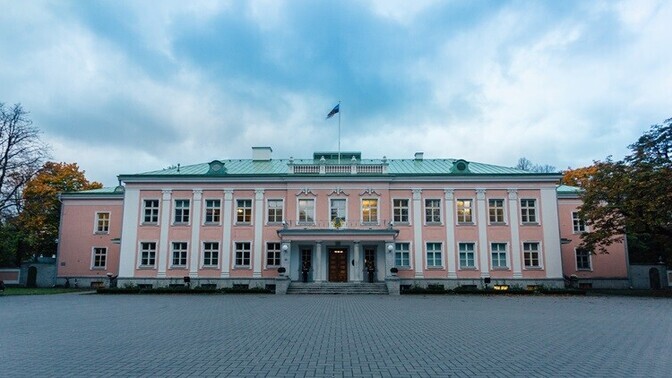
There is also the option of choosing from among non-partisan public figures. Such options could include Chancellor of Justice Ülle Madise and Auditor General Janar Holm, as well as Foreign Ministry Secretary General Jonatan Vseviov and diplomat Matti Maasikas. Kersti Kaljulaid, president 2016–2021, is eligible for a second term and has also been mentioned, as well as former justice chancellor and former presidential candidate Allar Jõks, and ex-EU commissioner Kadri Simson, among a galaxy of other names.
One name which has not been thrown into the ring yet is the current incumbent, Alar Karis, though he has said it would take a “minor miracle” to persuade him to run for a second term. Having already been in office can often make it harder to please all parties the next time around, however, as happened with Kaljulaid.
“Karis, like all previous presidents, has during his term found toes to step on, and it remains to be seen how important those toes will actually be in this selection process,” Jüristo said of the current president.
Ultimately a “relatively politically neutral candidate” needs to be found, at least if the next head of state is to get elected at the Riigikogu.
The advantage of parties having “their” president installed in Kadriorg, in addition to the prestige that brings, is having an ally who will avoid creating fissures in, for instance, anniversary or year-end speeches. This is again something which happened in the Kaljulaid years, and something which parties would want to avoid ahead of Riigikogu elections.
“Then it is easier to get one’s own things done if they have an ally in Kadriorg, as opposed to someone who is constantly trying in some way to call them to order or keep them in check,” Jüristo added.
If the electoral college process draws a blank, then the presidential elections return to the Riigikogu, but for a vote by its Council of Elders, which consists of the speaker, their two deputies, and the heads of all the party factions, currently six.
This happened when Kersti Kaljulaid was elected in 2016. Alar Karis ran unopposed in 2021 and attained a majority at the second ballot.
—
Source:
“Aktuaalne kaamera. Nädal”