This post was originally published on here
A number of agricultural and environmental projects have emerged among the top prize winners at this year’s Young Scientist and Technology Exhibition (YSTE).
Held in the RDS Dublin last week, one of the standout winners was St. Mary’s Secondary School from Mallow, Co. Cork, which secured multiple awards for agri-inspired projects.
Students Alvy Fitzgerald, Anna Duggan, and Leah O’Sullivan claimed the Department of Agriculture, Food and the Marine (DAFM) Award and first place for an intermediate group in the Biological and Ecological sciences category for their project, ‘An Investigation into the Effects of Nitrogen-fixing Bacteria (NFB) and N-Fertiliser Amendments on the Growth of Barley Plants.’
St. Mary’s also took home first place for a junior group in the same category, alongside a Teagasc Special Award, with students Méabh Dorgan, Katie Fitzgerald, and Muireann Murphy presenting research into soil organic matter using unmanned aerial vehicle (UAV) RGB imagery.
Their project supported the international “4 per 1000” climate initiative, which focuses on increasing soil carbon stocks to mitigate climate change.
Sheep wool
Aoife Fadian and Jessica O’Connor, 5th Year students from Ursuline College in Sligo, were crowned the overall best group at this year’s YSTE for their project ‘Sheep Strength II: Using Sheep Wool to Reinforce Concrete’.
Expanding on work from their submission at last year’s event, the pair investigated the most effective, market-friendly form of sheep wool as a strengthening agent for concrete.
Commenting on their project, Barry Kennedy, head judge for the technology category, said: “Using state-of-the-art scientific methods and rigorous evaluation techniques, Aoife and Jessica have demonstrated that embedding wool fibres reinforces concrete strength, enhances its thermal insulation properties and increases its durability.
“This novel use of wool has the potential to enable the manufacture of more sustainable concrete, enable new forms of thermal batteries, and open new business opportunities for sheep farmers in Ireland.”
In addition to being awarded as the best group project, Aoife and Jessica also won The Speed Fibre Group ‘Connected Horizons’ Award.
Pollinator protection
With many sightings of the Asian hornet being reported across the country in 2025, pollinator protection featured strongly among this year’s winners.
Daniel Ryan Begley and James Maher, from St Joseph’s College, Co. Tipperary, received the Research Ireland Societal Challenge Award for their investigation into a protection protocol for native Irish honey bees against the invasive Asian hornet using soundwaves.
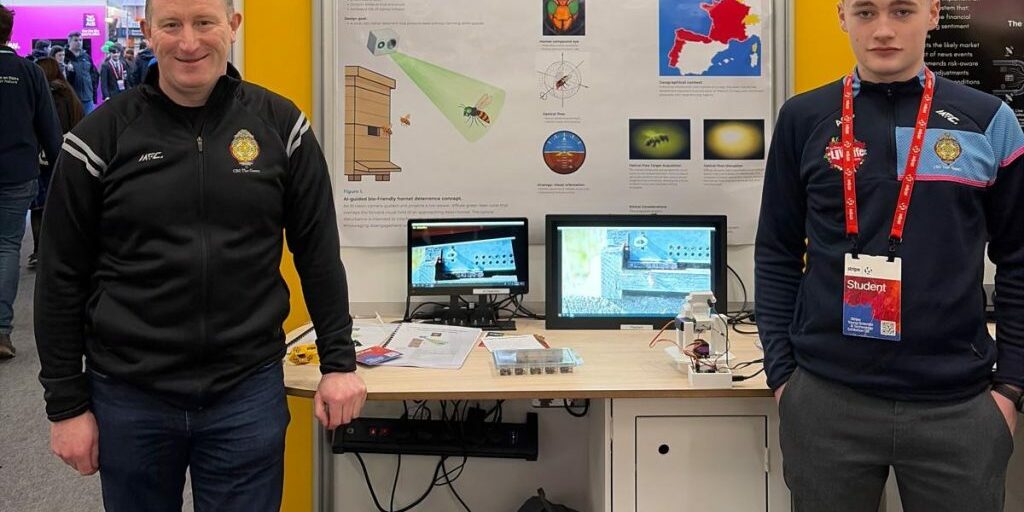
Alex O’Connor of CBS The Green, Co. Kerry, was named the winner of the AMD Award and second place for an intermediate individual in the technology category.
Alex’s project developed an artificial intelligence (AI)-based defence system aimed at reducing hornet predation on honeybee colonies.
Best School award
A number of awards were also given to agricultural and environmental projects from Moate Community School, Co. Westmeath, which helped the school claim this year’s title for Best School in the Republic of Ireland.
In the biological and ecological sciences category, Moate students Emily Galvin, Emma Kelly, and Rachel Pillion secured third place for a junior group, with their project exploring how native Irish plants can be used to restore soils following prolonged flooding at Lough Funshinagh in Co. Roscommon.

Students Denis Murray, Tom O’Connell and Conor Fox from Moate Community School, Co. Westmeath, with their freeze-resistant drinker prototype. Source: Fennell Photography
Fellow students Denis Murray, Tom O’Connell and Conor Fox also placed second for a junior group in the chemical, physical, and mathematical sciences category for their project, which engineered freeze-resistant livestock drinkers.
Junior groups
Young minds who created projects involving livestock and crop production were also awarded at the event.
Christian Brothers College Cork students Ben Dwyer, Daragh O’Mullane, and Oisín Sheehan were presented with the top prize for a junior group in the chemical, physical, and mathematical sciences category for their automatic irrigation system designed to improve crop productivity.
Eoin Slattery and James O’Reily of St. Bricin’s College, Cavan earned the second place prize for a junior group in the biological and ecological sciences category for their research into the fertiliser value of alpaca manure.

Students Fionn Murphy and Cathal O’ Shea from Boherbue Comprehensive School, Co. Cork. Source: Boherbue Comprehensive School Page’s Facebook.
Meanwhile, social issues within agriculture were also recognised, with Cathal O’Shea and Fionn Murphy from Boherbue Comprehensive School, Co. Cork, receiving third place for a intermediate group in the health and wellbeing category for their project, ‘Silent Struggles: Farmers Mental Health and the Weight of Change.’