This post was originally published on here
A team of scientists at the University of Missouri has identified a small group of unusual objects in the early universe using NASA’s James Webb Space Telescope.
The objects, identified by Haojing Yan and his team at Mizzou’s College of Arts and Science, appear to have characteristics of both stars and quasars but lack the broad emission lines typically seen in those objects. Instead, they exhibit narrow emission lines, which are usually associated with active star formation in galaxies, according to a community announcement.
The researchers have nicknamed these objects “platypus galaxies” due to their mix of features that don’t usually go together.
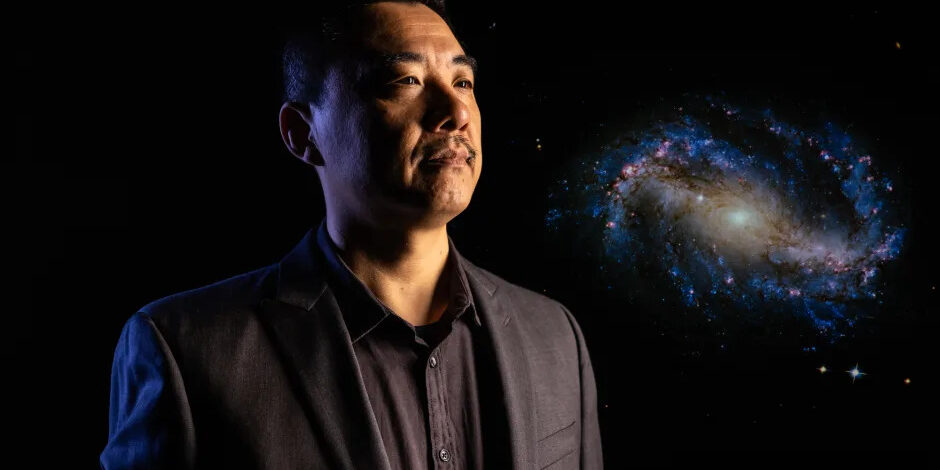
Haojing Yan
“Each property on its own is familiar to us,” Yan, a Mizzou astronomy professor and co-author of the study, said in the announcement. “But when added together, they create something we’ve never seen before.”
Discovery raises new questions about galaxy formation
The discovery comes as scientists continue to examine JWST’s deep-space images, which allow them to see the universe as it appeared billions of years ago. It raises new questions about how galaxies were created, according to the announcement.
Advertisement
Advertisement
“Our ongoing theory states that galaxies were formed by merging with other galaxies, often through violent collisions,” Yan said in the announcement. “But these ‘platypus galaxies’ may have formed quietly, without such dramatic events. This suggests the early universe may have been more flexible and creative than we thought.”
While the evidence is not yet strong enough to overturn existing theories, researchers believe the signs are strong enough to suggest some galaxies may have formed in ways previously unaccounted for.
Researchers plan to gather more data
The team plans to gather additional data on hundreds of other cosmic objects to see if they also share these unusual traits. This will involve collecting spectroscopy data on each object, which involves breaking their light into a spectrum and analyzing it like a barcode. This technique reveals details such as the age and chemical makeup of galaxies and how their stars are formed.
“If these objects are really a new type of galaxy, it tells us we’ve been missing part of the story,” said Bangzheng “Tom” Sun, a graduate student in Yan’s lab and co-author of the study, in the announcement. “And we’re just beginning to uncover it.”
Advertisement
Advertisement
The study, “A new population of point-like, narrow-line objects revealed by the James Webb Space Telescope,” was presented at the 247th meeting of the American Astronomical Society. Mizzou undergraduate student Riley Shive is also a co-author on the study.
This story was created by Janis Reeser, [email protected] with the assistance of Artificial Intelligence (AI). Journalists were involved in every step of the information gathering, review, editing and publishing process. Learn more at https://cm.usatoday.com/ethical-conduct/.
This article originally appeared on Columbia Daily Tribune: University of Missouri team flags new galaxy type in JWST data