This post was originally published on here
A new micro-encapsulation breakthrough could turn thyme’s powerful health benefits into safer, smarter nanodoses.
Thyme extract is often praised for its wide range of health benefits, giving it a reputation as a natural medicinal powerhouse. This reputation comes from several biologically active compounds — thymol, carvacrol, rosmarinic acid, and caffeic acid — that are known to support the immune system while also offering anti-inflammatory, antimicrobial, and antioxidant effects.
The Practical Problems With Thyme Extract
Despite its promise, thyme extract is not easy to work with. It evaporates quickly (a waste of thyme!), which makes it difficult to store and deliver efficiently. Using too much can also irritate the body, sometimes leading to skin rashes or digestive discomfort.
Encapsulating Thyme at the Nanoscale
Researchers have identified a way to address both evaporation and irritation by sealing extremely small amounts of thyme extract inside another liquid. This approach allows the extract to be delivered in controlled nanodoses while preventing it from evaporating. Scientists from Tomsk Polytechnic University and Surgut State University in Russia developed this encapsulation technique and reported their findings today (January 13) in Physics of Fluids.
How the Microdroplet System Works
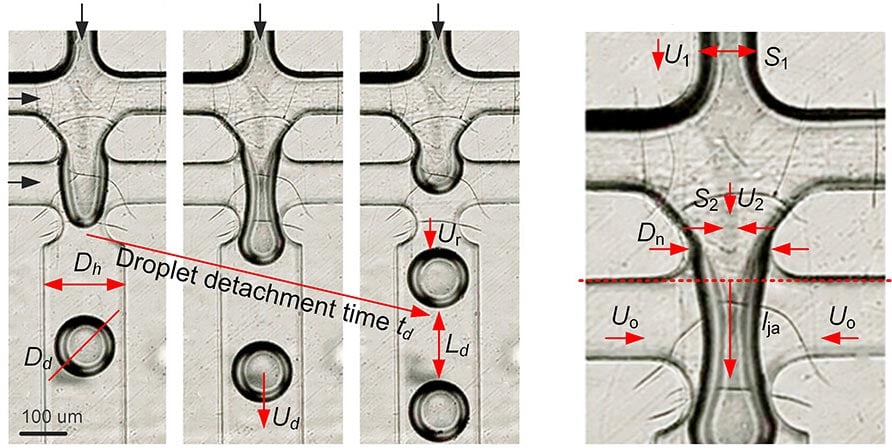
The method relies on carefully controlled liquid jets that include thyme extract, gelatin, sodium alginate — a commonly used thickening agent in the food industry — and oil. The team first combined thyme extract with gelatin and pushed this mixture through a tiny chip at the same time as a stream of sodium alginate. Inside the chip, the two liquids flowed together while remaining distinctly separated. A stream of oil injected from a perpendicular direction then broke the combined flow into extremely small droplets, each one sealed and encapsulated.
Why Precise Nanodosing Matters
The most important result of this research is not the amount of thyme extract delivered, but the proof that accurate and consistent nanodosing is achievable. Before this approach can be used in medicine, additional research will be needed to package these nanodoses into oral capsules suitable for pharmaceutical use.
“The system tends to be self-regulating in order to deliver a relatively consistent dose, which is valuable for drug delivery,” said author Maxim Piskunov. “At the same time, changing and adjusting the diameter of the microdroplets containing a biologically active substance nanodose is only possible by varying the oil phase flow rate.”
Beyond Medicine and Future Applications
The researchers say the technique is not limited to thyme extract and could be applied to many other substances. Its potential uses extend beyond pharmaceuticals and into the food industry. Piskunov also noted that adding machine vision and artificial intelligence could allow scientists to monitor and adjust nanodosing in real time.
“We believe that this method can be used to encapsulate various aqueous extracts,” said Piskunov. “From our study, no significant limitations have been identified. Moreover, we are currently working on encapsulating a water-alcohol extract with a much higher concentration of biologically active substances.”
Reference: “Mathematical model of nanodosing of water-thyme extract using droplet microfluidics” by Maxim Piskunov, Alexandra Piskunova, Alexander Ashikhmin, Sofia Kuimova, Yuliya Petrova, and Elena Bulatova, 13 January 2026, Physics of Fluids.
DOI: 10.1063/5.0303637
Never miss a breakthrough: Join the SciTechDaily newsletter.
Follow us on Google and Google News.