This post was originally published on here
- For confidential advice, call Alzheimer’s Society’s Dementia Support Line on 0333 150 3456
- Alzheimer’s Society’s symptoms checker can help spot the signs of dementia
Persistent brain fog, headaches and changes in smell or taste following Covid infection could signal an increased risk of Alzheimer’s disease later in life, scientists have warned.
US researchers analysing blood samples from more than 225 long-Covid patients found significantly increased levels of tau – a protein closely linked to Alzheimer’s and other forms of dementia.
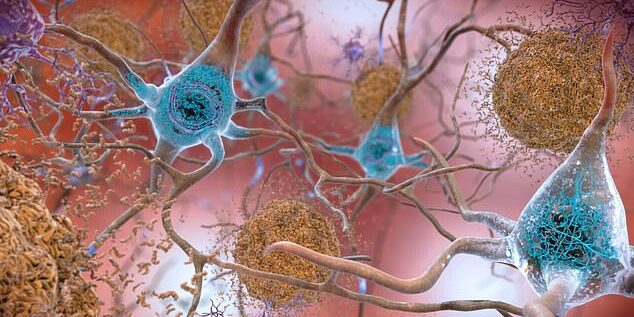
Abnormal clumps of tau can form tangles inside the brain’s nerve cells, disrupting communication and driving the memory loss and cognitive decline seen in the disease, the leading cause of dementia.
Dr Benjamin Luft, an infectious disease expert and lead author of the study, said: ‘The long–term impact of Covid-19 may be consequential years after infection and could give rise to chronic illnesses, including neurocognitive problems similar to those seen in Alzheimer’s disease.
‘On a practical level, this has important implications for the development of effective vaccines and therapies to prevent acute infection before it can embed itself and lead to long–term disease.’
Publishing their findings in the journal eBioMedicine, the researchers concluded that people who develop persistent symptoms after Covid may be at increased risk of future neurodegenerative disease.
The study analysed blood samples from 227 participants in the World Trade Center Health Program – a long–running cohort of 9/11 first responders – taken before they contracted Covid and again an average of 2.2 years after infection.
Common long–Covid symptoms include brain fog, headaches, vertigo, extreme fatigue, balance problems and changes in smell or taste.
The researchers focused on a specific form of tau known as pTau–181, an abnormal subtype strongly associated with Alzheimer’s disease.
Overall, participants showed an almost 60 per cent rise in blood tau levels after Covid if they experienced neurological symptoms such as headaches, vertigo or brain fog.
Those whose cognitive symptoms persisted for more than 18 months had significantly higher levels of tau biomarkers than those whose symptoms resolved sooner.

This, the researchers said, ‘might portend worsened cognitive function as individuals age’.
Professor Sean Clouston, a preventive health expert and study co–author, said: ‘Elevated tau in the blood is a known biomarker of lasting brain damage.
‘These findings suggest long Covid could worsen over time, causing neurological symptoms or cognitive difficulties that progressively intensify.
‘However, we do not yet know whether the increase in tau we observed follows the same biological trajectory seen in people who go on to develop Alzheimer’s or related diseases.’
The team compared the findings with a control group of 227 World Trade Center responders who either never contracted Covid or had the infection without developing long–term symptoms.
Unlike those with long Covid – also known as neurological post–acute sequelae of Covid (N–PASC) – this group showed no significant rise in blood tau levels.
The researchers are now investigating whether elevated tau in people with long Covid is directly linked to the development of neurodegenerative diseases such as Alzheimer’s.
They said: ‘The next step is to validate these findings using neuroimaging to determine whether rising plasma tau levels correspond to increased tau accumulation in the brain.’
The authors cautioned that the cohort may not be representative of the wider population, noting that as essential workers the participants may have had greater environmental exposure to the virus.
They added: ‘This is among the first studies to suggest that a virus may contribute to abnormal tau production over time.
‘The findings have important implications for understanding the biological pathways that lead to neurodegenerative disease.’
According to the NHS, long Covid – sometimes referred to as post–Covid syndrome – occurs when symptoms persist for more than 12 weeks after infection.
NHS England survey data suggest nearly one in ten people believe they may have long Covid.
Figures from the Office for National Statistics show around 3.3 per cent of people in England and Scotland – roughly two million – were experiencing symptoms of long Covid, with 71 per cent reporting symptoms lasting at least a year.
More than half said their symptoms had persisted for two years or longer.
Alzheimer’s disease affects around 982,000 people in the UK, a figure projected to rise to 1.4 million by 2040. Early symptoms typically include memory problems, difficulties with thinking and reasoning and language impairment, which worsen over time.