This post was originally published on here
WEST LAFAYETTE, Ind. — Sometimes to truly study something up close, you have to take a step back.
That’s what Andrea Donnellan does.
An expert in earth sciences and seismology, she gets much of her data from a bird’s-eye view, studying the planet’s surface from the air and space, using the data to make discoveries and deepen understanding about earthquakes and other geological processes.
“The history of Earth processes is written in the landscapes,” Donnellan said. “Studying Earth’s surface can help us understand what is happening now and what might happen in the future.”
Donnellan, professor and head of the Department of Earth, Atmospheric, and Planetary Sciences in Purdue’s College of Science, has watched the Earth for a long time. Her original research was studying and tracking glaciers in Antarctica.
“When I started working in Antarctica as an undergrad, you could measure motion in meters,” Donnellan said. “Now, thanks to GPS, we can measure movements in millimeters. Whether it’s glaciers or tectonic plates, I like precise measurements and watching things move to understand the underlying physics.”
Ground truthing
When looking for a dropped object, like an earring back or a contact lens, sometimes you look up close to the carpet to find it. But other times, you stand up and shift your perspective around to see if changes in the light and shadow can help you find it.
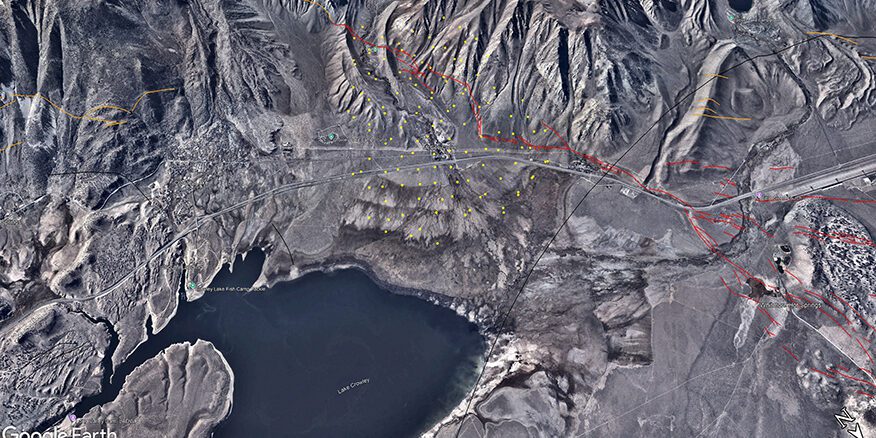
Much of Donnellan’s research works the same way. In her newest paper, she and a team launched a new instrument that collects topographic data from an aircraft flying at 41,000 feet. The instrument, appropriately dubbed QUAKES-I, for Quantifying Uncertainty and Kinematics of Earth Systems Imager, creates high-resolution color three-dimensional maps using eight cameras mounted on the belly of a Gulfstream V aircraft. They discuss the instrument in Earth and Space Science.
“As you move down from space, you have less visibility of the ground, so you have smaller and smaller patches that you can study,” Donnellan said. “With this aircraft we got a 12-kilometer-wide swath that we break into 10-by-12-kilometer sections. But you trade resolution and height for coverage, which is why satellites, aircraft and drones all have their places in terrain mapping research.”
The QUAKES-I instrument will help researchers studying earthquakes, volcanoes, wildfires, erosion and glaciers, as well as ecosystems, infrastructure and vegetation. It offers higher resolution than many satellites, as well as the ability to quickly deploy and rapidly gather a large amount of targeted data.
Such maps can provide context for radar observations, and the color component offers new context for the same terrain when mapped by lidar. The swath is wider than lidar observations are capable of; the two are complementary measurements.
QUAKES‐I is an airborne component of NASA’s Surface Topography and Vegetation incubation program, a constellation of airborne and spaceborne radar, lidar and stereoimaging instruments in development to map Earth’s dynamic surface. Using a combination of all three methods of mapping offers researchers the clearest and highest-resolution digital terrain map of the planet.
The instrument can be attached to a variety of other aircraft in tandem with other instruments. The aircraft was flown by a NASA pilot, though Donnellan herself flies drones for higher-resolution observations.
Earthquake warning
Increasingly, meteorologists are better able to forecast intense weather, including hurricanes, tornadoes, hail and severe storms. But understanding whether there is going to be an earthquake is something of a mystery.
Some earthquakes take place along large major faults, like California’s famous San Andreas fault. But other earthquakes are more difficult to track and even more difficult to forecast. Donnellan is trying to change that by studying and measuring the position and strain at tectonic faults, as well as their surrounding geologic landscapes.
“How do the different circumstances of Earth’s crust affect the likelihood of an earthquake?” Donnellan said. “When there’s a major earthquake, does it make having one nearby more or less likely?”
Most of the human population of the United States — and indeed most of the humans on Earth — live where they could potentially be affected by a damaging earthquake. California and Alaska may be famous for them, but in 2024, 38 states had earthquakes. Indiana was one of the states that did not have an earthquake in 2024.
Being able to forecast where earthquakes might occur, as well as how severe they might be, allows people to plan, build infrastructure appropriately, and be physically and mentally prepared for such an earth-shaking event.
“Not all earthquake motion is damaging,” Donnellan said. “Some — quiet motion — isn’t damaging at all. We’re working to get insights into how to judge how much of an earthquake actually shakes the surface and how much goes into that quiet motion.”
Answering that question can improve earthquake hazard assessment with a goal of providing better information to save lives, protect property and ensure a stabler future.
About Purdue University
Purdue University is a public research university leading with excellence at scale. Ranked among top 10 public universities in the United States, Purdue discovers, disseminates and deploys knowledge with a quality and at a scale second to none. More than 106,000 students study at Purdue across multiple campuses, locations and modalities, including more than 57,000 at our main campus locations in West Lafayette and Indianapolis. Committed to affordability and accessibility, Purdue’s main campus has frozen tuition 14 years in a row. See how Purdue never stops in the persistent pursuit of the next giant leap — including its integrated, comprehensive Indianapolis urban expansion; the Mitch Daniels School of Business; Purdue Computes; and the One Health initiative — at https://www.purdue.edu/president/strategic-initiatives.
Note to journalists:
A video interview of Andrea Donnellan is available on the AP portal or via Google Drive.