This post was originally published on here
Towards the end of the last ice age, an ancient wolf feasted on a young woolly rhinoceros (Coelodonta antiquitatis). When the wolf died, it ended up buried in Siberian permafrost for about 14,000 years until it was uncovered by paleontologists in 2015. Luckily for scientists, some woolly rhinoceros tissue remained inside of the wolf’s stomach. Now, these genetic detectives analyzed the woolly rhino’s genome and found that the species likely went extinct due to rapid population collapse and not a slow decline as Earth’s climate warmed. The findings are detailed in a study published today in the journal Genome Biology and Evolution.
“Sequencing the entire genome of an Ice Age animal found in the stomach of another animal has never been done before,” Camilo Chacón-Duque, a study co-author and paleogenomicist at Stockholm University in Sweden, said in a statement. “Recovering genomes from individuals that lived right before extinction is challenging, but it can provide important clues on what caused the species to disappear, which may also be relevant for the conservation of endangered species today,” he said.
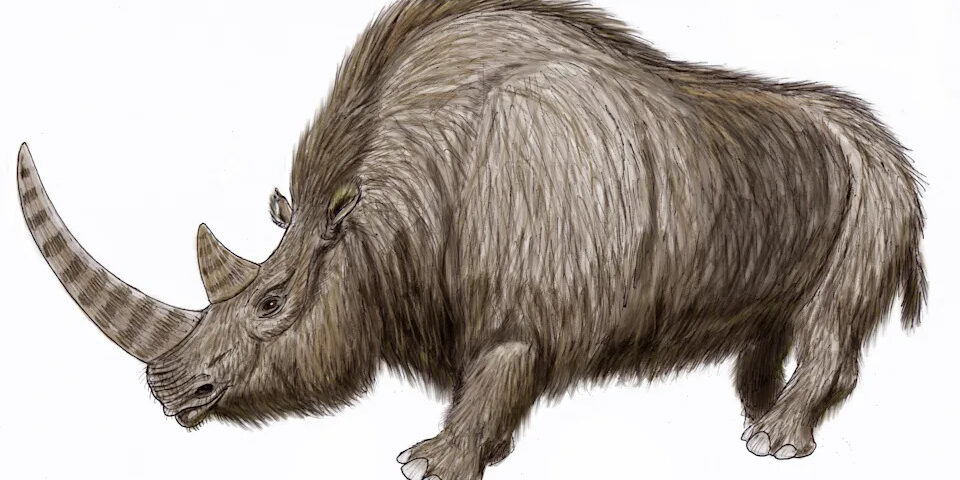
An illustration of what a woolly rhinoceros would have looked like. Image: ДиБгд via WikimediaCommons CC By 4.0
Frozen in time
The woolly rhino lived from 5.3 million to about 8,700 years so in present-day Europe, North Africa, and Asia. The large mammals had two large horns towards the front of the skull, and a thick coat of hair. Stone Age painters frequently included the woolly rhino in their work, including on cave paintings in France’s Chauvet–Pont d’Arc dating back about 30,000 years.
Advertisement
Advertisement
The woolly rhinoceros DNA found inside of the ice age wolf was discovered in permafrost near the village of Tumat in Siberia. When scientists performed an autopsy on the ancient wolf, they identified a small fragment of preserved woolly rhino tissue inside of its stomach. Radiocarbon dating indicated that the tissue was about 14,400 years old, making it one of the youngest specimens of woolly rhinoceros ever discovered.
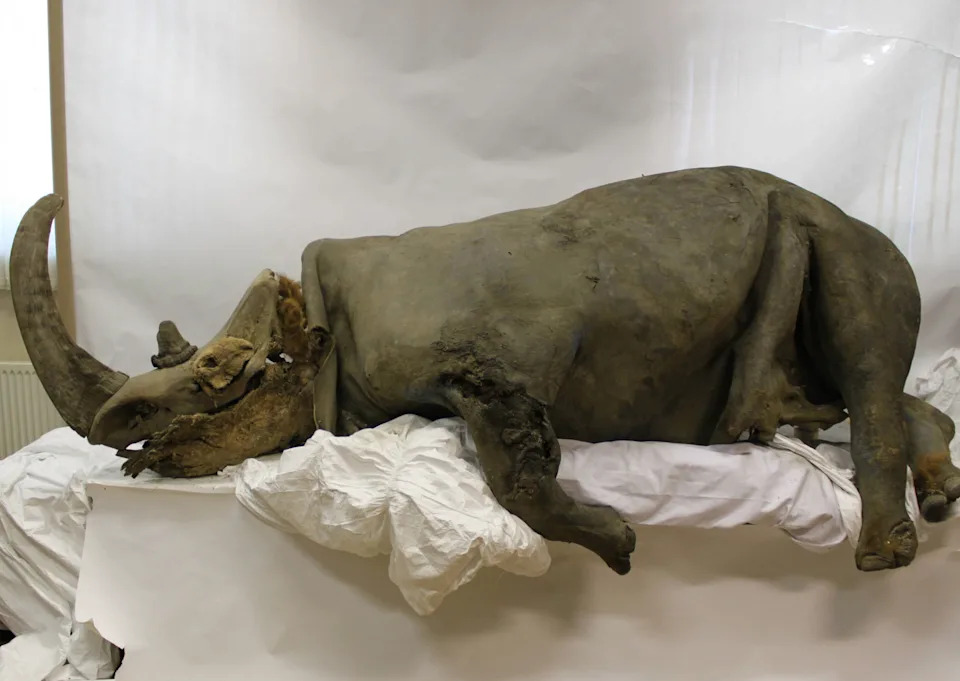
A permafrost-preserved woolly rhinoceros (not part of this paper) in Yakutsk, Russia. Image: Mammoth Museum of North-Eastern Federal University.
Since genetic material degrades over time, mapping the genome of animals like these that died thousands of years ago is incredibly difficult. The wolf’s own DNA also further complicates the analyses.
“It was really exciting, but also very challenging, to extract a complete genome from such an unusual sample,” added Sólveig Guðjónsdóttir, a study co-lead author, who carried out the work as part of her master’s thesis at Stockholm University.
Comparing genomes
To get a sense of how genome diversity, inbreeding levels, and harmful mutations changed throughout the last ice age, the team then compared the Tumat rhinoceros’ genome with two other high-quality genomes from older specimens. Both of these specimens were older, dating back to about 18,000 and 49,000 years ago.
Advertisement
Advertisement
They did not find any signs of genetic deterioration due to a lack of suitable mates as the woolly rhinos approached its extinction. This indicates that the species as a whole probably maintained a stable and relatively large population until just before it disappeared around 8,700 years ago.
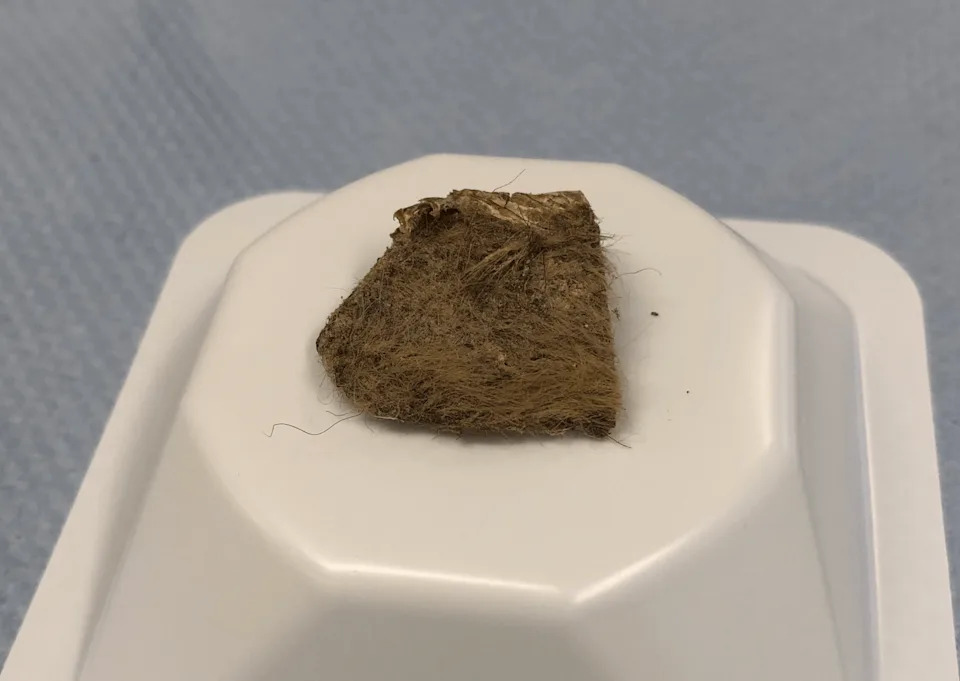
The piece of woolly rhino tissue found inside the stomach of the Tumat-1 puppy. Note that the small cut marks are from the DNA sampling done at the Centre for Palaeogenetics in Stockholm. Image: Love Dalén.
“Our analyses showed a surprisingly stable genetic pattern with no change in inbreeding levels through tens of thousands of years prior to the extinction of woolly rhinos,” said study co-author and paleogenomicist Edana Lord.
Additionally, there was no evidence of a long-term gradual population decline within the genome. The extinction appears to have occurred relatively quickly, likely due to global warming at the end of the ice age.
“Our results show that the woolly rhinos had a viable population for 15,000 years after the first humans arrived in northeastern Siberia, which suggests that climate warming rather than human hunting caused the extinction,” concluded study co-author and evolutionary genomicist Love Dalén.