This post was originally published on here
Nearly two miles beneath the Norwegian Sea, scientists have discovered that deep-sea hydrothermal vents are producing far more hydrogen gas than previously believed, and from an entirely unexpected source. A new study, published in Communications Earth & Environment, reveals that this hydrogen isn’t coming from the Earth’s mantle, as long assumed, but from buried sediments hidden beneath the ocean floor. This breakthrough is reshaping our understanding of how hydrogen is produced in deep ocean environments and its role in sustaining deep-sea ecosystems.
A Surprising Source Beneath The Seafloor
Until now, most research on hydrogen generation at hydrothermal vents focused on a process known as serpentinization, where seawater reacts with mantle-derived ultramafic rocks to produce hydrogen. This explanation, though widely accepted, no longer tells the full story.
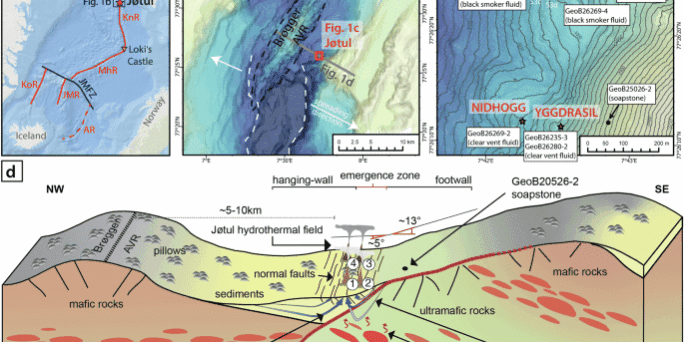
Scientists from the MARUM – Center for Marine Environmental Sciences, led by marine geochemist Alexander Diehl, conducted expeditions to the Jøtul Hydrothermal Field on the Knipovich Ridge. During their 2022 and 2024 missions, they found that the vents pierced through thick, muddy sediments rich in organic carbon, a setting not previously associated with high hydrogen levels.
“We were able to show that serpentinization is not the only explanation for how elevated hydrogen concentrations can occur in the deep sea,” said Diehl.
The team’s thermodynamic models pointed to an alternative process: under supercritical water conditions, extremely high temperatures and pressures, organic molecules in the buried sediments break down and release hydrogen.
This chemical breakdown could explain the unexpectedly high concentrations of hydrogen (over 15 millimoles per liter) and methane (up to 66.3 millimoles per liter) in the fluid samples. Notably, hydrogen sulfide, typically abundant in these environments, was relatively low, further suggesting a different chemical pathway than usual.
Keeping Hydrogen From Escaping The Data
One of the major challenges in studying vent gases is the difficulty of collecting accurate samples from extreme ocean depths. In early missions, researchers used standard sampling bottles that lost pressure as they ascended, causing the gases to escape.
“However, on the way to the surface the gases escaped and could no longer be precisely measured in the laboratory,” said Diehl.
To fix this, the 2024 mission deployed gas-tight samplers capable of maintaining the deep-sea pressure during recovery. This allowed for far more reliable measurements of hydrogen and methane, revealing chemical signatures consistent with buried sediment reactions rather than mantle rock.
The significance of this new technique goes beyond a single site. It offers a new methodology for accurately studying vent chemistry, which can vary dramatically over time and space. Future expeditions may use similar tools to explore other sediment-rich vent fields and test whether this hydrogen pathway is more widespread than currently known.
Ecosystems Thriving On Hidden Hydrogen
Beyond its chemical significance, the discovery holds major implications for deep-sea ecosystems. Many vent communities rely on a process called chemosynthesis, where microbes convert hydrogen and other chemicals into energy in the absence of sunlight. This energy is the foundation for entire ecosystems, including symbiotic relationships with species like Bathymodiolus mussels.
When hydrogen levels spike, they can shift microbial populations, which in turn affect the structure of the entire food web. This means the newly discovered hydrogen source might quietly power — or reshape, deep-sea life far beyond its immediate surroundings.
Importantly, hydrogen from these vents doesn’t stay localized. It spreads with rising plumes into surrounding seawater, where it can fuel microbes that convert carbon dioxide into biomass even at great distances. The new findings suggest that these buried sediment reactions could be contributing far more to global biogeochemical cycles than previously recognized.