This post was originally published on here
Key Points
-
Food scientists at the University of Guelph in Ontario, Canada, have developed mathematical models to explain how cookies change during baking, focusing on how temperature affects size, shape, and moisture.
-
The study found that cookies baked at moderate temperatures, around 205°C (401°F), achieved the best balance of structure and moisture compared to lower or higher heat levels.
-
The findings could improve home baking and industrial production by helping ensure consistent doneness, better texture, and more efficient energy use.
You’ve faithfully bought all the right ingredients. You’ve combined them in the order the recipe calls for, preheated your oven to the specified temperature (using an oven thermometer for maximum accuracy), and baked whatever you’re making for as long as you were told. And still, somehow, it comes out a mess. It’s frustrating, but it happens to all of us, because baking is an even more complicated science than most professionals realize. Luckily, someone with an advanced degree may have unlocked a secret to baking a better batch of cookies.
In 2024, researchers from the University of Guelph’s Department of Food Science published new findings examining how cookies change during baking, with a particular focus on how temperature affects their size and shape. The work, presented through the Institute of Food Technologists (IFT), applies advanced mathematical modeling to the development of a cookie as it bakes, yielding insights that could influence everything from industrial food production to the way recipes are written.
Advertisement
Advertisement
Maria Corradini, an associate professor at the university and chair in food quality at the Arrell Food Institute, said that better understanding these changes has implications beyond cookie perfection. Modeling how baked goods respond to heat can help improve food safety by ensuring products are fully cooked, reduce energy use during baking, and potentially improve texture and flavor.
“We are assuming every reaction in food is linear,” Corradini told IFT. “But this is wrong. It is a complex reaction; we have to separate each reaction into stages, and each has to be characterized.”
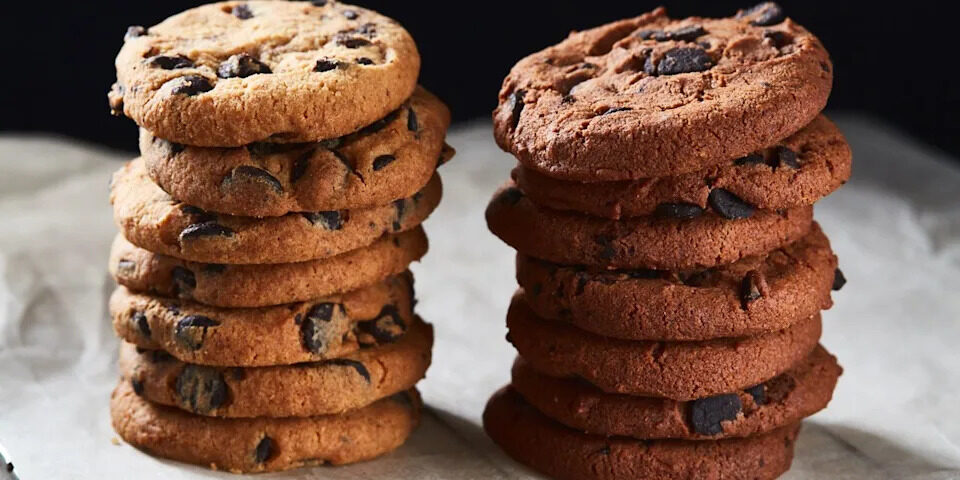
To study those stages, Corradini and her colleagues prepared a standardized cookie dough, divided it into three batches, and baked each at a different temperature: 185°C (365°F), 205°C (401°F), and 225°C (437°F). All three batches baked for up to 12 minutes, with the cookies removed every two minutes so the team could measure surface temperature and track physical changes over time.
As the cookies baked, the researchers analyzed their shape, color, size, and moisture content — work Corradini described as “basically mapping reaction kinetics of the different phenomena we’re interested in.” In other words, the team was tracking which physical and chemical processes mattered most at different moments in the bake.
Related: 16 Chocolate Chip Cookie Recipes With Brown Butter, Banana, and More
Advertisement
Advertisement
They then ran a correlation analysis to determine which variables had the strongest influence on the cookies’ final form. Early in the baking process, temperature played the dominant role in how the cookies spread. But after a critical inflection point, moisture content became the key factor, influencing thickness and shape as water evaporated from the dough. “The ability to identify those transitions is one of the most interesting parts of complicated modeling,” Corradini said.
The researchers did not identify a single “perfect” way to bake a cookie — a goal Corradini noted would be subjective anyway, given differing preferences for crisp or soft textures. But clear patterns emerged. At 185°C, the cookies dried more slowly than at higher temperatures, a pace the researchers said “precludes [the cookie] attaining the target doneness level” within the same baking window.
lenina11only / Getty Images
By studying how one dough behaved across repeated bakes—measuring spread, firmness, and moisture loss each time—researchers built a detailed model of the reactions that shape a cookie from start to finish.
Higher temperatures produced faster and more dramatic changes. Cookies baked at 225°C spread rapidly, reaching their widest point at about four minutes before shrinking again as moisture loss caused them to firm up. At 205°C, cookies peaked later, around six minutes, before tightening toward the end of the bake. Meanwhile, cookies baked at 185°C continued to spread gradually throughout the entire 12 minutes.
Moisture measurements helped explain these differences. After 12 minutes, cookies baked at 225°C were the driest, while those baked at 205°C retained more moisture, and those baked at 185°C retained the most. Within the lab conditions of the study, 205°C struck a middle ground — hot enough to promote structure and doneness without excessive drying. That balance may help explain why many experienced bakers gravitate toward slightly higher oven temperatures than individual recipes typically call for.
Advertisement
Advertisement
Corradini said the team is already working on the next phase of the research, with the goal of refining these models so they can be more easily applied across different foods. While baking may never be fully predictable, she hopes the work brings the science a step closer to everyday kitchens.
“The food industry is not known for its amazing modeling,” she said. “We are a little bit behind, so we are trying to simplify it in order to validate the whole cookie.”
Read the original article on Food & Wine