This post was originally published on here
Researcher is in the United States legally on a work visa, yet he’s being held at ICE’s detention center in Batavia.
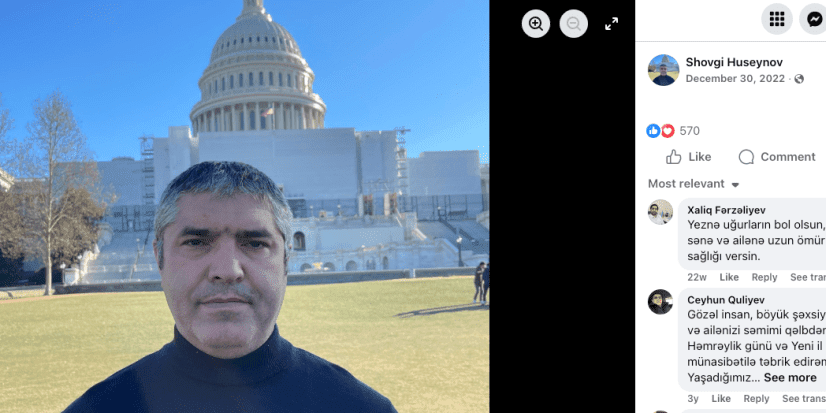
A screenshot of Huseynov’s Facebook page.
The Trump administration maintains its mass deportation program is aimed only at “the worst of the worst.”
In reality, the crackdown on immigrants is a dragnet, one that’s now ensnared a well-regarded neuroscience researcher from the University at Buffalo.
Azerbaijan native Shovgi Huseynov has no criminal record and a visa that allows him to work in the United States through 2029. But on January 7, Huseynov made a wrong turn onto the Peace Bridge and was detained by border agents upon his return to Buffalo.
A spokesperson for U.S Customs and Border Protection said agents “determined he may be subject to removal from the U.S.” and turned him over to ICE. He gave no specific reason for his arrest.
Huseynov has been held at the Batavia detention center for the past week.
According to UB spokesperson John Della Contrada, Huseynov had been working as a researcher at the Jacobs School of Medicine and Biomedical Sciences since 2022 on a work authorization approved by the Department of Homeland Security. Huseynov entered the country on a J1 visa commonly extended to university students and researchers, a spokesperson from ICE said, who indicated Huseynov had an application for another visa or other legal status pending.
The ICE spokesperson, in a statement, alleged Huseynov didn’t have legal status and said the agency is now seeking to deport him.
Huseynov is not alone. In the past year, at least five other people have been detained by immigration authorities after making a wrong turn onto one of the bridges in the Buffalo area to Canada. That figure, however, only counts people who were criminally charged upon reentry because they’d been previously deported. More people, like Huseynov, have been detained after a wrong turn but not criminally charged.
Such consistent ICE detentions following a wrong turn are a new phenomenon, said Jennifer Connor, executive director of the nonprofit advocacy group Justice for Migrant Families. Under past administrations, she said, such mistakes would often just delay a traveler. Sometimes they would result in a brief detention and an order to appear before an immigration judge.
“After January 2025, [detention] became the rule,” she said. “It seemed like everyone got detained.”
A respected researcher
For four years, Huseynov has been conducting complicated neuroscience research at the Jacobs School, focusing on various biological phenomena in the brains of opioid-addicted mice in an attempt to understand how the brain and immune system work together. He’s published several research papers alongside colleagues.
In recent Facebook posts, he’s noted his son’s success at swim meets, announced he had attended a large neuroscience conference in San Diego and celebrated his cultural heritage.
“We have been living in the United States of America for 5 years now, but as true Azerbaijanis, we keep our national and moral values, traditions alive [and] we teach our children,” he wrote in a March post. “We are proud to be Azerbaijani and represent it here.”
In other posts, he wrote about how dedicated he was to his job at UB. In a post from December 2024, Huseynov apologized for falling out of touch with friends due to focusing on his research and his family.
“I came to America with 1 purpose, 1 deed, and from the first day of my arrival, no reason has been able to divert me from my path and lead me in other directions,” he wrote. “I spend at least 12-14 hours in a day doing science. Real science is such a thing that you always have to think, do research, get acquainted with the latest innovations and publications in your field of research.”
One colleague at UB, research professor Michael Morales, spoke highly of Huseynov.
“He’s a good scientist, a good citizen. I consider him very hard working,” Morales said. “He was fun to work with.”
Morales noted that Huseynov has a wife and two young children, one of whom is a U.S. citizen.
“He’s certainly not a troublemaker or anything like that,” he said. “He’s found the same pathway that lots of international scientists have.”
Investigative Post attempted to reach Huseynov for this story but was not successful. Phone and text messages left for him at the ICE detention center were not returned. An attorney working with Huseynov, Siana McLean, declined to comment.
In a statement, Della Contrada said UB is aware of Huseynov’s arrest and is monitoring the situation.
“As more information becomes available, UB will provide appropriate support to his family and to his personal attorney,” he said.
Wrong turns lead to detention
In both Buffalo and Lewiston, it can be easy to drive into the wrong lane and get stuck heading to Canada with no way to turn around.
In at least five cases over the past year, migrant drivers have gotten stuck in the wrong lane, crossed into Canada and were detained by U.S. border agents upon their return.
The case of Giovanni Bernal Guerrero is typical.
On the evening of July 19, he was the passenger in a car that made a wrong turn onto the Peace Bridge. The driver traveled across to Canada, turned around and attempted to re-enter the United States. Upon inspection, Bernal Guerrero was found to have been previously deported to Mexico and agents arrested him.
He’s since been deported a second time.
Subscribe to our free weekly newsletters
Then there’s the case of Oscar Hernandez Sanchez.
Driving a tractor trailer last June, Hernandez Sanchez realized he’d taken the wrong lane of exit 9 and pulled over near the Duty Free store on the U.S. side of the Peace Bridge. He then attempted to back his truck down the ramp so he could re-enter Interstate 190. That’s when two Customs and Border Protection agents stopped him “out of concern that a traffic accident would occur,” according to a criminal complaint filed in federal court.
The agents asked Hernandez Sanchez for documentation, which included a Mexican passport and an ID from the Mexican consulate. They found he had been previously deported in 2011 and arrested him. He was ordered deported in September.
Arrests and detentions at bridges common
It’s not just a Western New York phenomenon. In Detroit, NPR reported that more than 200 people were detained at the Ambassador Bridge between January and April of last year, most the result of a wrong turn into Canada.
In other local cases, entire families have been detained at the bridges after being turned back from Canada. Last March, for example, a family attempting to emigrate to Canada was denied entry and subsequently held at the Rainbow Bridge for two weeks.
Connor, of Justice for Migrant Families, said detentions at the bridges worry her — whether for wrong turns or another reason — because there’s no public information about those held there. When a person is held at an ICE detention center, their names can be found in an online database. Not so for those detained in a cell at a bridge. That makes getting someone out all the more difficult.
“The issue that still exists with the detentions at the bridges is the complete lack of transparency,” Connor said.
One of her solutions? Don’t take Interstate 190. Find an alternative route.
“I give people advice about this constantly, because I’m trying to do damage control on it,” she said. “It’s like this very easy mistake with devastating consequences.”
posted 7 hours ago – January 14, 2026