This post was originally published on here
“They’re very destructive when there’s a lot of them, but one on one, what’s not to love?” Arianne Cease says.
She’s talking about locusts.
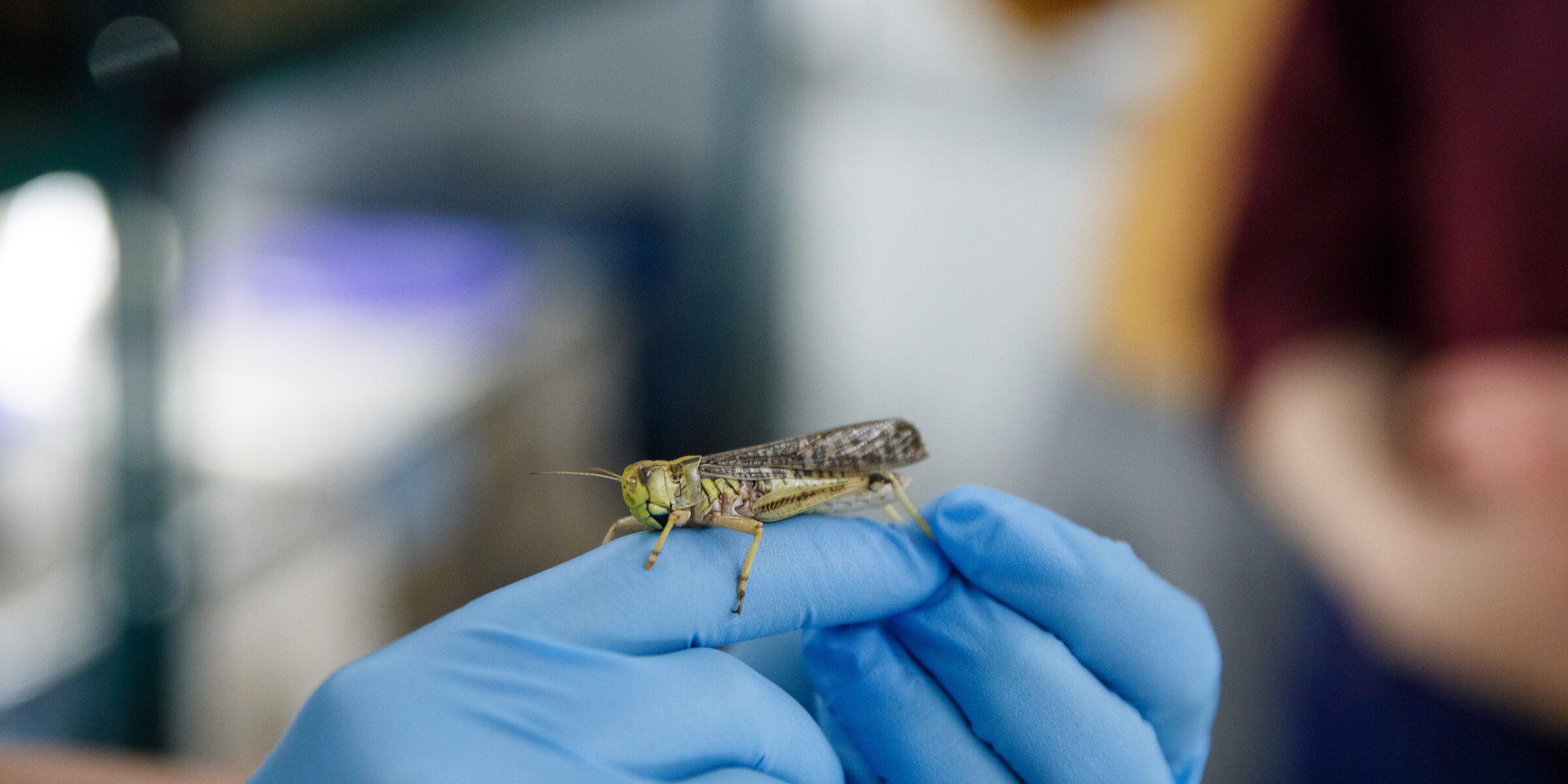
As the director of Arizona State University’s Global Locust Initiative, Cease has a healthy admiration for these insects, even as she studies ways to manage locust swarms and prevent the destruction they cause.
Locust swarms, which may conjure images of biblical plagues and ancient famines, remain a serious problem worldwide. They can destroy crops across entire regions, ruin people’s livelihoods and, in some places, impact children’s education and future economic opportunities. Swarms can cover hundreds of square miles — equal to a major metropolitan area like New York City or Phoenix.
So when Cease and her international team of scientists found a simple soil-based method to keep locusts from eating crops, they knew their work could change people’s lives. To the team’s knowledge, theirs is the first study to test this new method in real-world farming conditions and confirm that it works.
The study was published today in Springer Nature. Associate Professor Mamour Touré of Université Gaston Berger in Saint-Louis, Senegal, was the lead author of the study, while Cease served as the principal investigator of this project, supported through the U.S. Agency for International Development.
“The results are of major importance to the scientific community and also to Senegalese farmers,” Touré says. “The study gave them a better understanding of grasshoppers and locusts, as well as a practical way to control them at the local level.”
Everything you don’t want to know about locusts
“All locusts are grasshoppers, but not all grasshoppers are locusts,” says Cease, an associate professor with the ASU School of Sustainability in the Rob Walton College of Global Futures.
Like a werewolf exposed to moonlight, a locust is a grasshopper with the potential to completely transform under the right conditions. Out of around 6,800 described species of short-horned grasshoppers, only 19 are considered locusts.
A locust in a “solitarious” phase is shy. It acts like a regular grasshopper: avoiding others of its kind, appearing a camouflage green and staying in one area. A locust in a “gregarious” phase is just the opposite — it gathers with other locusts, wears bright colors to stand out and migrates huge distances in search of food.
To transform, locusts need rain and crowds.
Locusts generally live in arid desert environments that get heavy, unpredictable rainfall. After such a rain, desert plants flourish, which allows the locust population to grow.
Then they start bumping into each other. This simple trigger changes the locusts’ brains and behavior. In a matter of hours, these awkward introverts become avid partiers that love being together. As they reach adulthood, the locusts grow large wings that allow them to travel long distances as a swarm.
Over 15 years of studying locusts, Cease found that plants growing in nutrient-poor soil promote locust outbreaks. These plants are high in carbs and low in protein.
“This carbohydrate bias, or the ‘doughnut diet,’ is optimal for populations of locusts and swarming grasshoppers,” Cease says.
Just like runners who load up on carbs before a marathon, locusts need more carbs to fuel their migration.
In nitrogen-rich soil, plants are higher in protein and lower in carbs. These plants are bad for locusts to eat — their bodies can’t handle the extra protein and don’t get enough energy.
Protein-packed plants prevent pests
All this work led to a question: Can we prevent locust damage by changing the protein-to-carb ratio of plants? Small lab studies and field surveys suggested the answer might be yes, but no one had tested it in open, working farmland. To Cease, that was the next logical step.
The researchers partnered with 100 farmers from two villages in Senegal who experience outbreaks of the Senegalese grasshopper. This grasshopper does not form extreme swarms like the desert locust, but its consistent outbreaks and smaller swarms can make it more devastating for Senegalese farmers. These communities, which worked with Cease for previous studies, advocated for this larger study.
For the experiment, each farmer grew two plots of millet — one treated with nitrogen fertilizer and one untreated.
The scientists weren’t sure what effect this would have. The locusts might enter through untreated fields and eat a combination of crops and weeds. Or, the boost in plant protein might attract different pests that would damage the crops.
The team assessed the number of locusts and damage to farmers’ plots three times throughout the growing season. They also recorded millet yields for each plot at harvest time.
Compared with the untreated plots, the treated plots showed three clear differences: fewer locusts, less crop damage and a doubled crop yield. The team also found no evidence that nitrogen fertilizer made other pest problems worse.
While the research team provided nitrogen fertilizer for the purpose of the study, it’s not practical for communities to use on a regular basis. To really work long-term, they need a way to add nitrogen to the soil that is affordable and good for the farmland.
“Ongoing work led by Dr. Touré is focused exclusively on compost, and we seem to be getting the same results,” Cease says.
The project’s funding, provided through USAID, was canceled in early 2025. However, the farmers on the ground in Senegal are so encouraged by the results that they are continuing the compost system on their own.
“Farmers unanimously stated that they no longer burn crop residues after land clearing, but instead practice composting to fertilize their fields, thereby helping to reduce grasshopper infestations. This technique was fully mastered thanks to the project,” Touré says.
The team is applying for additional funding to help expand the project into other regions hard-hit by locusts.
Welcome to Hopper Town!
The Global Locust Initiative Lab, aka “Hopper Town,” is where Cease and a team of researchers and students learn about the secret lives of locusts.
Hopper Town comes with amenities like fine mesh grates over all vents to prevent escapes, shelves of green grass that the researchers grow for locust food, and sealed chambers where solitarious and gregarious locusts live separately. It also sports a flight chamber to measure how long locusts can fly depending on species, diet and other variables.
The lab, part of the Julie Ann Wrigley Global Futures Laboratory, focuses on locusts and the systems that surround them. Environmental factors, biology and behavior, economic impacts, policies, and landscape management all feed into the cycle of locust destruction — and offer opportunities to break it.
When the Global Locust Initiative launched in 2018, it was the first of its kind — a place where locust researchers across the world could share their insights and spark new ideas. The initiative’s professional network, HopperLink, now includes members from 45 countries. HopperLink is led by GLI’s project coordinator, Mira Ries, who is an ASU alumna.
The lab also develops community outreach tools, from educational booklets in local languages to a global digital hub — HopperWiki — created by experts for the public.
The human residents of Hopper Town have gained unique perspectives while working closely with these enigmatic insects.
Rick Overson, the institute’s co-director, sees locust swarms as just another force of nature that humans are learning to live with, much like wildfires. We can reduce their harm if we know how they work and how to prevent them from starting.
Others note that locusts can also benefit their ecosystems. These insects cycle carbon, increase plant biodiversity and bring nutrients to other areas as they travel across regions.
One thing every person in the lab agreed on: they’re delicious. (This author did not verify the claim herself.) Cease’s favorite way to prepare them? Baked with salt and dipped in chocolate. Apparently these morsels have a toffee-like flavor with the crunch and salt.
Staying a step ahead of locusts
The U.S. has no locust species inside our borders. Why study them here at all? Cease says it won’t stay that way forever. She’s keeping her eye on the Central American locust, whose range reaches about 200 miles from our border.
“We can say with pretty high certainty that Texas will be very suitable for locusts in about 10 to 15 years,” Cease says. “Whether or not they will create a problem is yet to be determined, but it’s something that we should definitely be aware of.”
Even without locusts, we have enough reasons to study grasshoppers in the U.S. — 12 of them, in fact. They’re called the Dirty Dozen.
These 12 rangeland grasshoppers (plus one cricket) are top species of management concern in the western U.S., according to the U.S. Department of Agriculture. When they swarm, they can outcompete livestock for grass, creating a huge problem for ranchers.
The department relies on chemical pesticides to keep the grasshoppers at bay, but with the Global Locust Initiative, they’re finding alternative treatments that are better for human health and the environment.
The more we learn about locusts in other parts of the world, the better we can address migratory pests at home and prepare for the day when locusts make their way to the U.S.
Why this research matters
Research is the invisible hand that powers America’s progress. It unlocks discoveries and creates opportunity. It develops new technologies and new ways of doing things.
Learn more about ASU discoveries that are contributing to changing the world and making America the world’s leading economic power at researchmatters.asu.edu.