This post was originally published on here
By now, it’s already Star Trek folk legend that Paul Giamatti was cast as the nefarious space pirate Nus Braka in the new series Starfleet Academy after he publicly said he wanted to play a Klingon. But when his dream actually came to fruition, he had to modify the Klingon thing a little bit.
“They said, yeah, we have another Klingon, but we can make him half. Maybe we’ll make him half of that,” Giamatti tells Inverse. The result is a half-Klingon, half-Tellarite baddie, which Giamatti plays with equal parts menace and pathos. In short, this celebrity Star Trek fan’s dream has been achieved.
And yet, the story that Giamatti happens to be a Star Trek fan, and parlayed that enthusiasm into his new role, is really just the latest outcome from a life infused with science fiction. Giamatti taking on this role isn’t just stunt casting; it seems to represent an outgrowth of his artistic philosophy. It wouldn’t be right to call Giamatti a sci-fi actor outright, and yet, his career is filled with great sci-fi roles: the most affecting episode of Black Mirror Season 7 starred him; if you listen to the audiobook version of Philip K. Dick’s classic A Scanner Darkly, that’s him narrating the entire thing; and don’t forget he was in Planet of the Apes back in 2001. “Science fiction, I know, is, in fact, the way I see the world,” he says.
As Giamatti beams into the 32nd century of Starfleet Academy, terrorizing the altruistic cadets and officers alike, Inverse sat down with the iconic actor to get a sense of his sci-fi journey, including his love for the genre, his favorite classic sci-fi novels that nobody’s heard of, which Star Trek series is his favorite, and why he tends to think about the very far future all the time.
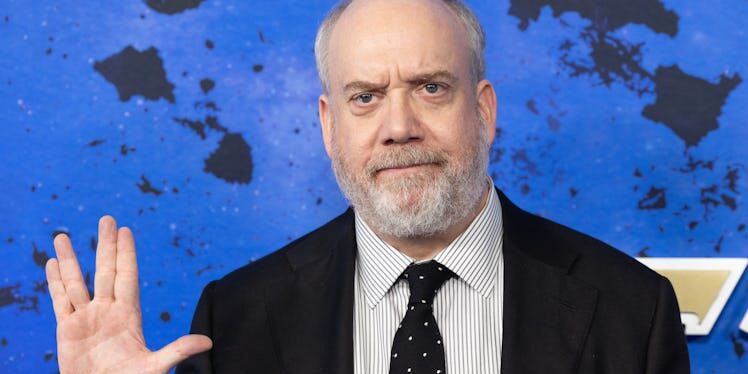
Paul Giamatti at the premiere of Starfleet Academy on January 6, 2026.
Stephanie Augello/THR/The Hollywood Reporter/Getty Images
“Science fiction, I know, is, in fact, the way I see the world.”
The first time I met Paul Giamatti was almost 20 years ago, while he was digging around in the corner of a used bookstore in New York City, where I worked part-time. He was looking for a series of vintage science fiction novels about outer space doctors. Back then, I soon forgot the title and author of the series, but today, when I bring up this question to Giamatti for our Starfleet Academy interview, he instantly knows what I’m talking about.
“Ah yes, the series is called Sector General, by the Irish writer James White,” he says with geeky pride. “It’s a series of short stories and novels about a hospital in outer space. They’re the closest thing to Star Trek that isn’t Star Trek that I’ve ever encountered. They’re really great. They should be better known than they are.”
This revelation may seem random, but it’s indicative of Giamatti’s true, organic interest in science fiction as an art form. He admits freely that he is “not an expert” on Star Trek, and because he was born in 1967, his exposure to The Original Series would have been in the 1970s, the famous heyday of the syndication of Star Trek, after its initial cancellation in 1969. He cites Star Trek as his gateway drug into the genre.
“As a kid, Star Trek was a big part of that introduction,” Giamatti says. “I can’t really think of much sci-fi I was aware of, before that. I was probably 7, maybe 6. I’m sure there are other things, but Star Trek was the thing that sparked that interest.”
After that, the path was a familiar one for many readers of now-classic science fiction; Giamatti devoured the works of Ray Bradbury, Ursula K. Le Guin, and Arthur C. Clarke. “I kept going from there, and eventually got to James White. I was probably in high school by that time.”

Various covers of James White’s Sector General books, one of Paul Giamatti’s favorite sci-fi series.
Amazon/Wikipedia
White’s Sector General books are an interesting microcosm of how Giamatti relates to science fiction; echoes of these books seem to connect to what he’s doing now. The first of these books was 1961’s Hospital Station, and, in some ways, predicts the set-up of Deep Space Nine, which Giamatti cites as his favorite all-time Star Trek series.
“Deep Space Nine, that’s my particular favorite one,” Giamatti enthuses. “I wish I had been further in my career when that started. Maybe I could have been on Deep Space Nine. And, in a way, Starfleet Academy is kind of like the spiritual successor to Deep Space Nine.”
This observation makes sense from a logistical standpoint. Like DS9, the new series presents both a stationary situation, Starfleet Academy itself, but also the ability to boldly go, since the school is also a starship. There are also plenty of different alien species all hanging out together at the same time, just like DS9, and Giamatti says he was even inspired by some of DS9’s greatest anti-heroes for his performance as Nus Braka.
“All the best villains are funny, I think. And Gul Dukat was somebody I really liked,” Giamatti explains. “Garak, too. Garak is a very funny character, so humor was a real part of this character for sure.”

Paul Giamatti as Nus Braka in Starfleet Academy, and Marc Alaimo as Gul Dukat in Deep Space Nine.
Paramount/CBS
Nus Braka’s hatred of Starfleet and the Federation in Starfleet Academy also mirrors some of the basic self-reflective critiques Deep Space Nine offered about the realism of the so-called utopian view of the future offered throughout the Trek mythos.
“I think the show is maybe a little more critical of the Federation in the way that Deep Space Nine was,” Giamatti says. “It’s more complicated in terms of questioning the Federation.”
Giamatti also notes that he had quite a bit of input on how Nus Braka would look, act, and think. “I was given a starting point, that he’s a guy who kind of plays the clown a little bit. And he wants you to underestimate him as a bit of a buffoon. He hides behind his sort of buffoonery,” he explains. “But [the producers and showrunners] were very open to my input on how he looked.”
According to Giamatti, he imagined his character’s body like “a kind of map of where he’s been.” All the jewelry, scars, and other aspects of Braka exist, in part, thanks to the actor directly collaborating with the production team.
“He’s a sort of drunken sailor, rover, pirate guy who’s just journeyed everywhere and he’s seen everything. And they were cool with that.”
“I find myself thinking, whenever something in the world is not going well, ‘What’s this going to be like in 100 years?’”
Clearly, Paul Giamatti’s Nus Braka is a complex villain — the kind of sympathetic baddie whose nuanced worldview is enhanced by a complex sci-fi vision. In other words, it’s a character Giamatti was born for, and the ethos of Star Trek nourishes.
In the 2009 science fiction film Cold Souls, Giamatti plays a fictional version of himself who says, “I don’t need to be happy. I just don’t want to suffer.” This sentiment feels very closely aligned with a kind of Philip K. Dick vibe from books like A Scanner Darkly, or in some ways, the non-Starfleet characters of Deep Space Nine or Starfleet Academy. Does science fiction create a balm? Maybe its purpose isn’t to make us happy, but perhaps to ease suffering? At least in our minds?
Just as Deep Space Nine offered hope through a grittier take on the Star Trek future, Paul Giamatti finds hope through the inherent speculation about the future. And in that particular lens, there’s not just an interesting kind of curious optimism, but also nuance and thoughtfulness.
“The AI stuff recently, I don’t necessarily find it menacing. I keep thinking, what’s it going to be like in 500 years instead of just five?” he says. “I find myself thinking, whenever something in the world is not going well, ‘What’s this going to be like in 100 years?’ I like to think in big blocks of time. That’s just how my brain is wired.”