This post was originally published on here
A bloody red moon will fill the skies across the U.S., Australia and Asia next month.
The moon’s ruddy hue is the result of a total lunar eclipse, which NASA says is expected to occur on March 3.
The eclipse will best be viewed along the West Coast early in the early hours of the morning.
Residents of San Francisco, Los Angeles and Seattle will see totality – when the moon passes entirely into the shadow of the Earth – at 3:33 a.m. EST.
Advertisement
Advertisement
“Farther east, skywatchers will still be able to see portions of the partial eclipse, but not totality,” according to AccuWeather’s Emily Speck.
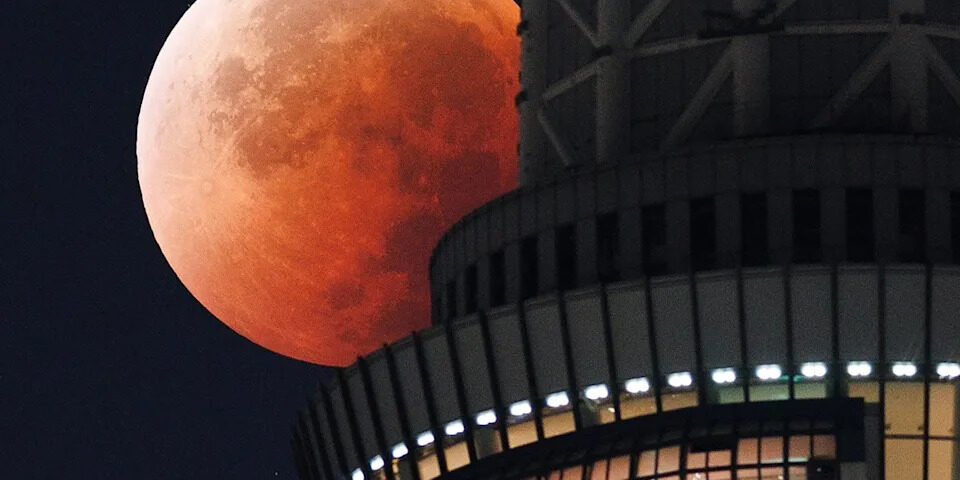
The blood moon emerges over Tokyo, Japan, last September. Another will grace the skies over Asia and the U.S. in March (JIJI Press/AFP via Getty Images)
But why is it red?
Scientists say that the answer is actually pretty simple.
The moon typically appears in a pearly, cream color against the inky blackness of the night sky because it is reflecting direct sunlight.
However, during a total lunar eclipse, the moon is blocked from the sun.
The moon is in the path of the Earth’s umbra, the darkest of two shadows cast by the Earth during an eclipse.
As light from the sun passes through Earth’s atmosphere, some shorter wavelengths are scattered away.
Advertisement
Advertisement
Red and orange wavelengths bend around the Earth and into its shadow, reaching the moon.
The best way to watch
Totality will last for just under an hour, with the partial phases of the eclipse stretching on for several hours until around 5:17 a.m. PST.
Unlike a solar eclipse, skywatchers don’t need any special equipment to view a lunar eclipse.
A telescope or binoculars can enhance the view.
But, any star or planet gazing is always best in a dark environment and away from any bright lights.
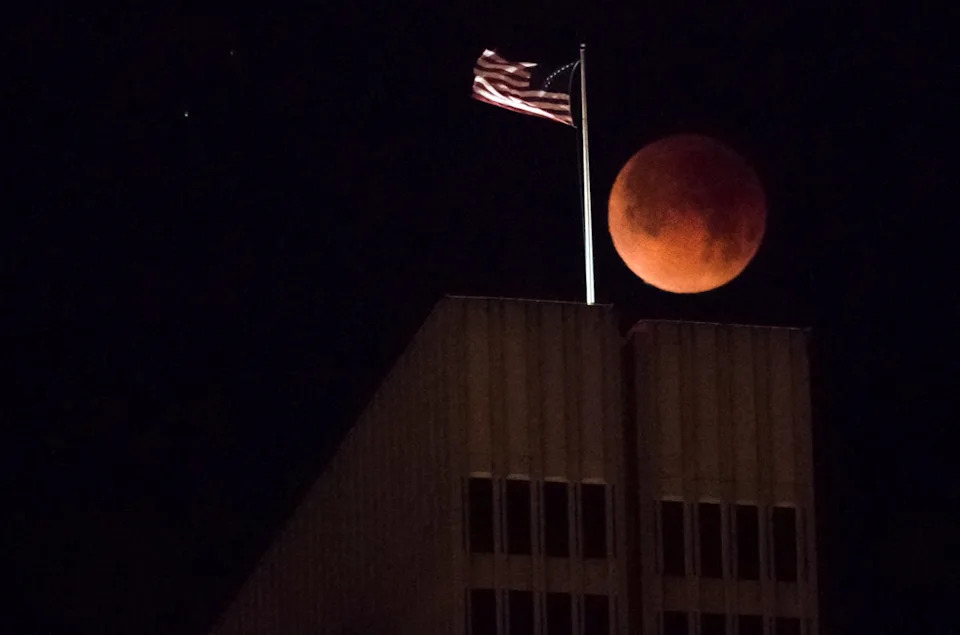
A blood moon is seen over a building in San Francisco, California, in January 2018 (AFP via Getty Images)
Catch the next one
You’ll have to wait a couple of years for the next total lunar eclipse, which is slated for December 21, 2028.
The next partial lunar eclipse is on August 28. A partial lunar eclipse is an imperfect alignment of the sun, moon and Earth.
The moon only passes through a part of Earth’s umbra and is never fully blocked.