This post was originally published on here
Nowadays there are millions of miles of optical fibre cables both underground and at the bottom of the ocean, and they form the all-important foundation of global digital communications.
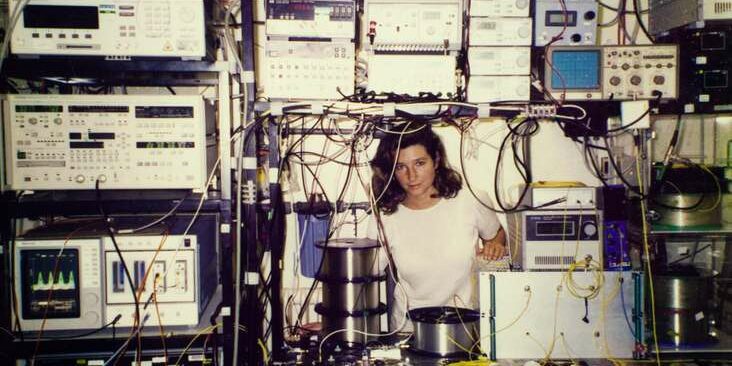
Polina Bayvel working in her lab in 1998 (Photo: Vitaly Mikhailov)[Missing Credit]
Bayvel’s work has not only earned her a damehood – following a 2017 appointment of CBE for services to engineering – but myriad prestigious awards for contributions to optical and electrical engineering as well, made all the more impressive given the field’s distinct and longstanding lack of female representation. In 2021, she became the first woman awarded the Thomas Young Medal from the Institute of Physics, and in 2023, she was the first woman and first UCL recipient of the Royal Society Rumford Medal since it was introduced in 1800.

Bayvel was born in Kharkiv, Ukraine – then part of the USSR – as the only child of Orthodox Jewish parents who practised their Judaism largely in secret throughout different periods of Soviet history, when it was very hard to do so.
She was 12 when the family emigrated to the UK in 1978, with the support of former Chief Rabbi Immanuel Jakobovits and then-Foreign Secretary David Owen.
Once settled in London, Bayvel attended Hasmonean High School for girls before receiving her bachelor’s and PhD degrees in electronic and electrical engineering at UCL.
After working as a systems engineer at STC Submarine Systems, STL and Nortel Networks, where she was involved in the design and planning of optical fibre transmission networks, she earned a 10-year Royal Society University Research Fellowship at UCL. It was during this fellowship that Bayvel founded ONG, the first optical communications research lab at a university in the UK – and one of the very few in the world at the time.
Aside from the birth of her two children, whom Bayvel calls “by far my greatest achievement”, her proudest accomplishments took place with ONG: building a recirculating fibre loop that emulates the length of a long-haul optical fibre in the compact space of the lab; demonstrating that you could use multiple wavelengths – or colours – of light to transmit information in different directions using a single strand of fibre; pushing the boundaries of amplifiers, used to give light pulses a boost when travelling across long distances for more intelligent use of the optical fibre capacity.
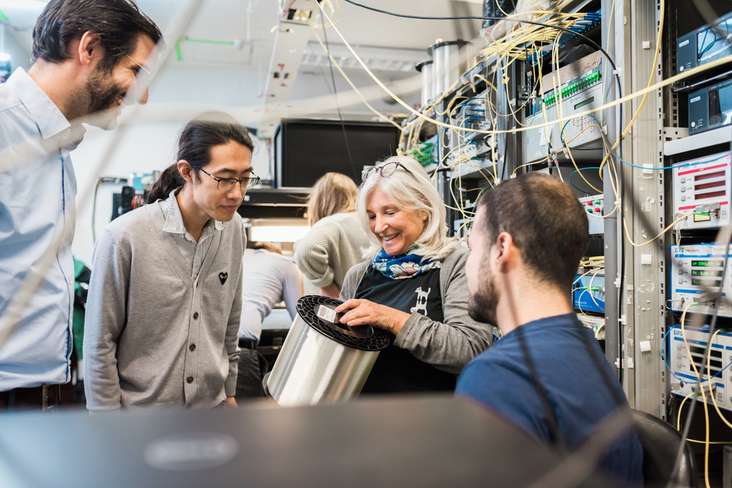 Polina with her students (Photo: James Tye)[Missing Credit]
“The kind of things that we do in the lab here, they are generations in advance of what’s available in the field,” says Bayvel. “We’ve gone up 100,000 times in transmission speeds over the past 30 years.”
Beyond speed, her lab is focusing on ensuring that optical fibre infrastructure of the future is energy efficient and resilient to uncertainty, whether that be attacks by “rogue actors”, energy increases or changes in technology.
Much the same as Bayvel looks to her academic predecessors while forging new innovations in digital communications, her “hugely important” relationship with faith is largely shaped by an awareness of our Jewish past.
“My parents and our ancestors have suffered a lot to maintain their Jewish identity,” she says. “And I think to know where you’re going, both in science and in life, you need to know where you’ve come from.”
For Bayvel, who is a member of Hampstead Garden Suburb Synagogue, Jewish identity has a lot to do with committed religious practice.
“Taking part in the rhythm of the Jewish calendar, Jewish education, Jewish history, Talmud, Hebrew – this all forms part of a Jewish identity, and I think it’s important to maintain and enhance that,” she says. “I always say that we want to maintain and enhance the UK’s leading position in optical communication, but I think it’s important to maintain and enhance our Jewish identity and the strength of belief in the Jewish community.”
Though she is often asked whether her work as a scientist contradicts her religious beliefs, Bayvel says the two “exist on different metaplanes”.
“Science requires absolute proof; faith requires no proof at all.”