This post was originally published on here
A Mars spacecraft that has been orbiting the red planet for more than a decade since its launch from Florida has now been AWOL for more than a month.
NASA first lost contact with its MAVEN orbiter at the beginning of December. Since then, all attempts to locate and reconnect with the wayward vehicle – one of three zooming around Mars’ atmosphere – have been unsuccessful.
But there’s been a significant roadblock: For more than two weeks, Mars and Earth have been on opposite sides of the sun – rendering communication with not only MAVEN, but any of NASA’s vehicles on our cosmic neighbor, impossible.
Advertisement
Advertisement
Now that Mars is back in sight, NASA is set to begin hailing MAVEN once again.
MAVEN launched in 2013 from what is now called the Cape Canaveral Space Force Station. While MAVEN has spent years studying Mars’ upper atmosphere, it’s also made other discoveries during its missions and even caught a glimpse of the now-famous 3I/ATLAS interstellar comet.
Here’s what to know about MAVEN, and NASA’s ongoing attempt to reestablish communications with the Mars orbiter.
What is NASA’s MAVEN mission? Orbiter launched from Cape Canaveral, Florida
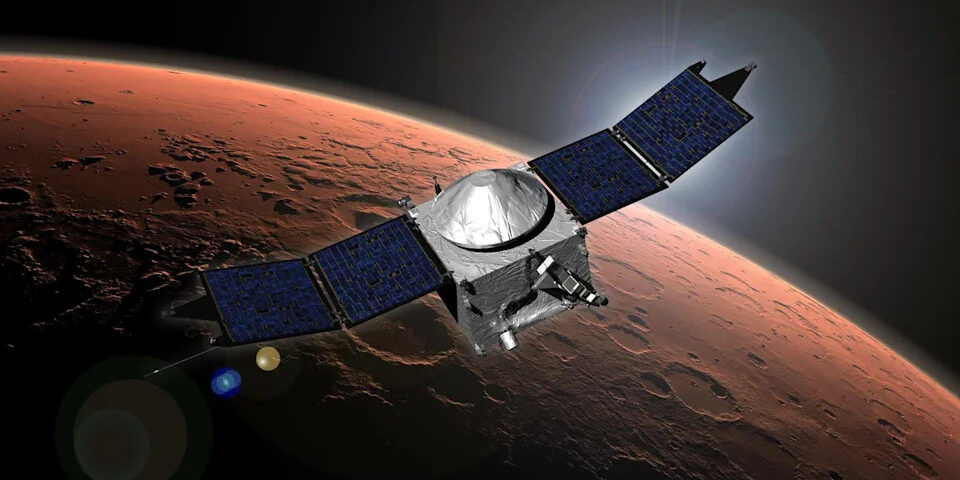
This image shows an artist concept of NASA’s Mars Atmosphere and Volatile Evolution (MAVEN) mission.
For more than a decade, NASA’s MAVEN spacecraft has been orbiting Mars studying its atmosphere.
The 11-foot-tall orbiter – short for the Mars Atmosphere and Volatile EvolutioN – launched Nov. 18, 2013, atop a United Launch Alliance Atlas V rocket from the Cape Canaveral Space Force Station along Florida’s Space Coast. MAVEN then reached Mars’ orbit on Sept. 21, 2014.
Advertisement
Advertisement
MAVEN’s purpose has been to gather data on the lost gases to space from Mars’ upper atmosphere, which have in turn lent insight into the history of the red planet’s climate, water and potential habitability, according to NASA.
MAVEN is one of three active orbiters around Mars, including the Mars Reconnaissance Orbiter launched in 2005 and the Mars Odyssey launched in 2001.
How long will the MAVEN mission last? NASA loses contact with Mars orbiter
While the mission remains ongoing more than 11 years later, NASA recently lost contact with MAVEN as the spacecraft passed behind Mars from Earth’s vantage.
The anomaly occurred Dec. 6 when ground teams on Earth “experienced a loss of signal” with the spacecraft, NASA said in a Dec. 9 blog post.
Advertisement
Advertisement
Telemetry data had showed all of MAVEN’s subsystems were working normally before the spacecraft orbited behind Mars. But when the orbiter later emerged again, NASA’s array of giant radio network antennas known as the Deep Space Network that communicates with MAVEN did not observe a signal.
NASA attempts to hail MAVEN again on Jan. 16
NASA has since continued efforts to reestablish communications with MAVEN – with the latest attempt reportedly planned Friday, Jan. 16.
While the space agency has still received no telemetry data gathered from the orbiter since Dec. 4, 2025, ground teams did manage to obtain “a brief fragment” of tracking data regarding the vehicle’s orbital position, NASA said in a Dec. 15 blog post. That signal suggests not only that MAVEN was wildly rotating when it emerged from behind Mars, but that it may be on a new trajectory.
The agency’s latest update on the MAVEN saga came in a Dec. 23 blog post, when NASA said it is still sending commands to MAVEN and is keeping a lookout for any signal from the spacecraft. Curiosity, one of NASA’s two rovers on the Martian surface, even attempted – in vain – to spot MAVEN from the ground.
Advertisement
Advertisement
Mars and Earth have since Dec. 29 been on opposite sides of the sun, making contact with MAVEN and any other vehicle on the red planet impossible. The event, known as a solar conjunction, comes to an end Jan. 16, which is when NASA indicated it will attempt to hail MAVEN once again.
MAVEN among spacecraft to image 3I/ATLAS interstellar comet

An ultraviolet image composite of the hydrogen atoms surrounding comet 3I/ATLAS, the third interstellar object ever detected by astronomers, as it passes through our solar system. This image was taken on Sept. 28, just days before the comet’s closest approach to Mars – by an instrument on NASA’s MAVEN spacecraft, which has been studying Mars from orbit since 2014.
MAVEN was among NASA’s fleet of space instruments that have had a chance to glimpse the interstellar 3I/ATLAS comet since the strange object was first spotted in July in Earth’s solar system.
While the Mars Reconnaissance Orbite captured one of the closest images of 3I/ATLAS, MAVEN obtained ultraviolet images that NASA said should help scientists understand the comet’s make-up. The Perseverance rover on Mars’ surface also snapped a faint photo of the interstellar comet.
The comet, just the third object ever discovered in our cosmic neighborhood originating from another star, made its closest approach to Earth in December. On Dec. 19, 3I/ATLAS passed within about 170 million miles of our planet – or about twice the distance between Earth and the sun.
Advertisement
Advertisement
Eric Lagatta is the Space Connect reporter for the USA TODAY Network. Reach him at [email protected]. Subscribe to the free Florida TODAY newsletter.
This article originally appeared on Florida Today: MAVEN, NASA Mars orbiter launched in Florida, still AWOL weeks later