This post was originally published on here
Beneath the bustling cities and rugged landscapes of Northern California, a hidden and potentially dangerous world of seismic activity has been silently unfolding for years. The region, known for its unpredictable and powerful earthquakes, has long been a focus for geologists seeking to understand the forces that shape the Earth’s surface. But a new breakthrough has revealed that what lies beneath is far more complex, and alarming, than scientists had previously imagined. In a new study published in Science on January 15, 2026, researchers have uncovered a hidden earthquake threat lurking beneath one of the most active fault zones in the world.
The Discovery of Hidden Earthquake Activity
Northern California, known for its proximity to the San Andreas Fault, has long been a hotbed of seismic research. Yet, even with decades of study, the complexity of its tectonic movements has remained an enigma. Recent findings from the U.S. Geological Survey (USGS), the University of California, Davis (UC Davis), and the University of Colorado Boulder have revealed new insights into the hidden earthquake activity beneath the Mendocino Triple Junction, a convergence of three tectonic plates.
While many people are familiar with the large, destructive earthquakes along the San Andreas Fault, a series of tiny, almost undetectable earthquakes are now providing a new window into the Earth’s hidden seismic world. These low-frequency earthquakes are not powerful enough to be felt by humans, but they offer scientists crucial information about how tectonic plates move beneath the surface.
As Amanda Thomas, a coauthor of the study from UC Davis, notes, “If we don’t understand the underlying tectonic processes, it’s hard to predict the seismic hazard.”
Understanding the Mendocino Triple Junction
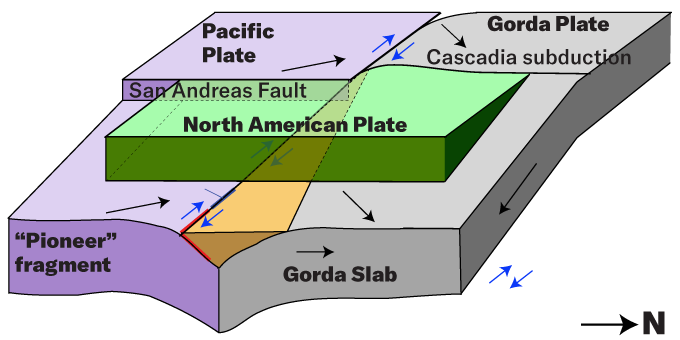
At the heart of this new discovery lies the Mendocino Triple Junction, located off the coast of Humboldt County. This area is where three major tectonic plates, the Pacific Plate, the North American Plate, and the Gorda Plate, meet. It is a geologically significant region because the interaction between these plates creates immense pressure, often leading to earthquakes. While the San Andreas Fault to the south has been well-documented, the complexities at the Mendocino Triple Junction have been much harder to understand due to the complex nature of the forces at play.
Through a dense network of seismometers installed throughout the Pacific Northwest, the research team was able to capture data on the tiny earthquakes occurring in this region. By examining these low-frequency seismic events, scientists developed a new model of the tectonic processes occurring beneath Northern California.
David Shelly, a key figure in the study from the USGS Geologic Hazards Center, explains, “You can see a bit at the surface, but you have to figure out what is the configuration underneath.”
The challenge of understanding this hidden world is akin to examining an iceberg, what we see on the surface is just a small part of a much larger and more complex system.
The Role of Low-Frequency Earthquakes
Low-frequency earthquakes, so small that they can’t be felt by humans, have become essential to understanding the subterranean processes of tectonic plates. These minute quakes, which occur when tectonic plates slowly slide past or over each other, may not pose an immediate threat, but they offer scientists a unique tool for studying plate motion and structure.
The team’s breakthrough was the realization that these small tremors were responding to tidal forces from the Sun and Moon, just like ocean tides. This interaction helped scientists test and refine their models of underground activity, offering critical insights into the dynamics of the plates. As tidal forces cause subtle shifts in the Earth’s crust, the rate of these low-frequency earthquakes increases, providing valuable data on the state of stress within the Earth’s tectonic layers.
New Tectonic Model: Five Pieces, Not Three
One of the most striking results of this research, published in Science, is the discovery that beneath the Mendocino Triple Junction, there are not just three tectonic plates interacting, but five distinct moving pieces. This revelation challenges previous assumptions about how tectonic plates interact in this region. As the research team’s findings indicate, the area’s tectonic configuration is more complex than previously thought.
The new model proposes that, south of the Triple Junction, the Pacific Plate is dragging a fragment of rock known as the Pioneer Fragment beneath the North American Plate. This fragment is a remnant of the ancient Farallon Plate, which once bordered the California coastline but has largely disappeared over millions of years.
In addition, a section of the North American Plate itself has broken off and is sinking along with the Gorda Plate in a process called subduction. These two hidden pieces of tectonic material, not visible on the surface, add another layer of complexity to the earthquake hazard in the region. As Scott Materna, another coauthor of the study, points out,
“It had been assumed that faults follow the leading edge of the subducting slab, but this example deviates from that.”
This means that the plate boundary is not exactly where scientists originally thought it was, making predictions of seismic activity in this area even more challenging.