This post was originally published on here
Suddenly, Lorraine Ashbourne is everywhere. Of the many striking and memorable television shows of the past few years, Ashbourne has been front and centre in several of them, always hypnotic, never typecast. She was, for example, entirely terrifying as a family crime boss in Sherwood, and was hysterically funny as the much put-upon grandmother in Sophie Willan’s Alma’s Not Normal (a work of genius, incidentally). She was also brilliant in Sally Wainwright’s Riot Women, one of 2025’s most memorable TV dramas.
Then there were her appearances in The Crown, Bridgerton and I Hate Suzie. As purple patches go, it’s a pretty impressive one.
“There’s been a glut of big programmes I’ve been in recently – it’s true,” Ashbourne says, “and so I am being noticed quite a bit more, I suppose. Obviously, it’s lovely to have your work appreciated, but I’m a very private person. In fact, I rarely do interviews at all, so you’re lucky to have me.” The grin that follows is equal parts the weary exasperation of Alma, and the malevolent intent of Sherwood. “I don’t really like talking about myself,” she says. “I’m not that interesting.”
The available evidence, however, would suggest otherwise. After all, you don’t become among the most interesting actors of your generation by accident. Ashbourne is 65 years old. She is married to fellow actor Andy Serkis, with whom she has three children, Ruby, Sonny and Louis, all in their twenties and all now actors themselves. Ruby is currently in the Tom Stoppard play Indian Ink at London’s Hampstead Theatre, alongside Felicity Kendal, while Louis features in the latest 28 Years Later film.
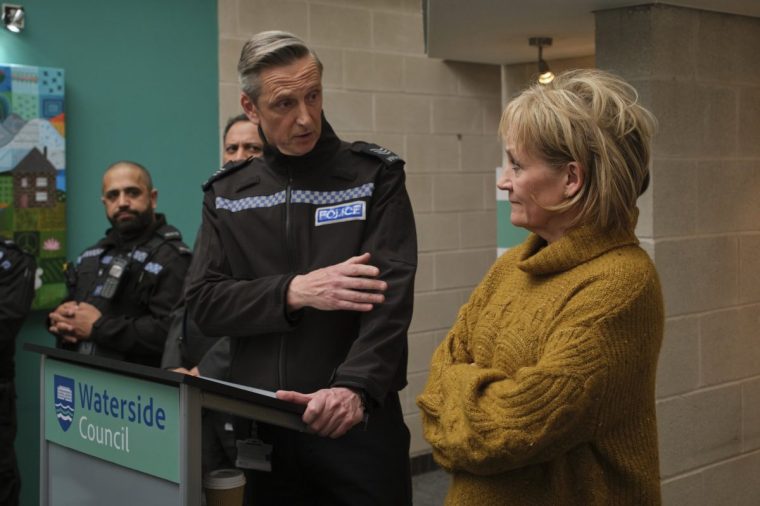
This week, Ashbourne returns for the second series of the ITV crime drama After the Flood. Written by TV writer Mick Ford (William and Mary, Ashes to Ashes), the series is essentially a police procedural but with an environmental twist. After spending much of the first series battling rising floodwaters while hunting a killer in the fictitious town of Waterside, police officer Jo Marshall (Sophie Rundle) finds herself recently promoted to detective. This time she’s investigating a spate of wildfires in the area.
On the home front, meanwhile, she’s just become a mother, and is nursing secrets. Jo’s late father had been involved in crime, a fact she is desperate to keep from her own mother Molly (Ashbourne).
“Police procedurals don’t necessarily interest me,” Ashbourne says, “but I often forgot that this was a police drama at all, simply because the writing is so good, and the relationships so fascinating. Mick writes really well about family, about people who can’t stand each other but can’t keep away from each other. And I love how he gets into the head of a middle-aged woman like me. I completely believed every line I was speaking.”
The relationship between the two women in the show, tested by both that secret and differing approaches to parenthood, becomes increasingly knotty.
“I love the dynamic with my daughter in the show,” Ashbourne says, “and the fact that Molly is quite often the child in the relationship. That kind of scenario can be very compelling.”
For someone quite so reluctant to submit to media scrutiny, Ashbourne nevertheless makes for a highly entertaining interviewee. She is warm, gregarious and funny. Sitting with her laptop on a pair of knees that won’t sit still for even a minute, she tells me that her heating has broken. “It’s freezing in here! I’m sitting here in layers, and there’s a blanket nearby, just in case.”
Ashbourne doesn’t like the cold, which is something she had to face during the filming of After the Flood. Her character Molly enjoys wild swimming with friends, something the actor herself very much does not.
“I hate the cold water!” Where she lives, she says, “I’m really close to the ladies’ pond in Hampstead. I could literally walk to it in my bikini in about 30 seconds. But I never did. I’ve always been keen to keep any kind of dementia at bay, to stay young and fit, but I just couldn’t face it. So when I realised I had to swim in cold water for the show, I took it very seriously.”
The first day she managed to wade into a lake filled with ice was a proud one. “I sent a picture of me submerged to my family.” Over time, she got to appreciate it, too. She’s now a regular at her local pond. “I’ve got the key, the wristband, all the gear, everything. Even the bobble hat. People talk about the euphoria you feel after swimming in freezing water. Me, I’m just glad I’m still alive when I get out of it.”
Ashbourne was born in Manchester in 1961 to a plumber father and an office worker mother. “There was no source of great ambition in my family for me to do anything,” she says. “No one told me to be a doctor, nothing like that. As long as I was happy, that’s all that mattered.”

She happened upon her future career by accident when, aged 16, she got a job working as an usher in Manchester’s Royal Exchange Theatre. “I got to watch amazing performances from people like Albert Finney, Tom Courtenay and Lindsay Duncan. I loved it,” she says “Much later I worked with Lindsay in Sherwood. I couldn’t wait to tell her the key role she’d played in my life all those years previously.”
She went to drama school, then swiftly landed an agent. “Early on, I did a film called Distant Voices, Still Lives [the much-lauded 1988 Terence Davies film], but I don’t know if it did me any good because I certainly had a lot of unemployment after that, and it didn’t catapult me anywhere.”
She met Serkis – best known as Gollum in the Lord of the Rings trilogy and now a pioneer of motion-capture filmmaking – in the early 90s, when they were both rising steadily through the acting ranks, each supporting the other during the occasional fallow periods that come with the territory. “There were times when massive, great big fat jobs came along, but also plenty of time when I was not working for so long that I wasn’t convinced I could actually call myself an actress any more.”
That must have been awful, I say. Nobody likes to be out of work. “Oh, I loved it! I’m so happy out of work, my days just somehow get filled. You know, my kids are at home, my husband’s quite demanding, and I’ve always got a massive list of things to do. In fact,” she says, leaning into her screen, “work tends to get in the way.”
Whatever her extracurricular activities might have been, they never really kept her away very long. Hers remained an actors’ home. Little wonder her children followed suit. “I really don’t think that we, as parents, did anywhere near enough resisting,” she says. “We should have taken them to the Science Museum more.”
She’s “still undecided” whether it’s a good idea for her children to pursue acting careers. Why? “I hate the idea of them having to go through rejection. We keep telling them that every actor has to face it. No matter what level they’re at, someone out there is not going to want you.”
Good advice, perhaps, but Ashbourne is hardly leading by example. At 65, she’s never been in greater demand. “The older we get, the more interesting we become,” she muses. “The ageing process is fascinating and complex. But as for me getting good [older] roles, I’ve just lucked out. I’ve not been particularly picky. I’ve just been in the right time at the right place.”
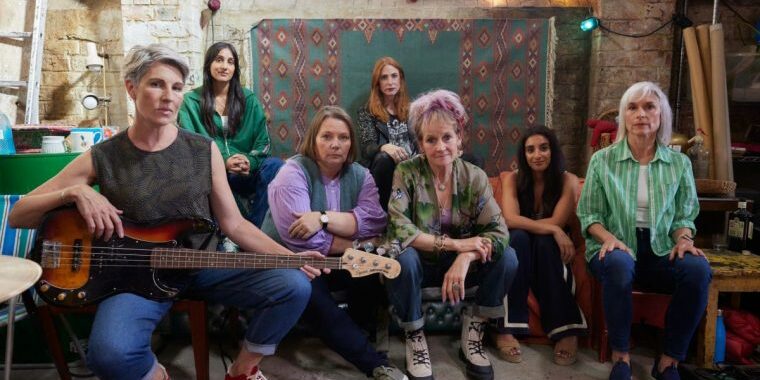
One of those ‘”right time, right place” roles was as Jess Burchill in Riot Women, the brilliant BBC series about a group of women either pre-, post-, or right in the middle of menopause, who form a punk band in order to vent their glorious spleen, mostly directed against the men that have failed and disappointed them in so many ways. She starred alongside Rosalie Craig (vocals), Joanna Scanlan (keyboards), Tamsin Greig (bass) and Amelia Bullmore (guitar). Ashbourne played drums, and did so with gleeful abandon.
The series, she says, struck a chord in more ways than one. “It really feels like we’ve started a revolution with Riot Women. I know that it’s a difficult watch, but it’s an important one. I’ve literally had women stop me in the street going, ‘Oh my God, thank you so much!’ It feels like we’ve done something important here, like we’ve really made waves.”
Later this year, the women will reconvene to film a second series. Ashbourne is counting the days. “I can’t wait to pick up my drumsticks,” she says.
‘After the Flood’ is on ITV1 at 9pm on Sunday