This post was originally published on here
A plant thought to be extinct has been rediscovered in northern Queensland after 58 years, with the help of a community-driven species identification smartphone app.
Ptilotus senarius, which belongs to a family of flowering plants called Amaranthaceae, is a small, slender shrub endemic to the dry regions of Western Australia.
It was last recorded to have been seen in 1967.
Due to the lack of a contemporary specimen of the shrub and the continuous cattle grazing in the area for more than a century, the category of “Presumed Extinct” was proposed for P senarius.
Advertisement
Advertisement
But in June 2025, while working on a private property in the Gilbert River region of Queensland, horticulturist Aaron Bean uploaded pictures of an unusual plant to the identification app iNaturalist.
Amateur scientists on the platform soon confirmed the new specimen as P senarius.
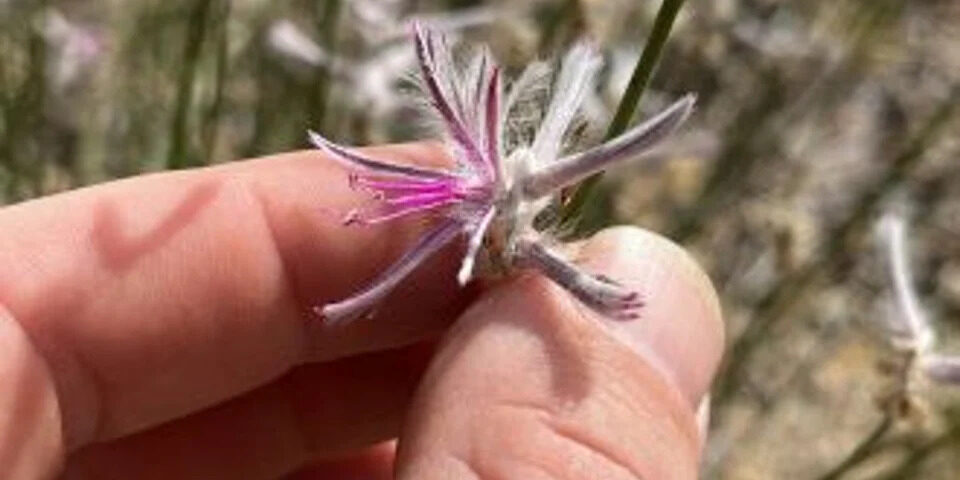
Closeup of rediscovered plant’s flower (Aaron Bean/iNaturalist)
The rediscovery highlights the power of the iNaturalist app for conservation and biodiversity science, according to a study on the find in the Australian Journal of Botany.
“We report the rediscovery of Ptilotus senarius AR Bean in northern Queensland, Australia, through the citizen science platform iNaturalist, 58 years after the last collection, and present photographs of the species,” researchers said in the study.
Advertisement
Advertisement
“We have not disclosed the exact location of this population because it occurs on private property.”
The researchers noted the ability of the iNaturalist app to capture observations from hard-to-reach places, publish them instantly and connect them with expert identifiers from across the world.
The platform is increasingly used by scientists to rediscover lost species and monitor the ranges of known species.
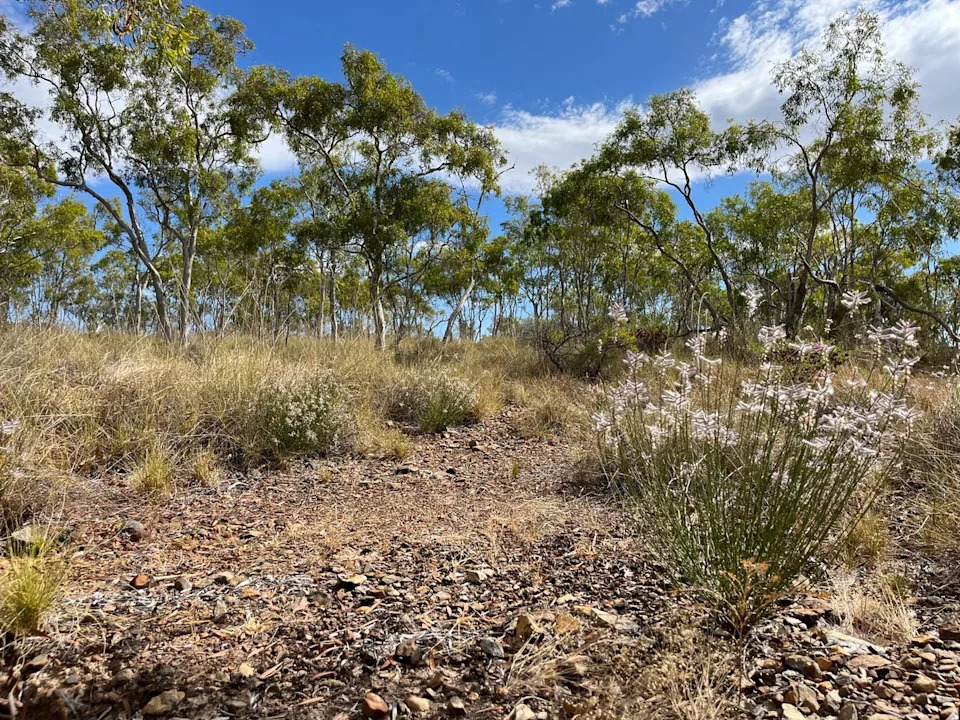
Rediscovered shrub (Aaron Bean/inaturalist.org/observations/288434421)
“With more than 104 million verifiable photographic vouchers of plants from around the globe having been uploaded to the platform as of July 2025, spanning over 175,000 species, iNaturalist is one of the largest and most significant sources of contemporary plant occurrence records,” the new study noted.
Advertisement
Advertisement
“A plant can be photographed and, provided the observer has an internet connection, the occurrence record and all of its data potentially made available within 15 to 20 seconds to an international community of millions of naturalists and researchers.”
It is particularly beneficial in assisting rediscoveries of extinct and long-lost plant species by rapidly making data available to its large network of botanical experts, researchers said.
“Rediscoveries offer that opportunity to conduct follow-up, targeted surveys and consistent long-term monitoring to give us a better understanding of exactly where and how these species are distributed across the landscape,” said study lead author Thomas Mesaglio from the University of New South Wales.
“iNaturalist especially has become an invaluable tool for recording biodiversity on private property, which can often be difficult to access by professional researchers.”