This post was originally published on here
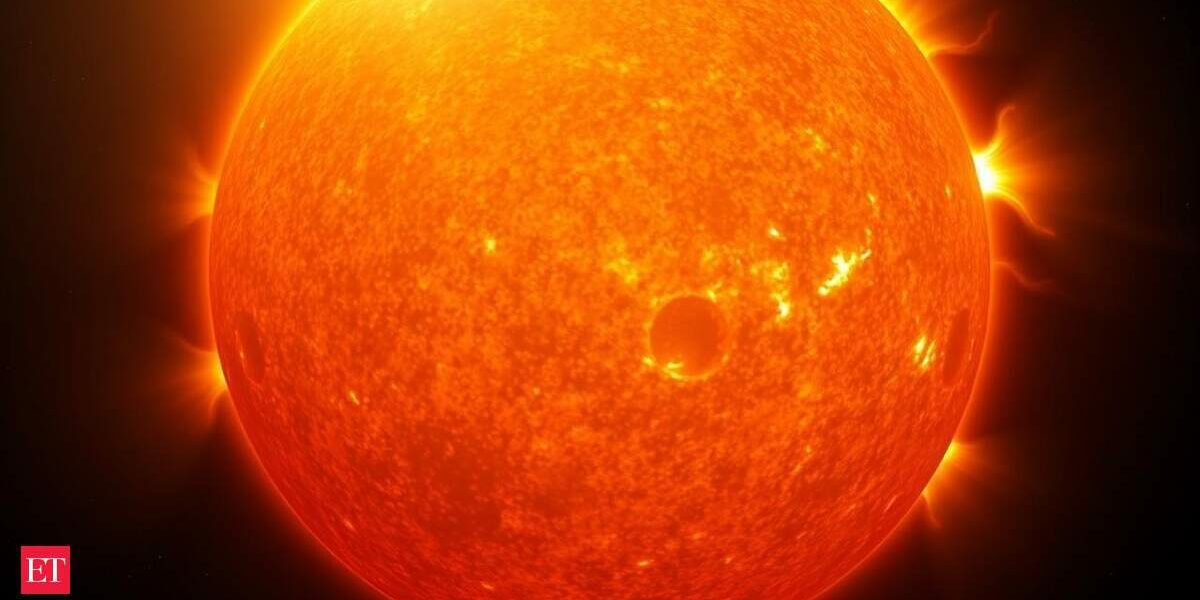
Coronal hole on the Sun: Scientists are closely monitoring a massive coronal hole on the Sun that is currently facing Earth, drawing attention not just for its size but also for its striking shape. According to Russian experts, the dark region resembles an inverted number “1” and stretches roughly one million kilometers in height, making it larger than the Sun’s radius, which is about 700,000 kilometers, as per a report.
A Massive Coronal Hole on the Sun Faces Earth
Because the coronal hole is pointed directly toward Earth, researchers believe it is releasing a high-speed stream of solar wind that is now traveling in our direction, as per a Daily Star report. Specialists at the Pushkov Institute of Terrestrial Magnetism, Ionosphere and Radiowave Propagation (IZMIRAN) say the phenomenon is tied to the Sun’s natural 11-year activity cycle.
Sun Approaching Solar Minimum: What It Means
Scientists explain that the Sun is moving toward its next solar minimum, expected around 2029–2030. Before activity declines, fluctuations are common, including the appearance of large coronal holes and sunspots. Experts say these dark regions began appearing more frequently at the start of last year, shortly after the peak of the solar cycle.
Also read: Bitcoin whale cashes out after 12 years, profiting 31,250% – here’s how the crypto trader turned $1.66 million worth BTC USD into a $500 million fortune
Recurring Coronal Hole Observed in December 2025
The same coronal hole was visible between December 21 and December 27 last year, although it appeared with a different shape at the time. Despite the change in appearance, its size remained about the same, roughly one million kilometers across, as per the Daily Star report.
Magnetic Storms Expected to Increase Until 2028
Researchers at the Laboratory of Solar Astronomy of the Space Research Institute of the Russian Academy of Sciences expect magnetic storms to become more frequent this year due to an increase in coronal holes. They anticipate storm activity to continue rising until around 2028, before dropping sharply as the Sun approaches solar minimum.
Recent Plasma Ejection Could Trigger Geomagnetic Storms
Recent solar activity has already had effects. A plasma ejection released by the Sun on January 13 reached Earth around 8 p.m. on January 16, as per the Daily Star report. Scientists say it could trigger weak geomagnetic storms and auroras, particularly at latitudes above 60 degrees.Also read: What is the most potent trade weapon that Macron has asked EU to use against Trump – here are the details
Effects of Solar Storms on Earth: Power, Radio, and Auroras
When solar storms are directed toward Earth, they can disturb the planet’s magnetic field, leading to geomagnetic storms. These events can cause radio disruptions, power outages, and vivid auroras in the sky.
Sunspots and coronal holes are signs of intense magnetic activity on the Sun. Individual sunspots can last from a few days to several months, growing and shrinking as they move across the solar surface. Some can reach up to 160,000 kilometers in diameter and are even visible from Earth without a telescope, as per the Daily Star report.
FAQs
What is a coronal hole?
A coronal hole is a dark, low-density region on the Sun’s surface where solar wind escapes at high speed.
Can we see this coronal hole from Earth?
No. coronal holes aren’t visible to the naked eye, so scientists observe them using satellites.