This post was originally published on here
The post The Ten-Month Marathon: Meet the Bird That Lives Its Whole Life in the Clouds appeared first on A-Z Animals.
Quick Take
-
The physiology of Apus apus is highly specialized, enabling essential functions, such as feeding, drinking, resting, and even mating, to occur almost entirely while airborne
-
Remaining airborne for up to ten months at a time requires extreme physiological and behavioral adaptations uniquely suited to life in constant flight.
-
Data from flight loggers indicate that common swifts rest in flight through brief, low-wingbeat glides during high-altitude “twilight ascents,” rather than entering full, ground-based sleep cycles.
-
Extended, continuous flight allows common swifts to exploit seasonal insect abundance across Europe and sub-Saharan Africa, maximizing survival rather than maintaining territorial dominance.
Of all the marvels of the natural world, few are as astonishing as the common swift (Apus apus). These small birds spend nearly their entire lives in flight, engaging in activities such as eating, mating, and even sleeping while airborne. Scientific research has revealed that swifts are not merely exceptional flyers; they are among the most relentless movers in the animal kingdom, challenging long-held assumptions about the limits of sustained flight.
Advertisement
Advertisement
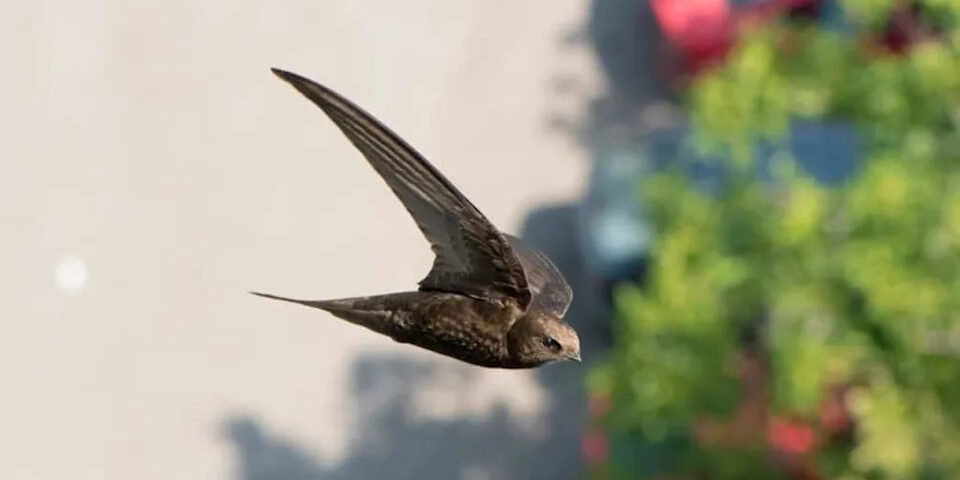
With wings that are long, narrow, and sharply curved, tapering to a point, and with streamlined bodies built for efficiency, common swifts are exquisitely adapted to an aerial existence. Their lives unfold almost entirely above our heads, at speeds and altitudes that make them easy to overlook, even as they perform biological feats unmatched by any other bird. What appears to be effortless gliding is, in reality, one of the most demanding lifestyles in the animal world.
Closely related species, such as chimney swifts, are long-distance migrants with original breeding ranges in the eastern United States and southeastern Canada. However, it is the common swift of Europe that currently holds the most extreme record for sustained flight. Scientists have long suspected that common swifts remain airborne for extraordinary lengths of time, particularly during their annual migrations between Europe and sub-Saharan Africa. Now, thanks to advances in tracking technology, those suspicions have not only been confirmed but surpassed, revealing a bird that has effectively made the sky its (almost) permanent home.
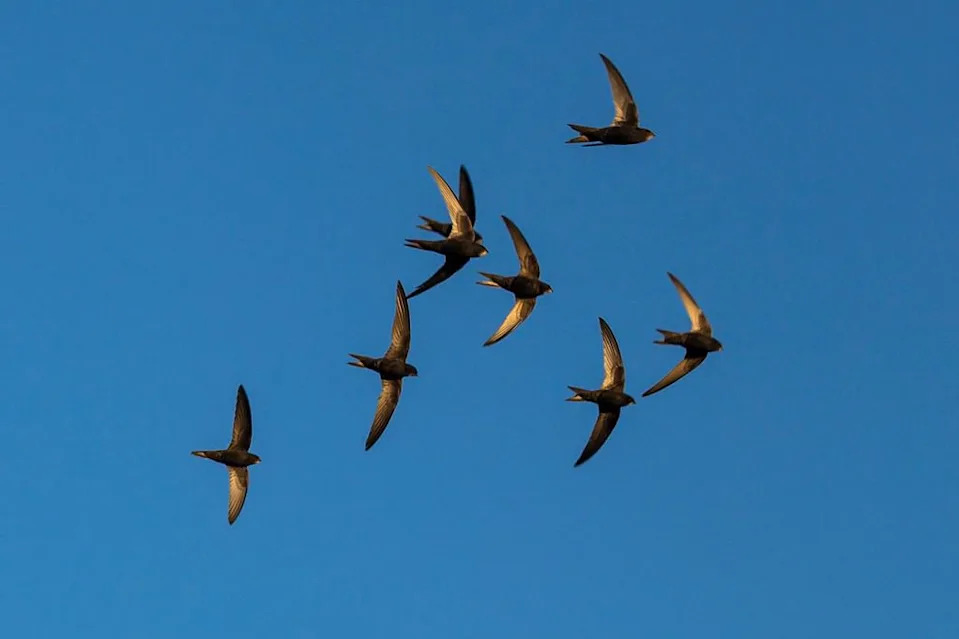
Unlike most birds, common swifts spend the vast majority of their lives in flight.
Using miniature data loggers attached to 19 individual swifts breeding in Sweden, researchers from Lund University tracked acceleration, wingbeats, flight activity, and, in some cases, light levels for geolocation. These tiny devices allowed scientists to reconstruct the birds’ movements continuously over months and, in some cases, across multiple years.
The results were staggering. Common swifts can fly for up to 10 months straight, spending almost their entire non-breeding season in the air, a record unmatched by any other bird. They are in the air 99% of their time. One individual stopped flying for just four nights in a whole year, and for only two hours the following year. Other birds landed slightly more often, but even then, the total time spent on solid ground was vanishingly small. Most remarkably, researchers have never identified consistent roosting sites for common swifts in sub-Saharan Africa, strongly suggesting that many never land outside their breeding period.
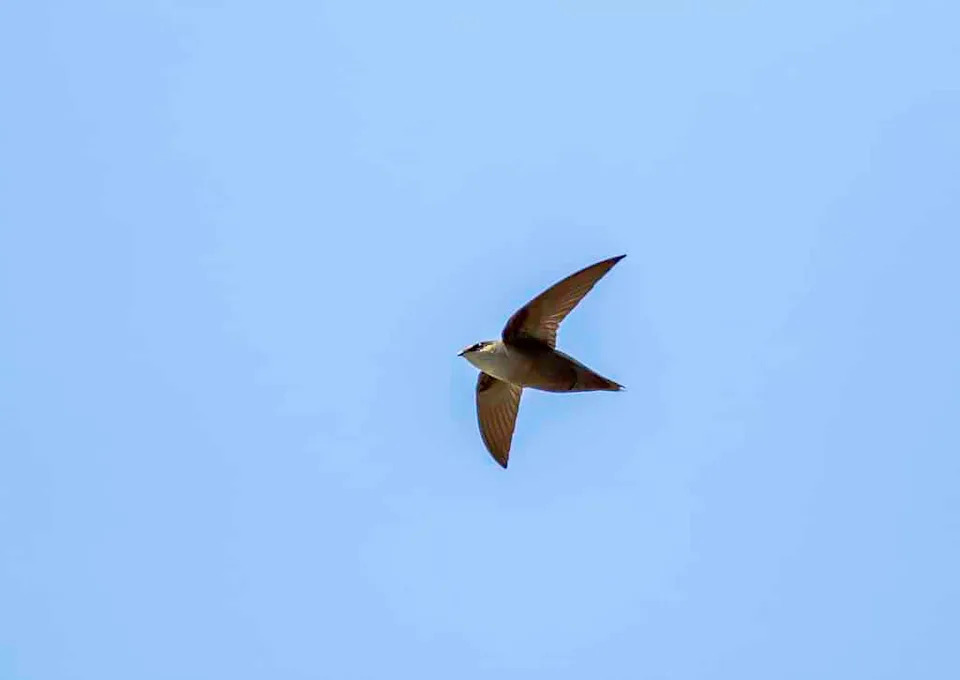
Common swifts are so perfectly adapted to life in the air that they seem untethered from the ground.
©iStock.com/Matthew Jolley
(iStock.com/Matthew Jolley)
This aerial endurance is made possible by a lifestyle that has evolved entirely around the sky. Swifts feed exclusively on flying insects, sweeping them up in midair with wide, gaping mouths as they cruise through invisible rivers of prey. They eat as they go. Common swifts are so perfectly adapted to life in the air that they seem untethered from the ground itself. They mate in flight, gathering briefly with partners before peeling away, and even collect nest material while airborne.
Advertisement
Advertisement
One of the most intriguing behaviors documented by the data loggers is known as twilight ascents. At dawn and dusk, swifts climb to extraordinary altitudes, sometimes nearly two miles above the ground, before entering long, shallow glides. During these ascents, wingbeats decrease dramatically, suggesting a period of rest. While scientists are still unraveling the exact mechanics of sleep in flight, the evidence strongly indicates that swifts take brief “power naps” while gliding in calm, high-altitude air. These moments of rest allow them to remain airborne continuously for months, without the need for a traditional roost.
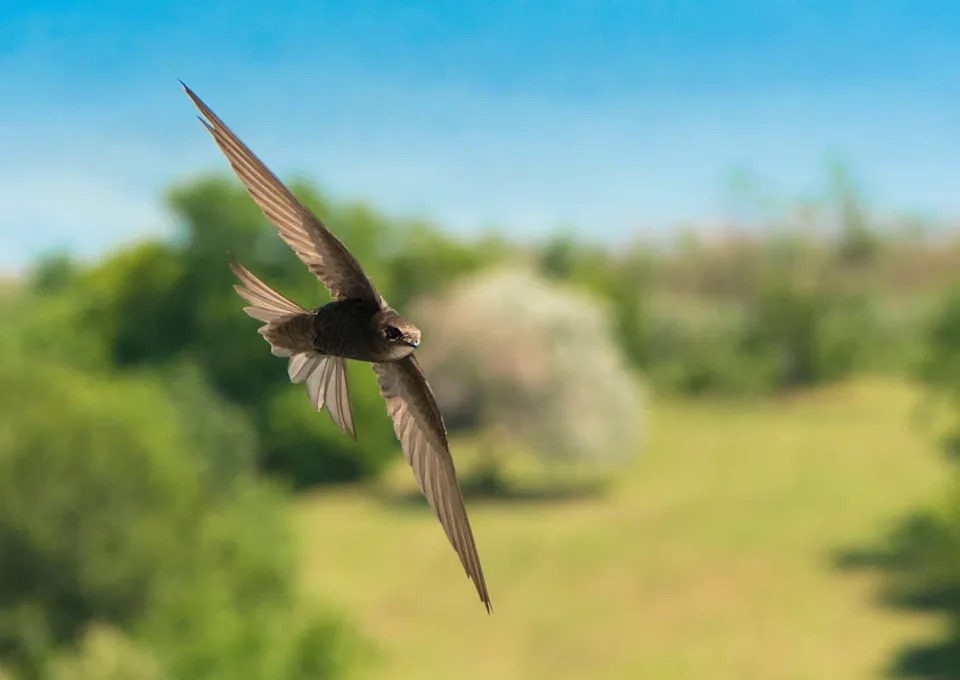
Swifts have ruled the skies for millennia by living, feeding, mating, and resting while never standing still.
©Dilomski/Shutterstock.com
(Dilomski/Shutterstock.com)
A bird that rarely lands must be built entirely for flight, and the common swift exemplifies this with its remarkable aerial adaptations. Its long, narrow wings are optimized for speed and efficiency, while its short legs are poorly suited for walking or launching from flat ground. In fact, swifts are so specialized for life in the air that they are awkward and vulnerable on land, rarely attempting to take off from it at all. This extreme specialization is thought to be driven by their dependence on high-altitude insect prey, an abundant but constantly moving resource that rewards endurance, efficiency, and speed.
Perhaps the most astonishing findings involve young birds. After fledging, juvenile common swifts disperse widely and may remain airborne for many months at a time before returning to breeding colonies when they are two or three years old. While early assumptions suggested that young swifts might stay aloft continuously for years, researchers now caution that there is no direct evidence confirming uninterrupted flight for that entire period. What has been documented, however, is extraordinary: individual swifts have been recorded remaining airborne for up to ten consecutive months, the longest continuous flight ever measured in a bird.
Swifts rely on specific nesting sites, such as cliffs and tree cavities, but also buildings and rooftops.
©Sokolov Alexey/Shutterstock.com
(Sokolov Alexey/Shutterstock.com)
In the story of life on Earth, few species embody mastery of their environment as completely as the common swift. Their existence stretches the boundaries of biology and endurance, revealing what evolution can achieve when every trait is refined for a single purpose: flight. And that flight seems never-ending.
Advertisement
Advertisement
Yet the swift’s story is not only one of awe-inspiring athleticism. It is also a reminder of the delicate balance that sustains even the most extreme forms of life. Swifts depend on healthy insect populations, stable climate patterns, and reliable nesting sites, conditions increasingly disrupted by habitat loss, pesticide use, and a rapidly changing climate. Paradoxically, a bird capable of circling the globe without landing is still vulnerable to changes occurring on the ground below.
There is something profoundly beautiful about the way swifts inhabit a dimension that feels almost beyond human reach. They live in wind and light, tracing invisible highways across continents, rarely bound by the surfaces that define so much of our own lives. And yet, despite this apparent distance, their fate is inseparably tied to human decisions made far below. The materials we choose for our buildings, the chemicals we spread across fields, and the ways we reshape cities and farmland all ripple upward into the air they call home.
Protecting nesting sites in old buildings and modern structures, preserving insect-rich habitats, and recognizing how climate change disrupts the delicate timing of insect emergence are not abstract or optional conservation ideals. They are concrete, immediate actions that determine whether one of nature’s most extraordinary life strategies, a life almost entirely lived on the wing, can continue to exist in a rapidly changing world.
To watch a swift is to witness a creature that has redefined what it means to live. Its life is measured not in footsteps or resting places, but in wind currents, insect swarms, and endless horizons. High above the noise of the ground, swifts remind us that the natural world still holds wonders capable of reshaping how we think about endurance, freedom, and adaptation.
The post The Ten-Month Marathon: Meet the Bird That Lives Its Whole Life in the Clouds appeared first on A-Z Animals.