This post was originally published on here
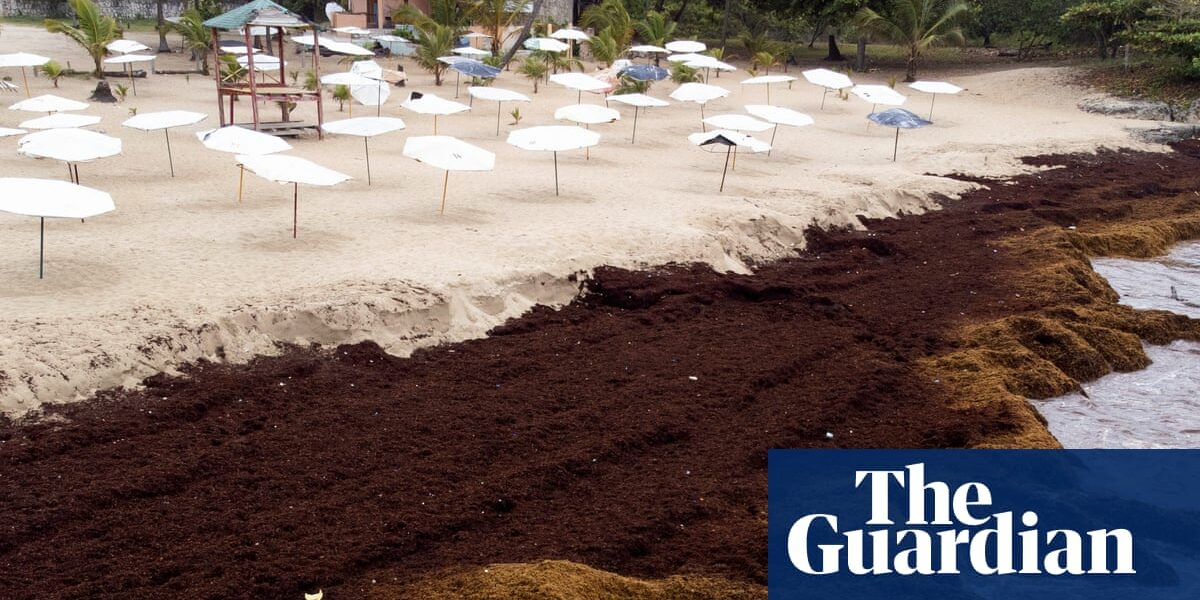
Scientists have warned of a potential “regime shift” in the oceans, as the rapid growth of huge mats of seaweed appears to be driven by global heating and excessive enrichment of waters from farming runoff and other pollutants.
Over the past two decades, seaweed blooms have expanded by a staggering 13.4% a year in the tropical Atlantic and western Pacific, with the most dramatic increases occurring after 2008, according to researchers at the University of South Florida.
In a new paper, they say this shift could darken the waters below, changing their ecology and geochemistry, and may also accelerate climate breakdown.
“Before 2008, there were no major blooms of macroalgae [seaweed] reported except for sargassum in the Sargasso Sea,” said Chuanmin Hu, a professor of oceanography at the USF College of Marine Science and the paper’s senior author.
“On a global scale, we appear to be witnessing a regime shift from a macroalgae-poor ocean to an macroalgae-rich ocean.”
Hu and his colleagues carried out the research in response to reports of expanding seaweed blooms in the Atlantic and Pacific.
The best-known example, the Great Atlantic Sargassum Belt, is visible from space, stretching from the Gulf of Mexico to the mouth of the Congo. Other blooms include a ring around the Chatham Islands off New Zealand, captured by Nasa this month, or “the red tide” that surfaced off the coast of Florida, which have been monitored by the state.
The scientists used artificial intelligence to scan 1.2m satellite pictures of the oceans taken between 2003 and 2022. A deep-learning model was employed to detect signals of floating algae – a process that took several months.
The team, who say their study provides the first global picture of algae floating in the world’s oceans, found that seaweed blooms increased in area by 13.4% a year over the period examined. Blooms of microalgae, such as phytoplankton, also increased but at a relatively more modest 1% a year.
“What is noteworthy is that most increases in both floating macroalgae and microalgae scums occurred in the recent decade, in line with the accelerated global ocean warming since 2010,” the authors wrote. They identified tipping points in 2008, 2011 and 2012 for three types of seaweed in different oceans.
However, while seaweed such as sargassum had thrived in some regions, phytoplankton have not shown similar responses to the changing environment, suggesting their growth may be more sensitive to shifts in temperature and eutrophication.
“If this is the case, we believe that a regime shift in oceanographic conditions has already occurred to favour macroalgae, which will have profound impacts on radiative forcing in the atmosphere and light availability in the ocean, as well as on carbon sequestration, ocean biogeochemistry and upper ocean stability,” the researchers wrote.
The findings are published in Nature Communications.