This post was originally published on here
The smart animal club continues to add new members, and the newest might surprise you. A pet cow in Austria named Veronika picks up sticks with her mouth and uses them to scratch herself—which a team at University of Veterinary Medicine, Vienna in Austria believes is tool use. Veronika and her ground-breaking scratching are detailed in a study published today in Current Biology.
“The findings highlight how assumptions about livestock intelligence may reflect gaps in observation rather than genuine cognitive limits,” Alice Auersperg, a study co-author and cognitive biologist at the university, said in a statement.
Veronika uses different scratching techniques on different body areas. Image: Antonio J. Osuna Mascaró.
Why tool use is a big deal
In biology, tool use is defined using an external object to achieve a goal through mechanical means. It is used by both biologists and anthropologists as a key indicator of a species’ brain and cognitive development. In humans, the Oldowan tool kit—three specific stone tools that date back roughly 2.9 million years—is considered the earliest known example of our species using stone tools.
Advertisement
Advertisement
Elsewhere in the animal kingdom, chimpanzees use sticks as tools to access bugs and honey, while crows also use sticks to probe for hidden sources of food. Humpback whales catch fish using “bubble nets,” which some scientists also consider to be a type of tool use.
Meet Veronika
Veronika is a 13-year-old Swiss Brown cow that is not farmed for meat or milk. She belongs to organic farmer and baker Witgar Wiegele as a companion. Over 10 years ago, Witgar noticed that Veronika would occasionally grab sticks and use them to scratch. Study co-author and animal cognition researcher Antonio Osuna-Mascaró tells Popular Science that Witgar said Veronika was very clumsy at first, but has improved her technique considerably over the years.
Witgar recorded a video of the behavior and shared it with Auersperg.
“When I saw the footage, it was immediately clear that this was not accidental,” she recalls. “This was a meaningful example of tool use in a species that is rarely considered from a cognitive perspective.”
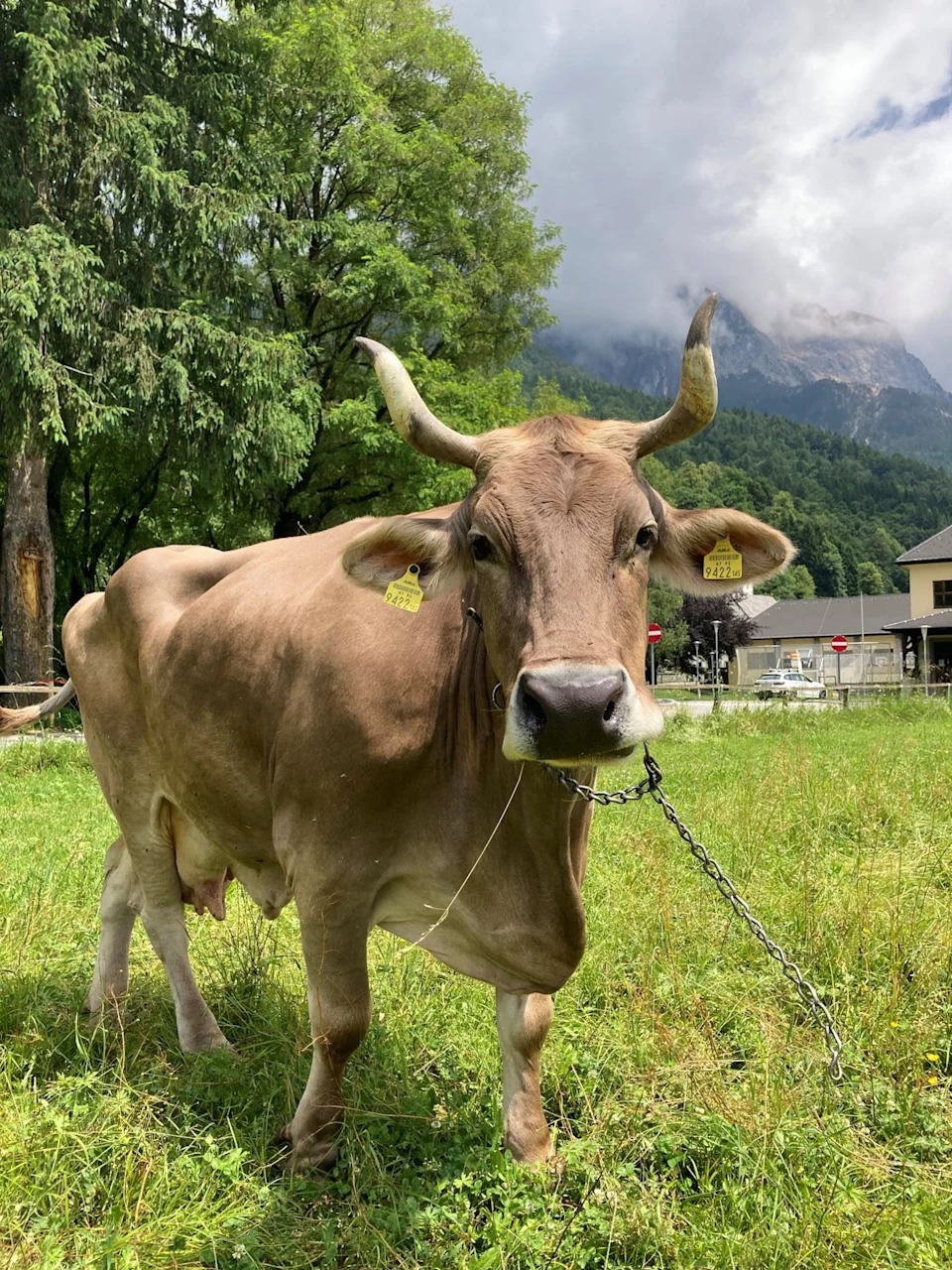
The wonderful Veronika. Image: Antonio J. Osuna Mascaró.
Along with Osuna-Mascaró, Auersperg conducted systematic behavioral tests with Veronika. In a series of controlled trials, they presented the cow with a deck brush that was positioned on the ground in random spots. They then recorded which end Veronika selected and which body region she targeted.
Advertisement
Advertisement
Across repeated sessions, they found that her choices were consistent and functionally appropriate for the body regions she targeted.
“We show that a cow can engage in genuinely flexible tool use,” added Osuna-Mascaró. “Veronika is not just using an object to scratch herself. She uses different parts of the same tool for different purposes, and she applies different techniques depending on the function of the tool and the body region.”
Researchers observed that Veronika typically prefers to use the bristled end of a deck brush when scratching the broad, firm areas of her body such as her back. However, when targeting the softer and more sensitive regions of her lower body, she switches over to the smooth stick end.
She also adjusts how she handles the tool. When scratching her upper body, Veronika uses more wide and forceful movements, while her lower-body scratching is slower, more careful, and highly controlled.
What makes Veronika tick?
The team believes that Veronika’s actions meet the standard definition of tool use, but also go one step further. They describe her scratching as flexible, multi-purpose tool use, meaning that she uses different features of the same object to achieve a different outcome. Multi-purpose tool use like this is extraordinarily rare. Outside of our species, it has only previously been documented convincingly in chimpanzees.
Advertisement
Advertisement
“Because she is using the tool on her own body, this represents an egocentric form of tool use, which is generally considered less complex than tool use directed at external objects,” said Osuna-Mascaró. “At the same time, she faces clear physical constraints, as she must manipulate tools with her mouth. What is striking is how she compensates for these limitations, anticipating the outcome of her actions and adjusting her grip and movements accordingly.”
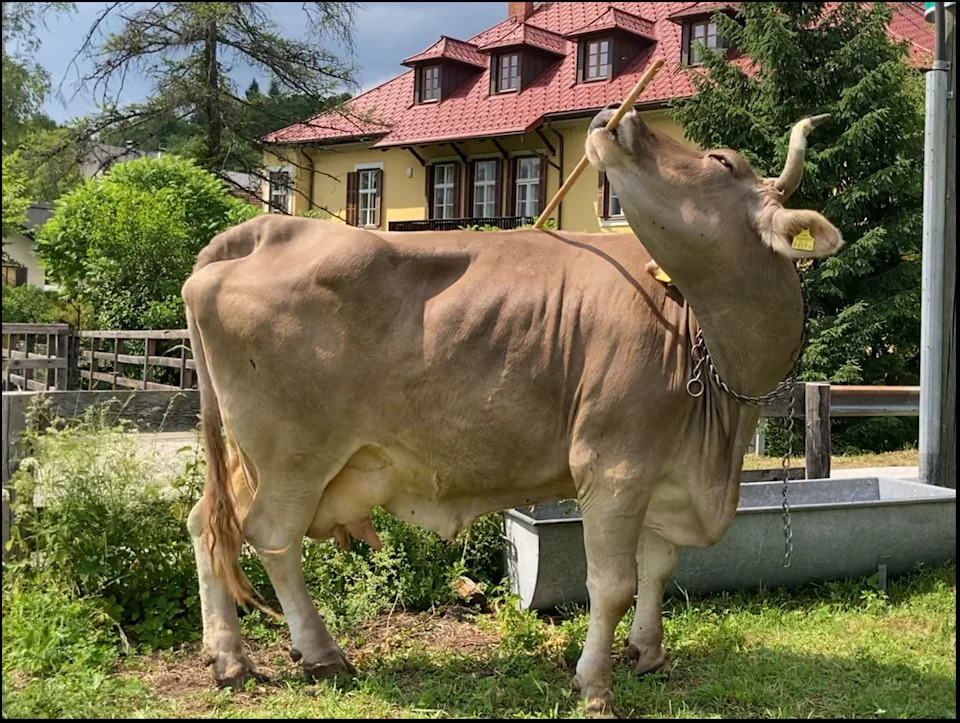
Veronika using the broom with the bakery as background. Image: Antonio J. Osuna Mascaró.
Importantly, the authors note that Veronika’s life circumstances may have played a major role in the emergence of this behavior. Most cows do not live to 13 or spend their days in open and complex environments. They are also rarely given the opportunity to interact with a variety of manipulable objects. Her long lifespan, daily contact with humans, and access to an engaging physical landscape likely created favorable conditions for her to explore and innovate.
The team plans to investigate which environmental and social conditions allow these kinds of behaviors to pop up in livestock species, and see how many similar cases may have gone unnoticed simply because no one was looking for them.
“Because we suspect this ability may be more widespread than currently documented,” Osuna-Mascaró said, “we invite readers who have observed cows or bulls using sticks or other handheld objects for purposeful actions to contact us.”