This post was originally published on here
The defining feature of Donald Trump’s politics is not dishonesty — that is ancient — but the increasingly confident attempt to out-argue reality itself. It is no longer sufficient to dispute a policy. One now disputes physics.
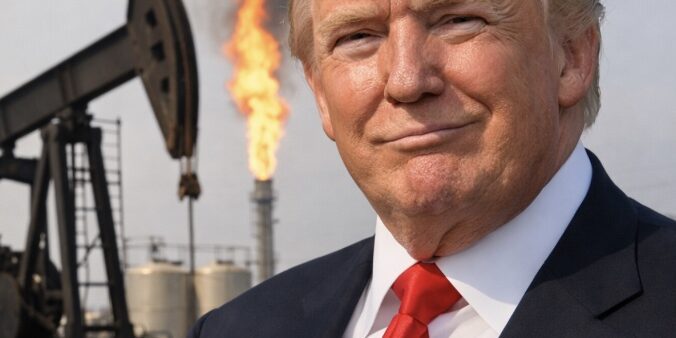
With the repeal of the Environmental Protection Agency’s 2009 “endangerment finding”, President Donald Trump has not merely relaxed environmental regulation. He has done something far more radical: he has declared, for practical legal purposes, that greenhouse gases are not a threat to human welfare. Carbon dioxide, after all its decades as a villain of environmental discourse, has been administratively rehabilitated.
The President calls the original rule the legal foundation of the “Green New Scam”. But the real story here is not science — the atmosphere will continue behaving with stubborn indifference to campaign rhetoric — but political economy. Washington has returned to a familiar model: government as a reciprocal arrangement between power and patronage.
The numbers are almost admirably candid. Fossil fuel interests contributed at least $75 million to Trump’s 2024 campaign and associated political committees. Oil executives hosted fundraisers. New donors emerged after hearing pledges of regulatory relief. Following the victory, the same industry added $11.8 million to the inauguration fund, and millions more to his political organisations despite the constitutional impossibility of a third term.
And, true to form, the administration delivered. In its first 100 days, more than 145 environmental rules were dismantled. Federal agencies overseeing energy production are now led by figures notably sympathetic to the industries they supervise. Drilling projects on public lands are being expedited. The Paris climate agreement has again been abandoned. A legislative package offers roughly $18 billion in tax incentives to oil and gas producers while reducing support for clean energy alternatives.
One oil executive reportedly described the programme as “positive for us across all of our top priorities”. It would be difficult to construct a clearer policy success — at least from the perspective of shareholders.
Trump’s defenders in the land of the freebie and the home of the depraved, argue that he is correcting an economic delusion imposed by scientists and environmental idealists alike. Cheap, reliable energy, they say, is the foundation of prosperity. Voters feel fuel prices immediately; climate projections belong to distant graphs and hypothetical decades. In that sense, the policy is politically rational. The electorate experiences the weekly petrol bill, not atmospheric chemistry.
Yet there is an uncomfortable temporal asymmetry at work. Donald Trump is a man in his late seventies governing a problem measured in half-centuries. The effects of climate policy — whatever one believes about their severity — are cumulative and slow. They unfold over decades. The consequences, beneficial or damaging, will be felt primarily by people who are currently young, or not yet born at all.
This is the central cynicism of the moment. The incentives in democratic politics reward immediate gains and discount long-term costs. A president can lower energy prices now. He will not be present when coastal infrastructure, agricultural patterns, insurance markets or migration pressures begin adjusting to whatever climatic reality ultimately emerges. History’s bills are sent to future addresses.
Critics therefore see less an energy doctrine than a philosophy: profit in the present outweighs risk in the future. The repeal of the endangerment finding is important not merely because of regulation, but because it removes the legal mechanism by which the federal government could easily act later, even if future leaders wished to. The policy does not just change direction — it dismantles the steering wheel.
America, of course, is not uniquely conflicted. European governments proclaim ambitious emissions targets while reopening coal plants during energy shortages. Politicians everywhere promise ecological virtue alongside uninterrupted economic growth. The difference in Washington is bluntness. Rather than attempting reconciliation, the administration has simply chosen the present over the future and dispensed with the language of compromise.
Trump’s famous slogan — “drill, baby, drill” — now functions less as rhetoric than as governing principle. Wind turbines irritate him, solar panels inspire little enthusiasm, and hydrocarbons remain the practical core of industrial civilisation. For many voters, this is refreshingly straightforward. For others, it is breathtakingly short-sighted.
The deeper question is not whether climate change exists; the climate will answer that in its own time. The question is what it means for a government to decide that scientific consensus is politically negotiable. The EPA once concluded greenhouse gases endangered public health. Now, legally, they do not. The molecules remain unchanged. Only the paperwork has evolved.
In earlier centuries, rulers sometimes believed they could command nature. Today’s leaders are subtler: they redefine it.
The administration may yet be vindicated by technological innovation, energy abundance, or economic growth. Or it may be remembered as a moment when immediate prosperity was purchased at a deferred cost. But what is certain is this: the verdict will arrive long after the policymakers themselves have left the stage.
History, unlike an election cycle, does not operate on four-year terms.
Click here for more News & Current Affairs at EU Today
Click here to check out EU TODAY’S SPORTS PAGE!
_____________________________________________________________________________________________________________________
Post Views: 962