This post was originally published on here
The findings, published today in the journal Science, reveal the team has identified a remarkably small ribonucleic acid (RNA) molecule, named QT45, that can copy itself and its complementary strand.
This is a key step toward self-replication.
One of science’s greatest questions
How life emerged from simple chemical building blocks remains one of science’s greatest questions.
One leading theory suggests that RNA molecules spontaneously formed in a ‘primordial soup’ and began replicating and evolving.
Until now, scientists had only found RNA strands capable of copying other RNA, but these were too long and complex to be able to copy themselves.
Copying RNA is a complicated process involving a cascade of sophisticated molecular interactions.
Therefore, it had also been widely assumed that only large and complex RNA molecules would be capable of such a feat.
Challenging one leading theory
The LMB team’s discovery of QT45, a short RNA polymerase ribozyme, changes that.
Its small size means not only that it is much easier for QT45 to copy itself, but also that it could plausibly have appeared spontaneously.
Together, this discovery supports the hypothesis that life could have started with self-replicating RNA.
The team’s breakthrough was achieved by generating vast pools of random RNA sequences and selecting those with RNA-copying activity.
Through repeated rounds of laboratory evolution, QT45 emerged as a highly efficient ribozyme.
Researchers confirmed its ability to copy diverse RNA sequences and ultimately to synthesize itself and its complementary strand.
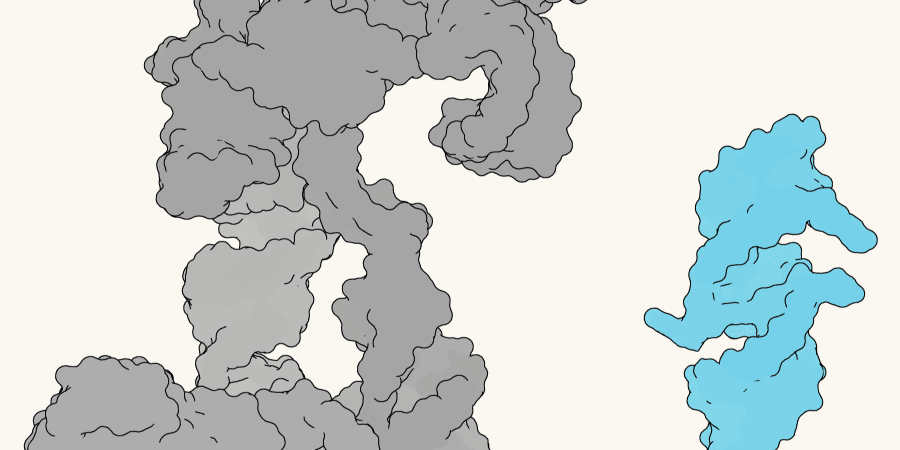
Previously discovered large RNA polymerase ribozyme structure (grey, based on pdb: 8T2P) vs. newly discovered small RNA polymerase ribozyme QT45 (blue, AlphaFold3 prediction). Credit: Edoardo Gianni
A glimpse into the earliest steps of life
Lead author Edoardo Gianni explained:
This research offers a glimpse into what the earliest steps of life might have looked like and deepens our understanding of the fundamental molecules that underpin all living systems.
Everyone in this field had been working on the same ribozyme lineage for over 30 years and believed that finding a new one would be very difficult, and that it had to be a long RNA sequence to carry out its function.
By identifying a small RNA, it makes the whole idea that self-replicating RNA emerged spontaneously much more likely, and thanks to its size, it managed to copy all of itself and its template – unlike previous work where only small parts were copied.
Kickstarting a self-replication cycle
Now that the team have successfully demonstrated experimentally the two key reactions needed for self-replication, they have now set their sights on combining the two reactions to kickstart a self-replication cycle.
Edoardo added:
Beyond its scientific significance the discovery also has implications with regards to how likely life is to emerge spontaneously and whether similar processes could occur on other planets.
Discovering a piece of the puzzle
Dr Glenn Wells, Deputy Executive Chair at the Medical Research Council (MRC), said:
I think we should take a moment to appreciate how weird and wonderful our jobs are, when our colleagues may have discovered a piece of the puzzle of how life began on earth!
This remarkable breakthrough showcases how our MRC LMB researchers are continually resetting the boundaries, merging physics, chemistry and biology to understand the building blocks of life.